Losing a Tech Costs You More Than You Think
Why pool technicians quit is a question every pool service owner asks eventually, usually after their best tech gives two weeks notice and takes three customers with them. Replacing a pool technician costs $3,000 to $8,000 when you account for recruiting, training, lost productivity during ramp-up, and the customers who churn during the transition.
The average voluntary turnover rate across all U.S. industries is 13%. For outdoor service trades like pool maintenance, landscaping, and pest control, turnover runs significantly higher, often 25 to 40% annually. That means if you have four techs, you are statistically likely to lose one every year.
25-40%
annual turnover rate for outdoor service trades, compared to 13% across all industries
Source: Bureau of Labor Statistics / Select Software Reviews
Corey Adams has hired and lost pool techs across 15 years. "Every time I lost a good one, it was because I ignored a warning sign. The reasons are almost always the same five things, and most of them are fixable if you pay attention."
Reason #1: The Pay Is Not Competitive
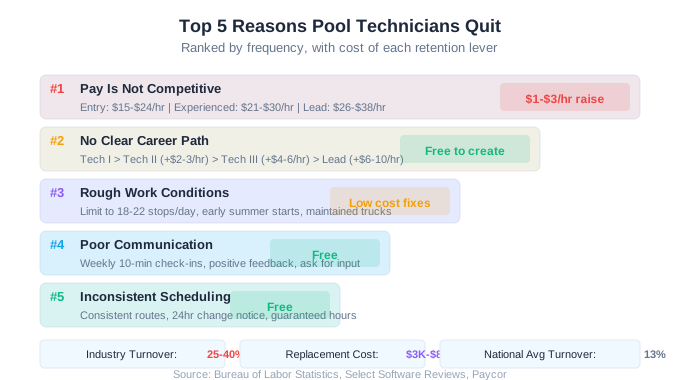
Pay is the most common reason pool techs leave, but it is not always about the hourly rate. It is about total compensation compared to what they can get elsewhere. A pool tech making $18 per hour will leave for a landscaping or HVAC company paying $20 per hour, even if they like the work better, because $2 per hour is $4,000 a year.
| Market | Entry-Level Tech | Experienced Tech (3+ yrs) | Lead Tech/Foreman |
|---|---|---|---|
| Low cost of living | $15-$18/hr | $18-$22/hr | $22-$28/hr |
| Average market | $17-$21/hr | $21-$26/hr | $26-$32/hr |
| High cost of living (FL, AZ, CA) | $19-$24/hr | $24-$30/hr | $30-$38/hr |
What to Do About It
- Know your market rate. Check Indeed, ZipRecruiter, and local job boards quarterly. If your pay is below the 50th percentile for your area, you are losing techs to the market.
- Add performance bonuses. A per-pool bonus ($0.50 to $1.00 per stop above a threshold) rewards efficiency and gives your best techs a path to earning more without you raising base pay across the board.
- Offer annual raises tied to performance. Even $1 per hour per year keeps techs progressing. Flat pay year after year signals that you do not value their growth.
- Consider benefits. Health insurance, even a stipend toward an individual plan, puts you ahead of 80% of pool companies. A simple IRA match costs little and dramatically increases stickiness.
Reason #2: No Clear Path Forward
Pool technicians who see no career path beyond their current role start looking for one elsewhere. If the only promotion available is "owner," and the owner is not going anywhere, ambitious techs will leave. This is especially true for techs under 30 who expect visible career progression.
The fix is creating a path even in a small company. You do not need corporate titles. You need defined levels with clear requirements and corresponding pay increases.
| Level | Requirements | Added Responsibilities | Pay Increase |
|---|---|---|---|
| Tech I (Entry) | Basic training completed | Runs assigned route with supervision | Base rate |
| Tech II (Experienced) | 6 months + CPO cert | Runs route independently, handles basic repairs | +$2-$3/hr |
| Tech III (Senior) | 18 months + advanced training | Trains new techs, handles complex repairs | +$4-$6/hr over entry |
| Lead Tech / Route Manager | 24+ months + proven leadership | Manages techs, handles escalations, quality audits | +$6-$10/hr over entry |
Post this on the wall. Share it during interviews. Reference it during monthly check-ins. When a tech knows exactly what they need to do to get to the next level, they are less likely to look elsewhere for growth.
Reason #3: The Work Conditions Are Rough
Pool service is physically demanding outdoor work. Techs carry heavy chemical jugs, work in extreme heat, deal with chemical fumes, and are exposed to sun, rain, and insects all day. You cannot change the nature of the work, but you can make it more tolerable.
What to Do About It
- Limit route sizes to reasonable daily stops. Overloading routes to 25 to 30 stops per day burns out techs fast. 18 to 22 stops is sustainable long-term and produces better service quality.
- Provide proper equipment. Quality poles, nets, and vacuums make the job physically easier. Forcing techs to use worn-out equipment signals that you do not respect their effort.
- Keep trucks maintained and air-conditioned. A tech spending 2 to 3 hours per day driving in a truck with broken AC in July will not stay through August.
- Supply safety gear and sunscreen. Chemical-rated goggles, acid-resistant gloves, and sunscreen cost pennies per day. Providing them shows you care about their health.
- Adjust summer schedules. Starting routes at 6 or 7 AM during peak summer lets techs finish before the worst afternoon heat. Even a 30-minute earlier start makes a measurable difference in heat exposure.
A study by the Occupational Safety and Health Administration (OSHA) found that heat-related illness accounts for a significant number of outdoor worker injuries. Starting routes earlier in summer and providing coolers with water and electrolytes on every truck is not just a perk, it is a safety measure.
Reason #4: Poor Communication and Management
Pool techs work alone most of the day. If the only time they hear from you is when something goes wrong, that is a problem. Employees who feel ignored or only criticized are the most likely to disengage and eventually leave. In fact, engagement and culture account for 37% of all departure reasons, according to HR industry research.
What to Do About It
- Weekly check-ins (even 10 minutes). A quick Monday morning text, call, or huddle covers the week priorities and gives techs a chance to raise concerns before they fester.
- Positive feedback for good work. If a customer compliments a tech, pass it along immediately. Positive reinforcement is free and powerful.
- Clear expectations from day one. Techs should know exactly what a complete service visit looks like: every step, every chemical test, every photo. Ambiguity breeds frustration.
- Handle customer complaints privately. Never blame a tech in front of a customer. Discuss service issues in private and frame it as coaching, not punishment.
- Ask for their input. Techs in the field see things you do not. Ask what is slowing them down, what equipment needs replacing, which pools are problem accounts. Then act on what they tell you.
The bar in the pool industry is low. Most small pool companies have zero formal communication with their techs beyond route assignments. Just checking in weekly puts you ahead of most competitors in the local hiring market.
Reason #5: Inconsistent or Unreliable Scheduling
Pool techs want predictable schedules. When hours fluctuate wildly between busy season and slow season, or routes change without notice, or the tech does not know until Sunday night which pools they are servicing Monday, frustration builds fast.
What to Do About It
- Set consistent weekly routes. Same pools, same days, same order whenever possible. Techs build rhythm and efficiency on familiar routes.
- Communicate schedule changes in advance. Adding three stops to a route on the morning of the route day is disrespectful of the tech time. Give at least 24 hours notice for changes.
- Guarantee minimum hours during slow season. Offering a guaranteed 32-hour week even in December keeps techs from seeking a more stable job in October. Fill the gap with equipment maintenance, filter cleans, or pool openings.
- Keep routes balanced. If one tech has 22 stops per day and another has 15, the overloaded tech is burning out while the other one is bored. Rebalance quarterly based on drive time and stop complexity, not just stop count.
The pool companies with the lowest turnover are the ones where techs have owned their route for years. They know the customers, the dogs, the gate codes, and the problem pools. That institutional knowledge is irreplaceable and only comes from retention.
What Non-Compensation Retention Levers Actually Work?
Not every retention tool costs money. Some of the most effective retention strategies for pool technicians are free or nearly free. These matter more than most owners think, because 31% of employees cite work-life balance as their primary reason for leaving.
| Retention Lever | Cost | Impact on Retention |
|---|---|---|
| Flexible start times | Free | High. Early starts in summer, later in winter. |
| Friday early release (if routes complete) | Free | High. Powerful motivator. |
| Paid CPO certification | $300-$600 | Medium. Shows investment in their career. |
| Company-provided phone or tablet | $30-$50/mo | Medium. Removes personal device friction. |
| Referral bonus for new hires | $250-$500 | Medium. Techs recruit people they trust. |
| Monthly team lunch or outing | $50-$100 | Medium. Builds connection in an isolated job. |
| Annual performance review with raise path | Free | High. Clarity reduces job-searching. |
| Named routes ("Jake's route") | Free | Medium. Ownership mindset builds pride. |
The unifying theme is respect. Respect for their time, respect for their growth, and respect for their contribution. Pool techs who feel respected stay. Pool techs who feel like interchangeable parts leave as soon as something better appears.
Ready to streamline your pool service business?
Pool Founder gives you route optimization, automated invoicing, chemical tracking, and everything else you need to run a more profitable pool business.
Frequently Asked Questions
What is the average turnover rate for pool technicians?
There is no exact industry-wide statistic for pool technicians specifically, but outdoor service trades (pool, landscaping, pest control) typically see 25 to 40% annual turnover. The broader U.S. voluntary turnover rate is 13%. Pool companies that invest in retention can get below 15%, which is a significant competitive advantage.
How much does it cost to replace a pool technician?
Replacing a pool tech costs $3,000 to $8,000 when you factor in recruiting (job posts, interview time), training (2 to 4 weeks of reduced productivity), and customer churn during the transition. Senior techs with customer relationships cost even more to replace due to potential account losses.
How do I keep pool techs from leaving for competitors?
Pay competitively (check local market rates quarterly), create a clear career path with defined levels and pay increases, keep routes manageable (18 to 22 stops per day), communicate regularly (weekly check-ins), and offer non-compensation perks like flexible start times and Friday early release.
Should I offer benefits to pool technicians?
Yes, if you can afford it. Health insurance (even a monthly stipend toward an individual plan) and a Simple IRA with employer match put you ahead of the vast majority of pool companies. Benefits dramatically increase retention, especially for techs with families.
How many pool stops per day is too many for a technician?
More than 22 to 24 stops per day leads to burnout, rushed service, and higher turnover. The sustainable sweet spot is 18 to 22 stops per day depending on drive time and stop complexity. Quality suffers above that threshold, which leads to customer complaints, which leads to tech frustration.
What should I pay a new pool technician?
Entry-level pool tech pay ranges from $15 to $24 per hour depending on your local cost of living. Check Indeed and ZipRecruiter for current rates in your market. Plan for annual raises of $1 to $2 per hour tied to performance and certifications, with a path to $26 to $38 per hour at the lead tech level.