You Are Probably Paying More in Taxes Than You Need To
Pool service business taxes are straightforward once you know which deductions to take. Most pool company owners miss thousands of dollars in legitimate write-offs every year because they do not track expenses properly, do not understand Section 179, or forget about deductions hiding in plain sight like mileage, home office, and phone costs.
This guide covers the major tax deductions available to pool service companies, how quarterly estimated tax payments work, and the Section 179 equipment deduction that can save you thousands in the year you buy a truck or major equipment.
$0.725
per mile is the 2026 IRS standard mileage deduction for business driving
Source: IRS, December 2025
Corey Adams estimates he overpaid taxes by $4,000 to $6,000 in his first two years because he was not tracking mileage and did not know about the home office deduction. "That is money I could have put into marketing or a second truck. Once I started working with a CPA who understood service businesses, my tax bill dropped significantly."
What Are the Biggest Tax Deductions for Pool Service Companies?
Pool service businesses have more deductible expenses than most owners realize. Every dollar of legitimate deduction reduces your taxable income, which means you keep more of what you earn. Here are the major categories ranked by typical dollar impact.
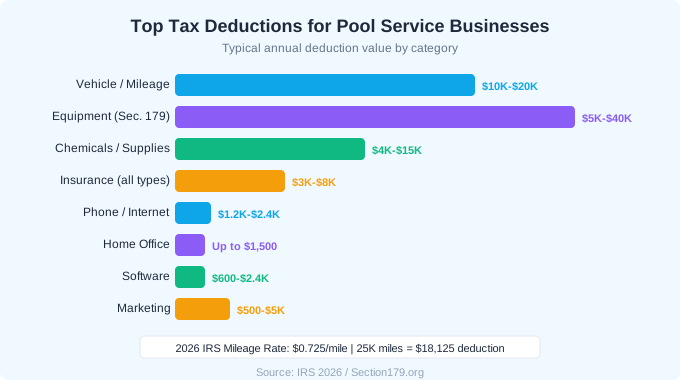
| Deduction Category | Typical Annual Value | Tracking Method |
|---|---|---|
| Vehicle expenses or mileage | $10,000-$20,000 | Mileage log or actual expenses |
| Equipment (Section 179) | $5,000-$40,000 (year of purchase) | Purchase receipts |
| Chemicals and supplies | $4,000-$15,000 | Receipts + credit card statements |
| Insurance (all types) | $3,000-$8,000 | Premium statements |
| Payroll and payroll taxes | Varies with employees | Payroll service records |
| Home office | $1,500 (simplified) | Square footage measurement |
| Phone and internet | $1,200-$2,400 | Monthly bills, business % applied |
| Software subscriptions | $600-$2,400 | Receipts |
| Marketing and advertising | $500-$5,000 | Receipts |
| Professional services (CPA, attorney) | $500-$3,000 | Invoices |
| Continuing education and certifications | $200-$1,000 | Receipts |
Keep records for every deduction. The IRS requires documentation (receipts, mileage logs, invoices) for all business expense claims. No record means no deduction if you are audited.
How Does the Vehicle Deduction Work for Pool Service?
The vehicle deduction is usually the largest single deduction for a pool service business. You have two options: the standard mileage rate or actual expenses. You can choose whichever gives you a bigger deduction, but there are rules.
Standard Mileage Rate (Simpler)
For 2026, the IRS standard mileage rate is $0.725 per business mile. If your pool service truck drives 25,000 business miles per year, that is an $18,125 deduction. You must keep a mileage log showing the date, destination, business purpose, and miles driven for each trip.
Actual Expense Method (Often Larger)
Add up all actual vehicle costs: fuel, insurance, maintenance, repairs, depreciation, registration, and loan interest. Multiply by your business-use percentage. If your truck is used 90% for business and your total vehicle costs are $14,000, your deduction is $12,600.
| Method | 25,000 Business Miles Example | Pros | Cons |
|---|---|---|---|
| Standard mileage | $18,125 | Simple. Just track miles. | Cannot also deduct actual expenses. |
| Actual expenses (90% business) | $12,600 (on $14,000 total) | May be higher for expensive trucks. | Must track every expense and receipt. |
For most pool service operators driving used trucks, the standard mileage rate produces the larger deduction. If you drive a newer, more expensive truck, run the math both ways. Your CPA can compare at tax time if you track both miles and actual expenses throughout the year.
If you use the standard mileage rate in the first year you use a vehicle for business, you can switch to actual expenses in later years. But if you start with actual expenses, you cannot switch to the standard mileage rate for that vehicle.
What Is the Section 179 Equipment Deduction?
Section 179 allows you to deduct the full purchase price of qualifying equipment in the year you buy it, instead of depreciating it over several years. For pool service companies, this applies to trucks, trailers, robotic cleaners, pressure washers, and most other equipment used in the business.
For 2026, the Section 179 deduction limit is $2,560,000. You will never hit that cap. What matters is the practical impact: buy a $25,000 used truck in June, and you can deduct the entire $25,000 from your taxable income that year.
Vehicle Weight Matters
| Vehicle Weight | Section 179 Limit | Examples |
|---|---|---|
| Under 6,000 lbs GVWR | Limited (luxury auto caps apply) | Small pickups, SUVs, sedans |
| 6,000-14,000 lbs GVWR | Up to $32,000 for SUVs | Ford F-250, Chevy 2500, large SUVs |
| Over 14,000 lbs GVWR | Full purchase price (no cap) | Heavy-duty trucks, large trailers |
Most pool service trucks (half-ton pickups like the F-150 or Silverado 1500) weigh under 6,000 lbs GVWR and are subject to annual depreciation caps. If you are buying a heavier truck like an F-250 or a large cargo van, the Section 179 deduction is more generous. The vehicle must be used more than 50% for business to qualify.
Bonus depreciation allows 100% first-year deduction for heavy vehicles purchased and placed in service after January 19, 2025, under the One Big Beautiful Bill Act. This makes it an excellent time to purchase qualifying work vehicles.
How Do Quarterly Estimated Tax Payments Work?
As a self-employed pool service business owner, the IRS expects you to pay income and self-employment taxes quarterly instead of waiting until April. If you owe more than $1,000 at tax time, you may face an underpayment penalty, currently 7% annualized for 2026.
| Quarter | Income Period | Payment Due Date |
|---|---|---|
| Q1 | January - March | April 15, 2026 |
| Q2 | April - May | June 15, 2026 |
| Q3 | June - August | September 15, 2026 |
| Q4 | September - December | January 15, 2027 |
The Safe Harbor Rule
The safe harbor rule protects you from underpayment penalties. If you pay at least 100% of your prior year tax liability in quarterly installments (110% if your adjusted gross income exceeded $150,000), you will not be penalized, even if you owe additional tax when you file.
The simplest approach: take last year total tax bill, divide by four, and pay that amount each quarter. If your business is growing, you might owe more at filing time, but you avoid the penalty. Set aside 25 to 30% of net profit each month in a dedicated tax savings account so the quarterly payments are funded when they come due.
Self-employment tax (Social Security and Medicare) is 15.3% on top of your income tax rate. This is the number that shocks first-year pool business owners. Budget for it from day one.
What Is the Home Office Deduction for Pool Businesses?
If you run your pool business from home (which most solo operators and small companies do), you can deduct a portion of your housing costs. There are two methods, and the simplified method is designed for people who do not want to calculate percentages of every household bill.
Simplified Method
Deduct $5 per square foot of dedicated home office space, up to 300 square feet. Maximum deduction: $1,500 per year. No need to track mortgage interest, utilities, or insurance separately. Report it directly on Schedule C without filing Form 8829.
Regular Method
Calculate the percentage of your home used for business (office square footage divided by total home square footage). Apply that percentage to your mortgage interest or rent, utilities, insurance, repairs, and depreciation. This often yields a larger deduction than the simplified method but requires more record-keeping.
The key requirement: the space must be used regularly and exclusively for business. A corner of the kitchen table does not qualify. A dedicated room or converted garage space where you do your scheduling, billing, and admin work does qualify.
What Other Deductions Do Pool Companies Miss?
Beyond the big-ticket items, there are dozens of smaller deductions that add up. Most pool service owners miss at least a few of these each year.
- Phone bill: Deduct the business-use percentage of your cell phone plan. If 80% of your usage is business, deduct 80% of the monthly bill.
- Internet service: Same business-use percentage applies to your home internet.
- Uniforms and branded clothing: Pool company shirts, hats, and any clothing required for work that is not suitable for everyday wear.
- CPO and other certifications: The Certified Pool Operator course ($400 to $600) and renewal fees are fully deductible.
- Trade association dues: PHTA membership, local business association fees, and chamber of commerce dues.
- Business meals: 50% deductible when discussing business with a client, vendor, or potential hire. Keep receipts with notes on who you met and what was discussed.
- Bank and payment processing fees: Stripe fees, QuickBooks fees, bank account maintenance fees.
- Business license and permit fees: Annual business license renewal, pool contractor license fees, county permits.
- Startup costs: If you started your business this year, up to $5,000 in startup costs can be deducted in year one.
$1,500
maximum annual home office deduction using the simplified method ($5/sq ft, max 300 sq ft)
Source: IRS Publication 587
Ready to streamline your pool service business?
Pool Founder gives you route optimization, automated invoicing, chemical tracking, and everything else you need to run a more profitable pool business.
Frequently Asked Questions
How much should a pool service business set aside for taxes?
Set aside 25 to 30% of net profit for federal income tax and self-employment tax. Self-employment tax alone is 15.3%. Add state income tax if applicable. Put this money into a separate savings account each month so quarterly estimated payments are funded when due.
Can I deduct my pool service truck on my taxes?
Yes. You can either deduct the IRS standard mileage rate ($0.725 per mile in 2026) or your actual vehicle expenses (fuel, insurance, maintenance, depreciation), whichever is larger. The truck purchase may also qualify for Section 179 immediate expensing. The vehicle must be used more than 50% for business.
What is the Section 179 deduction limit for 2026?
The 2026 Section 179 deduction limit is $2,560,000. For SUVs over 6,000 lbs GVWR, the vehicle-specific limit is $32,000. Vehicles over 14,000 lbs GVWR have no cap. The deduction allows you to expense the full purchase price of qualifying equipment in the year you buy it instead of depreciating over time.
When are quarterly estimated tax payments due?
For 2026: Q1 is due April 15, Q2 is due June 15, Q3 is due September 15, and Q4 is due January 15, 2027. To avoid penalties, pay at least 100% of your prior year tax liability in quarterly installments, or 110% if your AGI exceeded $150,000.
Can I deduct pool chemicals on my taxes?
Yes. All chemicals purchased for customer pool service are a deductible business expense under cost of goods sold. This includes chlorine, acid, stabilizer, shock, algaecide, and any other chemicals used in servicing pools. Keep purchase receipts or credit card statements as documentation.
Do I need a CPA for my pool service business?
A CPA is not required but is strongly recommended once your annual revenue exceeds $100,000 or you have employees. A good CPA familiar with service businesses typically saves more in deductions and tax strategy than they cost. Expect to pay $500 to $2,000 for annual tax preparation depending on complexity.