You Do Not Need to Love Bookkeeping. You Need to Do It.
Bookkeeping for pool service business owners is not complicated, but ignoring it is expensive. Every pool company owner who got blindsided by a tax bill, ran out of cash mid-winter, or could not tell if they actually made money last quarter has the same root problem: they were not tracking their numbers.
You do not need an accounting degree. You need five accounts set up correctly, a basic understanding of cash vs. accrual accounting, and 30 minutes per week to keep things current. That is it.
40%
of small business owners say bookkeeping and accounting is the worst part of running their business
Source: SCORE / SBA Small Business Survey
Corey Adams spent his first three years stuffing receipts in a shoebox and handing them to a tax preparer in March. "I had no idea what my actual profit was until tax time. By then it was too late to fix anything. The day I started tracking my numbers monthly was the day my business started growing, because I could finally see where the money was going."
What Five Accounts Does Every Pool Company Need?
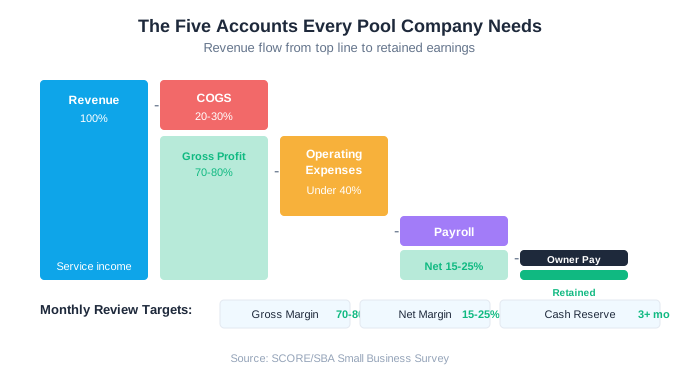
Forget the 47-line chart of accounts your accountant wants to set up. As a pool service owner, you need to watch five numbers. Everything else is detail that matters at tax time but not for day-to-day decision-making.
1. Revenue (Service Income)
All money coming in from pool service, repairs, chemical sales, and one-time jobs. Break this into sub-categories if you want more detail: recurring service, one-time service, chemical revenue, equipment revenue. At minimum, know your total monthly revenue number.
2. Cost of Goods Sold (COGS)
Direct costs to deliver service: chemicals, parts, subcontractor labor. This does not include your truck, your insurance, or your phone bill. Those are overhead. COGS is what it costs you to actually service the pools. For most pool companies, COGS runs 20 to 30% of revenue.
3. Operating Expenses (Overhead)
Everything that keeps the business running that is not a direct service cost: vehicle payments and fuel, insurance, software subscriptions, phone, marketing, office supplies, uniforms. Target keeping operating expenses under 40% of revenue.
4. Payroll (If You Have Employees)
Separate from COGS and overhead. Track gross wages, payroll taxes (the employer share is 7.65% for FICA), workers comp premiums, and any benefits you offer. Payroll is typically your largest expense once you hire, running 30 to 50% of revenue depending on your pricing.
5. Owner Draws or Salary
What you pay yourself. Track this separately from business expenses. If you are a sole proprietor or single-member LLC, your pay comes as owner draws. If you are an S-Corp, you pay yourself a reasonable salary plus distributions. Either way, know exactly how much you are taking out each month.
Revenue minus COGS equals gross profit. Gross profit minus operating expenses minus payroll equals net profit. Net profit minus owner pay equals retained earnings (your cash reserve). If any of these five numbers surprise you at the end of the month, your bookkeeping is behind.
Should a Pool Company Use Cash or Accrual Accounting?
Cash accounting records income when you receive it and expenses when you pay them. Accrual accounting records income when you earn it (even if the customer has not paid yet) and expenses when you incur them. For most pool service companies under $25 million in annual revenue, you can choose either method.
| Factor | Cash Basis | Accrual Basis |
|---|---|---|
| Simplicity | Simple. Money in, money out. | More complex. Tracks receivables and payables. |
| Cash visibility | Shows actual cash on hand. | Shows earned revenue, not necessarily collected. |
| Tax timing | Pay taxes on collected revenue. | Pay taxes on earned revenue, even if unpaid. |
| Best for | Solo operators, small crews. | Companies with employees, inventory, or seeking loans. |
| Required when | Always available under $25M revenue. | Required over $25M revenue. |
For most pool service companies, cash basis is the right starting point. It is simpler, gives you a clear picture of actual cash flow, and lets you time expenses for tax benefit (buy chemicals in December to reduce taxable income for that year). You can always switch to accrual later if a bank or investor requires it.
One trap with cash basis: if you bill monthly in arrears, December service does not show as income until January when you collect. This can make December look slow and January look great, even though the work happened in December. Be aware of this timing gap when analyzing your numbers.
What Bookkeeping Software Should Pool Companies Use?
You need accounting software from day one. A spreadsheet works for the first month, but it breaks as soon as you have more than 20 transactions. The two practical choices for pool service companies are QuickBooks Online and Wave.
QuickBooks Online (Recommended)
Starts at $35/month for the Simple Start plan. Every bookkeeper and CPA in the country knows QuickBooks, which means handing off your books later is seamless. It connects to your bank account, auto-categorizes transactions, and generates the reports you need for tax time. If your pool service software integrates with QuickBooks, invoices and payments sync automatically.
Wave (Free Alternative)
Wave is free for accounting and invoicing. It lacks some of the automation and integrations that QuickBooks offers, but for a solo operator watching every dollar, it is a solid starting point. You can always migrate to QuickBooks when the business grows.
Regardless of which tool you pick, the key habit is the same: connect your business bank account and business credit card, and categorize every transaction weekly. Do not let a month go by without categorizing. That is how the shoebox problem happens digitally.
What Reports Should You Review Monthly?
Three reports tell you everything you need to know about the financial health of your pool company. Review them on the same day each month. First of the month works well because you have the full previous month to look at.
Profit and Loss Statement (P&L)
Shows revenue, expenses, and net profit for the month. Compare it to the same month last year to see if you are growing. Compare it to last month to catch expense spikes. Your gross margin (revenue minus COGS) should be 70 to 80% for a pool service company. If it is below 65%, your pricing is too low or your chemical costs are out of control.
Balance Sheet
Shows what you own (assets), what you owe (liabilities), and the difference (equity). For a pool company, assets include your bank balance, trucks, and equipment. Liabilities include vehicle loans, credit card balances, and unpaid vendor bills. Watch your cash position and make sure liabilities are not growing faster than assets.
Accounts Receivable Aging
Shows who owes you money and how long it has been outstanding. Sort by age: current, 30 days, 60 days, 90+ days. Anything over 30 days needs a phone call. Anything over 90 days is likely uncollectible and should be written off. If your total AR is more than 10% of monthly revenue, your collection process needs tightening.
| Report | Key Metric | Target Range | Red Flag |
|---|---|---|---|
| P&L | Gross margin | 70-80% | Below 65% |
| P&L | Net profit margin | 15-25% | Below 10% |
| Balance Sheet | Cash position | 3+ months expenses | Under 1 month |
| AR Aging | Current % | 90%+ current | Under 80% current |
How Should You Handle Receipts and Expense Tracking?
The IRS requires you to keep records of all business expenses. Losing receipts means losing deductions. The old shoebox method is not just messy, it costs you real money at tax time. Here is a system that takes less than five minutes per day.
- 1Use a separate business bank account and credit card. No exceptions. Mixing personal and business expenses is the number one bookkeeping mistake small business owners make. It makes tax prep expensive and increases audit risk.
- 2Photograph every paper receipt immediately. Use your phone camera or a receipt scanning app like Dext or QuickBooks receipt capture. Paper fades. Digital does not.
- 3Categorize transactions weekly. Set a recurring 30-minute block every Friday to review and categorize bank and credit card transactions in your accounting software.
- 4Track mileage daily. Use a mileage tracking app or log your starting and ending odometer each day. The IRS standard mileage deduction for 2026 is $0.725 per mile. At 25,000 business miles per year, that is an $18,125 deduction you do not want to lose.
- 5Keep digital copies of all invoices sent. Your pool service software handles this if you invoice through it. If you invoice externally, save PDFs of every invoice.
A dedicated business credit card for all chemical purchases creates an automatic, categorized record of your largest variable expense. No receipt tracking needed since the credit card statement is your record.
When Is It Time to Hire a Bookkeeper?
You should handle your own bookkeeping when you are a solo operator doing under $100,000 in annual revenue. It takes 30 to 60 minutes per week and forces you to understand your numbers. But there comes a point where your time is better spent servicing pools or growing the business.
Hire a bookkeeper when any of these become true:
- You have employees and need to manage payroll, payroll taxes, and workers comp.
- Your monthly transaction count exceeds 200 and categorizing takes more than an hour per week.
- You are more than two months behind on reconciling your books.
- You are about to apply for a business loan and need clean financial statements.
- Your annual revenue exceeds $150,000 and the complexity justifies the expense.
A part-time bookkeeper costs $300 to $600 per month for a pool company with 1 to 3 employees. A full-service bookkeeping firm that handles everything including payroll runs $500 to $1,000 per month. Either option costs less than the mistakes you will make trying to manage complex books yourself while running routes.
When you do hire, find someone who works with service businesses. They will understand route-based revenue, seasonal fluctuations, and the chart of accounts that makes sense for your industry. Ask for referrals from other pool or landscaping company owners in your area.
Ready to streamline your pool service business?
Pool Founder gives you route optimization, automated invoicing, chemical tracking, and everything else you need to run a more profitable pool business.
Frequently Asked Questions
What accounting software is best for a pool service business?
QuickBooks Online is the standard for pool service companies. Starts at $35 per month and every bookkeeper and CPA knows how to use it. Wave is a free alternative that works for solo operators. Choose whichever you will actually use consistently. The best software is the one you update weekly.
Should a pool company use cash or accrual accounting?
Cash basis is best for most pool companies under $25 million in revenue. It is simpler, shows actual cash on hand, and lets you time expenses for tax benefit. Switch to accrual only if a bank, investor, or your growth level requires it.
How much does a bookkeeper cost for a small service business?
A part-time bookkeeper costs $300 to $600 per month for a pool company with 1 to 3 employees. Full-service firms including payroll run $500 to $1,000 per month. Handle your own books until you have employees or exceed $150,000 in annual revenue.
What is a good profit margin for a pool service company?
Gross profit margin (revenue minus direct service costs) should be 70 to 80%. Net profit margin (after all expenses including owner pay) should be 15 to 25% for a healthy pool service business. If your net margin is below 10%, investigate your pricing, chemical costs, and overhead.
Do I need a separate bank account for my pool business?
Yes, absolutely. Mixing personal and business finances is the number one bookkeeping mistake. It complicates tax prep, increases audit risk, and makes it impossible to see your true business performance. Open a business checking account before you accept your first payment.
How long should I keep pool business financial records?
The IRS recommends keeping tax returns and supporting documents for at least three years, and up to seven years if you file a claim for a loss from worthless securities or bad debt. Keep digital copies of all receipts, invoices, and bank statements indefinitely. Storage is cheap and audits are not.