Your Truck Is Your Second-Biggest Expense. Treat It Like One.
Pool service truck costs are the second-largest line item in most pool company budgets, behind labor. Your vehicles carry your techs, your chemicals, and your reputation. Get the vehicle decision wrong and you are either overspending on a truck that is more than you need, or limping along in a truck that breaks down on route and costs you customers.
Corey Adams has been through six service vehicles in 15 years. His advice: "Your first truck does not need to be new. A 3 to 5 year old half-ton pickup with 40,000 to 60,000 miles is the sweet spot. You save $15,000 to $20,000 off new pricing and you still get five solid years of service out of it."
$0.725
per mile is the 2026 IRS standard mileage rate, reflecting the true cost of operating a vehicle
Source: IRS, December 2025
This guide covers every vehicle cost a pool service company faces: purchase or lease decisions, fuel, insurance, maintenance, and a simple formula for calculating your per-pool vehicle cost.
How Much Does a Pool Service Truck Cost Per Year?
Should You Buy or Lease a Pool Service Truck?
Buying is almost always the better financial decision for pool service trucks. You put heavy wear on your vehicles, drive them loaded with corrosive chemicals, and need to modify them with racks, toolboxes, and chemical tanks. Lease agreements penalize you for all of that.
| Factor | Buy (New) | Buy (Used 3-5 yr) | Lease |
|---|---|---|---|
| Upfront cost | $35,000-$45,000 | $18,000-$28,000 | $0-$3,000 down |
| Monthly payment | $550-$750 (60 mo) | $300-$500 (48 mo) | $400-$600 |
| Mileage limits | None | None | 12,000-15,000/yr typical |
| Modification freedom | Full | Full | Restricted by lease terms |
| Wear penalties | None | None | Excess wear charges at return |
| Ownership after payments | Yes | Yes | No. Return or buy out. |
| Tax benefit | Section 179 + depreciation | Section 179 + depreciation | Lease payments deductible |
A new 2026 Ford F-150 XL work truck starts at $39,885 MSRP. A comparable 2023 model with 45,000 miles runs $22,000 to $26,000 on the used market. For a first truck, the used option frees up $15,000+ in capital for equipment, chemicals, and marketing.
Leasing makes sense in one scenario: if you need multiple trucks simultaneously to scale fast and cannot tie up capital in vehicle purchases. Even then, negotiate a high-mileage lease (20,000+ miles per year) and understand the wear policy before signing.
What Does Fuel Actually Cost Per Pool Stop?
Fuel cost per pool stop depends on two things: your miles per gallon and the distance between stops. A well-designed route with tight density keeps fuel costs under $1.50 per stop. A sprawling route with 10+ mile gaps between pools can push that past $4.00 per stop.
The average pool service truck (half-ton pickup, V6 or small V8) gets 18 to 22 MPG unloaded and 14 to 18 MPG when carrying a full chemical load. At $3.50 per gallon of regular gas, your fuel cost per mile runs $0.19 to $0.25.
| Avg Miles Between Stops | Fuel Cost/Stop (18 MPG) | Daily Fuel (20 stops) | Monthly Fuel (80 stops/wk) |
|---|---|---|---|
| 2 miles | $0.39 | $7.80 | $124.80 |
| 4 miles | $0.78 | $15.60 | $249.60 |
| 6 miles | $1.17 | $23.40 | $374.40 |
| 8 miles | $1.56 | $31.20 | $499.20 |
| 10 miles | $1.94 | $38.80 | $624.80 |
Route density is the most effective lever for controlling fuel costs. Cutting your average distance between stops from 6 miles to 3 miles saves $187 per month per truck. That is $2,244 per year in pure margin.
If you run diesel (common in larger trucks or those towing trailers), expect to pay $0.22 to $0.30 per mile but get better MPG under load. Diesel makes more financial sense if you regularly tow equipment trailers or carry heavy chemical loads.
How Much Does Commercial Vehicle Insurance Cost?
Commercial vehicle insurance for a pool service truck runs $1,200 to $2,400 per year for a single vehicle with standard liability, collision, and comprehensive coverage. That is $100 to $200 per month per truck. The rate depends on your location, driving history, coverage limits, and the number of vehicles on the policy.
| Coverage Type | Annual Cost | What It Covers |
|---|---|---|
| Liability (100/300/100) | $800-$1,500 | Bodily injury and property damage to others |
| Collision | $300-$600 | Damage to your truck in an accident |
| Comprehensive | $150-$400 | Theft, vandalism, weather damage |
| Uninsured motorist | $100-$200 | Protection if other driver has no insurance |
| Hired/non-owned auto | $200-$400 | Coverage when employees use personal vehicles |
Multi-vehicle discounts typically save 10 to 15% per truck. Bundling commercial auto with your general liability and workers comp policy can save another 5 to 10%. Shop your policy annually. Insurance carriers compete aggressively for small fleet accounts.
One cost that catches new operators off guard: if you hire employees who drive your trucks, your insurance cost jumps. Each additional driver added to the policy increases your premium based on their age, driving record, and experience. Budget an extra $400 to $800 per year per employee driver.
What Should You Budget for Truck Maintenance?
Pool service trucks take a beating. Short trips with frequent stops, heavy loads, chemical exposure, and all-weather use mean you are on an accelerated maintenance schedule compared to a normal commuter vehicle. Budget $2,400 to $4,000 per year per truck for maintenance and repairs.
| Maintenance Item | Frequency | Cost |
|---|---|---|
| Oil change | Every 5,000 miles | $50-$80 |
| Tire rotation | Every 7,500 miles | $30-$50 |
| Brake pads (front) | Every 25,000-35,000 miles | $200-$350 |
| Tire replacement (set of 4) | Every 40,000-50,000 miles | $600-$1,000 |
| Transmission service | Every 30,000-50,000 miles | $150-$300 |
| Battery replacement | Every 3-4 years | $150-$250 |
| AC system service | Annual | $100-$200 |
| Chemical spill cleanup/bed treatment | Twice yearly | $50-$100 |
Chemical corrosion is the hidden truck killer for pool companies. Liquid chlorine splashes, acid fumes, and calcium buildup eat through bed liners, tailgates, and toolbox mounts faster than normal wear. Spray-in bed liners ($400 to $600) and sealed chemical storage containers pay for themselves by extending your truck bed life by years.
Keep a maintenance log for each vehicle. Beyond keeping trucks reliable, documented maintenance history adds $1,000 to $2,000 to resale value when you replace the truck.
How Do You Calculate Your Per-Pool Vehicle Cost?
Your per-pool vehicle cost is the total annual cost of running a truck divided by the total number of pool stops per year. This number tells you exactly how much of each service visit goes to keeping a truck on the road.
Example Calculation
| Expense | Annual Cost |
|---|---|
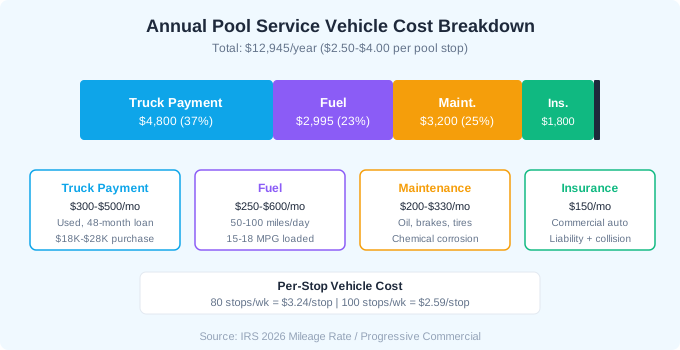
| Truck payment (used, 48 mo) | $4,800 |
| Fuel (80 stops/wk, 4 mi avg) | $2,995 |
| Insurance | $1,800 |
| Maintenance and repairs | $3,200 |
| Registration and tags | $150 |
| Total annual vehicle cost | $12,945 |
At 80 stops per week for 50 weeks (4,000 stops per year), your per-pool vehicle cost is $3.24 per stop. At 100 stops per week, it drops to $2.59. More stops per truck means a lower per-pool cost, which is another reason route density matters.
$2.50-$4.00
per pool stop is the typical vehicle cost for a well-run pool service truck
Add this number to your labor cost per stop and chemical cost per stop to get your true cost of service. Most pool companies find their total cost per stop is $18 to $28, with the vehicle accounting for 10 to 15% of that figure.
What Truck Modifications Do Pool Companies Need?
A stock pickup truck needs several modifications to function as a pool service vehicle. Some are essential on day one. Others can wait until you have cash flow to justify them.
Essential Day-One Modifications
- Spray-in bed liner ($400-$600): Protects against chemical corrosion. A drop-in plastic liner traps chemicals underneath and accelerates rust.
- Chemical storage racks or shelf system ($200-$500): Keeps jugs secure during transit. Loose chlorine jugs sliding around the bed is a spill waiting to happen.
- Locking toolbox ($150-$400): Secures expensive test kits, parts, and tools. Theft from open truck beds is common.
- Magnetic or vinyl signage ($100-$300): Turns every drive into free advertising. Magnetic signs work if you use the truck personally too.
Worth Adding Once You Have Cash Flow
- Chemical tank with pump ($500-$1,200): Bulk liquid chlorine tank eliminates juggling individual jugs. Pays for itself in time savings within months.
- Ladder rack ($200-$500): Frees bed space by mounting poles, hoses, and nets on an overhead rack.
- Tonneau cover or camper shell ($500-$1,500): Protects equipment from weather and theft. Hard covers are more secure than soft.
- GPS tracker ($15-$30/mo): Monitors truck location, routes, and driving habits. Essential when employees drive your vehicles.
Free starter kit
Start a pool service business with the numbers already run.
A short email series from an owner who started with $1,200 and a used truck. No software pitch, just the four things that decide whether year one works.
- Startup cost breakdownEvery line item from $2K bootstrap to fully equipped
- Pricing calculatorThe minimum you can charge per visit and still profit
- First-10-customers playbookDoor hangers, referrals, and the phone script that closes
- Licensing & insurance checklistWhat your state requires and which insurers pay claims
Already running routes? Try Pool Founder free
Frequently Asked Questions
What is the best truck for a pool service business?
A half-ton pickup like a Ford F-150, Chevy Silverado 1500, or Toyota Tundra is the standard for pool service. You need a full-size bed (6.5 ft minimum) for chemical storage and equipment. V6 engines offer the best balance of towing capacity and fuel economy. Four-wheel drive is unnecessary unless you work in areas with unpaved access.
How much does it cost to run a pool service truck per year?
Total annual operating cost for a pool service truck is $10,000 to $15,000, including the vehicle payment, fuel, insurance, and maintenance. That breaks down to roughly $2.50 to $4.00 per pool stop depending on your route density and number of weekly stops.
Can I use my personal truck for pool service and deduct it?
Yes. You can deduct either the IRS standard mileage rate ($0.725 per mile in 2026) or your actual vehicle expenses, whichever is higher. Keep a mileage log of every business mile driven. The standard mileage rate is simpler but actual expenses often yield a larger deduction for high-mileage service vehicles.
How many miles per year does a pool service truck drive?
A pool service truck averaging 4 miles between stops and running 20 stops per day, five days per week, drives approximately 20,000 to 25,000 miles per year on route. Add drive time to the shop and supply runs, and total annual mileage is typically 25,000 to 30,000 miles.
Is it better to buy a new or used truck for pool service?
Used is better for most pool companies, especially when starting out. A 3 to 5 year old half-ton pickup with 40,000 to 60,000 miles saves $15,000 to $20,000 compared to new and still has 5+ years of reliable service life. Put that savings into equipment, chemicals, and customer acquisition.