Why Does Your Pool Business Structure Matter More Than You Think?
Choosing between an LLC and a sole proprietorship is one of the first decisions every pool service owner faces, and it is also one of the most consequential. Your business structure determines whether a single lawsuit could take your home and personal savings, how much you pay in taxes, how clients perceive your credibility, and how easily you can scale from a one-truck operation to a multi-crew company.
Pool service businesses carry unique liability exposure that makes this decision especially important. Your technicians handle hazardous chemicals like chlorine and muriatic acid on customer property every day. They operate equipment near expensive pool finishes, automated systems, and outdoor living spaces. A chemical spill, a cracked deck, or a slip-and-fall incident can generate claims that far exceed what most new owners expect, and your business structure determines whether those claims can reach your personal assets.
This analysis compares LLCs and sole proprietorships specifically for pool service businesses using 2026 data from the SBA, IRS, LegalZoom, NerdWallet, and LLC University. All filing fees and tax figures reflect current state and federal requirements.
What Is the Difference Between an LLC and a Sole Proprietorship?
Before weighing the pros and cons of each structure, it helps to understand what each one actually is, how it gets created, and what it means for you as a pool business owner on a practical, day-to-day level.
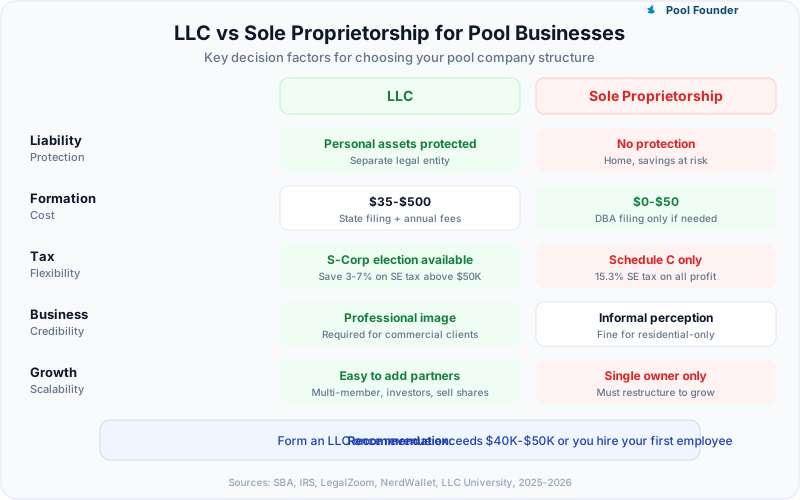
Sole Proprietorship: The Default Structure
A sole proprietorship is the simplest business structure in the United States. There is no formation paperwork, no state filing, and no separate legal entity. The moment you start cleaning pools and accepting payment, you are operating as a sole proprietor by default. You and your business are legally the same entity. You report business income on Schedule C of your personal tax return, and you are personally responsible for every debt, obligation, and legal claim the business incurs.
Many pool technicians begin as sole proprietors because the barrier to entry is essentially zero. You may need a local business license or a DBA ("doing business as") filing if you operate under a name other than your own, but beyond that, there is nothing to file with the state. This simplicity is the sole proprietorship's greatest advantage and, as we will see, its greatest risk.
LLC: A Separate Legal Entity
A limited liability company (LLC) is a formal business entity created by filing articles of organization with your state. Once formed, the LLC exists as a separate legal "person" distinct from you. This separation is the foundation of the LLC's primary benefit: personal asset protection. Your home, car, personal bank accounts, and retirement savings are shielded from business debts and lawsuits, provided you maintain the separation between personal and business finances.
Forming an LLC requires filing paperwork with your state's Secretary of State office, paying a filing fee that ranges from $35 in Montana to $500 in Massachusetts, and creating an operating agreement that outlines how the business will be managed. The average LLC filing fee across all US states is approximately $132 in 2026. The entire process typically takes one to two weeks, though some states offer expedited processing for an additional fee.
$132
Average LLC filing fee across all US states in 2026
Source: LLC University
| Factor | Sole Proprietorship | LLC |
|---|---|---|
| Formation cost | $0-$50 (DBA only) | $35-$500 (state filing fee) |
| Personal liability protection | None — personal assets fully exposed | Yes — personal assets separated from business |
| Tax treatment | Pass-through (Schedule C) | Pass-through by default; S-Corp election available |
| Credibility with clients | Lower — appears informal | Higher — signals established business |
| Formation time | Immediate | 1-2 weeks (varies by state) |
| Annual maintenance | Minimal (renew licenses) | $0-$800/year (annual reports, franchise tax) |
| Ability to raise funding | Limited — no ownership structure | Flexible — can add members, attract investors |
How Does Each Structure Protect Pool Business Owners?
Liability protection is the single most important reason pool service owners form LLCs, and it is where the two structures diverge most dramatically. Pool businesses operate in an environment with moderate-to-high liability risk every single day, and understanding how each structure handles that risk could save you from financial ruin.
The Sole Proprietorship Liability Problem
As a sole proprietor, there is no legal distinction between you and your business. If your business is sued, you are personally sued. If your business owes a debt it cannot pay, creditors can pursue your personal assets: your home, your vehicle, your savings accounts, your retirement funds. There is no firewall. Every asset you own is on the table.
For a pool service business, this exposure is not theoretical. Consider three scenarios that occur regularly in the industry. First, a technician accidentally spills muriatic acid on a customer's travertine pool deck, causing $15,000 in damage. Second, a technician slips on a wet surface at a customer's home and requires surgery, generating $80,000 in medical bills and a workers' compensation claim. Third, a chemical imbalance goes undetected and damages a $40,000 pebble-finish pool interior. In each case, if you are a sole proprietor and the claim exceeds your insurance coverage or you have a gap in coverage, your personal assets are directly at risk.
Pool service companies handle hazardous chemicals including chlorine, muriatic acid, and calcium hypochlorite at every service stop. This chemical exposure, combined with regular access to customer property and expensive pool equipment, creates a liability profile that is significantly higher than many other home-service businesses.
How LLC Protection Works
An LLC creates a legal barrier between business liabilities and your personal assets. If your pool service LLC is sued, the plaintiff can only pursue assets owned by the LLC: the business bank account, company equipment, and vehicles titled to the business. Your personal home, personal vehicle, personal savings, and retirement accounts remain protected, assuming you have maintained proper separation between personal and business finances.
This protection is not absolute. Courts can "pierce the corporate veil" and hold you personally liable if you commingle personal and business funds, fail to maintain the LLC as a separate entity, or use the LLC to commit fraud. But for pool service owners who maintain a separate business bank account, keep personal and business expenses distinct, and follow basic LLC formalities, the liability shield is robust and well-established in case law across all 50 states.
An LLC does not replace insurance. Think of it as a second layer of protection. Your general liability and commercial auto insurance handle most claims, and the LLC protects your personal assets if a claim exceeds your policy limits or falls outside your coverage.
What Are the Tax Implications for Pool Service Companies?
One of the most common misconceptions about LLCs is that they provide automatic tax advantages over sole proprietorships. The reality is more nuanced: by default, a single-member LLC is taxed identically to a sole proprietorship. The IRS treats it as a "disregarded entity," meaning all income passes through to your personal return on Schedule C, and you pay the same self-employment tax of 15.3% on net business income. The LLC itself does not file a separate tax return or pay separate taxes.
Self-Employment Tax: The Baseline
Both sole proprietors and single-member LLC owners pay self-employment tax of 15.3% on net business income (12.4% for Social Security on income up to $176,100 in 2026, plus 2.9% for Medicare on all income). This covers both the employer and employee portions of Social Security and Medicare taxes. On $80,000 in net pool service income, self-employment tax alone comes to approximately $11,300, before any income tax.
The S-Corp Election Advantage
Where LLCs gain a genuine tax advantage is through S-Corp election. An LLC can elect to be taxed as an S-Corporation by filing IRS Form 2553. Under S-Corp taxation, you pay yourself a "reasonable salary" and take remaining profits as distributions. Only the salary portion is subject to self-employment tax; distributions are not. For a pool service business earning $100,000 in net profit, paying yourself a reasonable salary of $55,000 and taking $45,000 as distributions could save approximately $6,900 per year in self-employment taxes.
The S-Corp election is not free, however. You must run payroll for yourself, file a separate S-Corp tax return (Form 1120-S), and the IRS scrutinizes "reasonable salary" amounts. If your salary is unreasonably low relative to industry norms for pool service technicians and managers, the IRS can reclassify distributions as salary and assess back taxes plus penalties. Most accountants recommend S-Corp election once net business income consistently exceeds $60,000-$80,000 per year.
~$6,900/yr
Potential self-employment tax savings with S-Corp election on $100K net income
Source: IRS, NerdWallet
Deductions Available to Both Structures
Both sole proprietors and LLC owners can deduct ordinary and necessary business expenses: chemicals, equipment, vehicle costs (mileage or actual expenses), insurance premiums, software subscriptions, marketing expenses, and home office costs. The deduction rules are identical regardless of structure. The Qualified Business Income (QBI) deduction, which allows eligible business owners to deduct up to 20% of qualified business income, is also available to both sole proprietors and LLC owners with pass-through taxation.
How Much Does It Cost to Form a Pool Service LLC?
LLC formation costs vary significantly by state, with total first-year costs typically ranging from $700 to $1,000 when you include all common expenses beyond just the state filing fee. Understanding the full cost picture helps you budget accurately and avoid surprises.
State Filing Fees for Popular Pool Service States
The following table shows LLC filing fees for states with large pool service markets. These are the core states where the majority of residential pool service businesses operate due to climate and pool density.
| State | LLC Filing Fee | Annual Report Fee | Notes |
|---|---|---|---|
| Florida | $125 | $138.75/year | Large pool market; moderate costs |
| Texas | $300 | $0 (no annual report) | No state income tax; no annual report required |
| California | $70 | $800/year franchise tax | Low filing fee but highest ongoing cost |
| Arizona | $50 | $0 (no annual report) | One of the cheapest states overall |
| Georgia | $100 | $50/year | Moderate costs; growing pool market |
| Nevada | $75 | $150/year + $200 business license | No state income tax; higher annual fees |
California LLC owners pay an $800 minimum franchise tax annually regardless of income, making it the most expensive state for LLC maintenance. If you are a small pool service operator in California earning under $50,000 net, the franchise tax alone may represent a significant percentage of your profit. Some California pool operators delay LLC formation until revenue justifies the cost.
Beyond the Filing Fee: Total First-Year Costs
The state filing fee is just one component of LLC formation costs. Most pool service owners also incur costs for an operating agreement (free if you draft your own using a template, $50-$200 from an online legal service, or $500-$1,500 from an attorney), a registered agent service ($0 if you serve as your own, $100-$300 per year for a professional service), an EIN from the IRS (free), and a separate business bank account (typically free or low-cost). The total all-in cost for the first year typically falls between $700 and $1,000 for most states.
$700-$1,000
Total first-year LLC formation cost including all common expenses
Source: LegalZoom, NerdWallet, LLC University
Ongoing annual costs after the first year are typically lower: annual report fees (if required by your state), registered agent renewal, and any state-specific franchise taxes. For most pool service states outside California, annual LLC maintenance costs run $50-$300 per year, a modest expense relative to the protection provided.
Which Structure Should You Choose for Your Pool Business?
The right structure depends on where you are in your business journey, your risk tolerance, and your growth plans. While there is no universal answer, the data and liability profile of pool service businesses point clearly in one direction for most operators.
When a Sole Proprietorship May Be Sufficient
A sole proprietorship can make sense if you are testing the waters with a handful of pools on the side, have minimal personal assets to protect, plan to keep the business very small with no employees, and want to validate demand before investing in formal business structure. Even in these cases, you should carry general liability insurance and plan to convert to an LLC once the business generates consistent revenue.
When You Should Form an LLC
- You service pools as your primary source of income
- You have personal assets worth protecting (home, savings, retirement accounts)
- You plan to hire employees or subcontractors
- You handle chemicals on customer property (which is essentially every pool service business)
- You want to build a business that can eventually be sold
- You want to build credibility with residential and commercial clients
- Your annual net income exceeds $30,000-$40,000
For the vast majority of pool service businesses, the LLC is the right choice. The combination of moderate-to-high liability risk from chemical handling and property access, the relatively low formation cost of $700-$1,000, and the option to elect S-Corp taxation as the business grows makes the LLC the clear winner for any pool service owner who treats this as a real business rather than occasional side work.
The best time to form your LLC is before you service your first paying customer. Retroactively converting from a sole proprietorship to an LLC is straightforward but does not provide liability protection for incidents that occurred before the LLC existed. Start with the right structure from day one.
A Practical Decision Framework
Ask yourself three questions. First, do you have personal assets worth more than $10,000 that you want to protect? If yes, form an LLC. Second, do you or will you handle chemicals on customer property? If yes, and you run a pool service business the answer is almost certainly yes, form an LLC. Third, do you plan to do this for more than 12 months? If yes, form an LLC. The $700-$1,000 formation cost is a rounding error compared to the financial devastation of a single lawsuit that pierces through to your personal assets.
Once your LLC is established and your pool service business consistently earns above $60,000-$80,000 in net income, consult a CPA about S-Corp election to optimize your tax position. This two-step approach, LLC at formation followed by S-Corp election at scale, gives you the best combination of liability protection, tax efficiency, and operational simplicity as your pool business grows.
Free starter kit
Start a pool service business with the numbers already run.
A short email series from an owner who started with $1,200 and a used truck. No software pitch, just the four things that decide whether year one works.
- Startup cost breakdownEvery line item from $2K bootstrap to fully equipped
- Pricing calculatorThe minimum you can charge per visit and still profit
- First-10-customers playbookDoor hangers, referrals, and the phone script that closes
- Licensing & insurance checklistWhat your state requires and which insurers pay claims
Already running routes? Try Pool Founder free
Frequently Asked Questions
Can I switch from a sole proprietorship to an LLC later?
Yes, you can convert a sole proprietorship to an LLC at any time by filing articles of organization with your state. The process typically takes one to two weeks and costs the standard state filing fee ($35-$500 depending on state). However, the LLC only provides liability protection going forward. It does not retroactively shield you from claims arising from incidents that occurred while you were a sole proprietor. For this reason, forming the LLC before you begin servicing customers is strongly recommended.
Do I need an LLC if I already have general liability insurance?
Insurance and an LLC serve different but complementary purposes. General liability insurance covers specific types of claims up to your policy limits (typically $1-$2 million per occurrence). An LLC protects your personal assets if a claim exceeds your insurance limits, falls outside your coverage, or if there is a gap in your policy. Think of insurance as your first line of defense and the LLC as your safety net. Most pool service professionals carry both.
How is a single-member LLC taxed differently from a sole proprietorship?
By default, it is not. The IRS treats a single-member LLC as a "disregarded entity," meaning all income passes through to your personal tax return on Schedule C, exactly like a sole proprietorship. You pay the same 15.3% self-employment tax on net income. The tax advantage comes when you elect S-Corp taxation by filing Form 2553, which allows you to split income between salary (subject to self-employment tax) and distributions (not subject to self-employment tax). This election is typically worthwhile once net income consistently exceeds $60,000-$80,000 per year.
What is the cheapest state to form a pool service LLC?
Montana has the lowest LLC filing fee at $35, followed by Kentucky at $40 and Arkansas and Arizona at approximately $50. However, you should generally form your LLC in the state where you operate your pool service business, not the cheapest state. Forming in a different state requires you to also register as a foreign LLC in your home state, which means paying filing fees in both states and maintaining compliance in both. For most pool service businesses, forming in your home state is the simplest and most cost-effective approach.
Does forming an LLC make my pool business look more professional?
Yes, and this matters more than many new owners realize. Having "LLC" in your business name signals to customers that you are an established, legitimate business rather than a casual side operation. Commercial property managers and HOAs often require contractors to be registered business entities before awarding service contracts. An LLC also makes it easier to open business bank accounts, apply for business credit, and establish trade accounts with chemical and equipment suppliers, all of which contribute to operational credibility and growth capacity.