Your Software Has Reports. Are You Using the Right Ones?
Every pool service software platform generates reports. Most owners never open them. The ones who do often stare at dashboards full of data without knowing which numbers actually require action. The result is the same either way: decisions made on gut feel instead of evidence. In an $8.8 billion industry with 78,817 businesses competing for customers, the companies that use their data win. The ones that ignore it plateau.
You do not need 50 reports. You need six. Six reports, pulled monthly, give you a complete picture of your business health: where money is being made, where it is being wasted, whether customers are staying or leaving, and whether your team is productive or spinning wheels. The pool service software market is valued at $1.10 billion and growing at 10.5% CAGR because owners are realizing that data-driven operations outperform intuition-driven operations every time.
Corey Adams, Pool Founder co-founder and 15-year pool service veteran: "I ran my business for years without looking at a single report. I knew I was busy. I thought I was profitable. Then I pulled a chemical cost report and found out I was spending $14 per stop on one route because the tech was over-dosing every pool. That one report saved me $400 a month."
Which Six Reports Should You Pull Monthly?
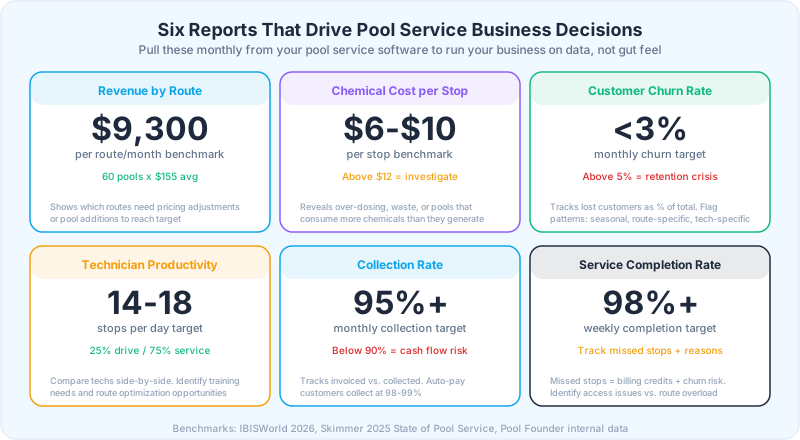
The six reports that matter for pool service companies are: revenue by route, chemical cost per stop, customer churn rate, technician productivity, collection rate, and service completion rate. Each report answers a specific business question. Together, they give you a monthly health check that takes 30 minutes to review and can save thousands in missed opportunities or hidden waste.
| Report | Business Question | Frequency | Action Threshold |
|---|---|---|---|
| Revenue by route | Which routes are underperforming? | Monthly | Below $7,500/route/month |
| Chemical cost per stop | Are we wasting chemicals? | Monthly | Above $12/stop |
| Customer churn rate | Are we losing customers too fast? | Monthly | Above 3%/month |
| Technician productivity | Are techs efficient? | Weekly/Monthly | Below 12 stops/day |
| Collection rate | Are we collecting what we bill? | Monthly | Below 95% |
| Service completion rate | Are we missing scheduled stops? | Weekly | Below 98% |
How Do You Use the Revenue by Route Report?
The revenue by route report shows total monthly recurring revenue generated by each route or each day of the week. A balanced operation has routes within 10-15% of each other. If your Monday route generates $10,200 and your Friday route generates $6,800, you have a density and pricing problem on Friday that needs attention.
What to Look For
- Revenue per route per month: target $8,000-$10,000 for a full route (55-65 pools)
- Revenue per pool: should be $140-$175 for standard residential. Below $130 indicates underpricing.
- Revenue variance between routes: more than 20% variance suggests pricing inconsistency or route imbalance
- Revenue trend over 3-6 months: declining revenue on a route signals churn outpacing new additions
- Revenue per pool by customer age: newer customers at lower rates drag the average down
Action Items from Revenue Reports
If a route is below target, the fix is either adding pools to increase density (if the tech has capacity), raising prices on below-market accounts, or consolidating low-revenue routes by moving pools between days. Price increases of 5-8% annually on below-market accounts bring revenue per pool back to target over 1-2 years without shocking customers into cancellation.
$9,300
per route per month is the benchmark for a full 60-pool route at $155/month average. Routes below $7,500 need pricing adjustments or pool additions.
Source: Pool Founder internal benchmarks
What Does the Chemical Cost per Stop Report Reveal?
Chemical cost per stop is the most underused report in pool service. It reveals whether your technicians are dosing efficiently or dumping chemicals without testing first. The benchmark is $6 to $10 per residential stop for weekly service including chlorine, acid, and specialty chemicals. Anything above $12 per stop consistently warrants investigation.
| Cost Range | What It Signals | Action |
|---|---|---|
| Under $5 | Possible under-dosing or inaccurate tracking | Verify chemical inventory matches reported usage |
| $6-$10 | Healthy range for standard residential pools | Monitor monthly for seasonal variation |
| $10-$12 | Slightly elevated, may reflect larger pools or problem pools | Review pool-by-pool breakdown for outliers |
| $12-$15 | Elevated. Likely over-dosing or high-demand pools | Audit technician dosing practices |
| Above $15 | Significant waste or pool-specific problems | Identify specific pools. Consider equipment issues. |
Pool-level chemical cost tracking is where the real insights live. If your average is $8 per stop but three pools are running $18 each, those pools are dragging your margins down. The cause might be a failing chlorinator, high CYA requiring more chlorine, a cracked shell losing water and chemicals, or simply a tech who doses by habit instead of by test results. Software that tracks chemical usage per pool per visit makes this analysis possible.
Chemical costs are seasonal. Expect 20-40% higher costs in summer due to heat, UV degradation, and higher bather loads. Compare month-over-month and year-over-year instead of comparing July to January. Seasonal spikes are normal. Year-over-year increases without explanation are not.
How Do You Track and Reduce Customer Churn?
Customer churn rate is the percentage of customers who cancel service in a given period. For pool service, calculate it monthly: customers lost / total customers at start of month. A healthy churn rate is under 3% monthly (which translates to roughly 30% annual turnover when you account for compounding). Above 5% monthly is a retention crisis that will shrink your business faster than marketing can replace it.
Segmenting Churn for Actionable Insights
Raw churn rate is useful but segmented churn is actionable. Your software should help you answer: which route has the highest churn? Which technician has the highest churn? How long do customers stay before canceling (tenure at cancellation)? What month has the highest cancellations? What reason do customers give for canceling?
| Churn Segment | What It Reveals | Example Insight |
|---|---|---|
| By route | Route-specific service quality issues | Route C has 6% churn vs. 2% on other routes |
| By technician | Tech-specific training or attitude problems | Tech #3 loses 3x more customers than others |
| By tenure | Onboarding failures vs. long-term dissatisfaction | 40% of churn happens in first 90 days |
| By season | Seasonal patterns requiring proactive retention | October cancellations spike without fall campaigns |
| By reason | Systemic issues to address operationally | "Did not know you came" = missing service reports |
The most valuable churn data point is reason. When you know why customers leave, you can fix the systemic issue. If 30% of cancellations cite "did not know you were coming," the fix is service completion notifications. If 25% cite "found someone cheaper," the fix is better documentation that demonstrates value.
What Does Technician Productivity Data Tell You?
Technician productivity is measured primarily by stops per day and drive time percentage. The benchmark is 14-18 stops per day for residential weekly service with drive time at 25% or less of total route time. Pool companies using route optimization software service 22% more pools per day and reduce driving time by 31%, which means productivity gains come from better routing before they come from working faster.
Productivity Metrics to Track
| Metric | Benchmark | Red Flag | What to Investigate |
|---|---|---|---|
| Stops per day | 14-18 | Below 12 | Route density, service time per pool, drive time |
| Drive time % | Under 25% | Above 35% | Route optimization needed, poor geographic clustering |
| Avg time per stop | 18-25 min | Above 35 min | Pool condition issues, tech efficiency, over-servicing |
| Revenue per tech | $10-$14K/mo | Below $8K/mo | Route not full, pricing too low, too many drive gaps |
| Completed vs. scheduled | 98%+ | Below 95% | Access issues, time management, route overload |
When comparing technician productivity, account for route differences. A tech running 12 stops in a rural area with 20-minute drives between pools is not less productive than a tech running 18 stops in a tight subdivision. Normalize for drive time before comparing. The real metric is stops per available service hour (total hours minus drive hours).
22%
more pools per day are serviced by companies using route optimization software, with a 31% reduction in driving time
Source: Zeo Route Planner 2026
How Do Collection Rate and Service Completion Reports Protect Cash Flow?
Collection rate measures the percentage of billed revenue that is actually collected. The target is 95% or higher. Customers on auto-pay collect at 98-99%. Customers on manual invoicing collect at 85-92%. The gap between those two numbers is the strongest argument for moving every customer to auto-pay. Service completion rate measures the percentage of scheduled stops that are actually performed. The target is 98% or higher.
Improving Collection Rate
- Move all customers to auto-pay (credit card or ACH) at sign-up. New customers should default to auto-pay.
- For existing customers on manual invoicing, offer a $5-$10/month discount for switching to auto-pay
- Send invoices on the same day every month. Consistency reduces "I forgot" non-payments.
- Auto-send payment reminders at 3, 7, and 14 days past due
- Pause service at 30 days past due with a friendly but firm notification
Tracking Service Completion
Every missed stop has a cost: the direct revenue loss if you credit the customer, the churn risk from the customer feeling neglected, and the chemical imbalance that makes the next visit harder. Track missed stops by reason: access issue (gate locked, construction), weather, tech absence, route overload, or skip decision. Each reason has a different fix. Access issues need better pre-service communication. Route overload needs route rebalancing. Weather needs a clear reschedule policy communicated to customers.
Pool Founder generates revenue reports by route and customer, tracks chemical usage per stop, monitors service completion rates, and automates billing with auto-pay. The reporting dashboard gives you all six of these reports without spreadsheet gymnastics.
Ready to streamline your pool service business?
Pool Founder gives you route optimization, automated invoicing, chemical tracking, and everything else you need to run a more profitable pool business.
Frequently Asked Questions
What reports should I pull from pool service software every month?
Pull six reports monthly: revenue by route (target $8,000-$10,000/route), chemical cost per stop (target $6-$10), customer churn rate (target under 3%), technician productivity (target 14-18 stops/day), collection rate (target 95%+), and service completion rate (target 98%+). This review takes 30 minutes and gives you a complete business health picture.
What is a good chemical cost per stop for pool service?
A healthy chemical cost per stop for standard residential weekly service is $6 to $10, including chlorine, acid, and specialty chemicals. Costs above $12 per stop consistently warrant investigation into technician dosing practices, pool-specific equipment issues, or high CYA levels requiring more chlorine. Expect 20-40% higher costs in summer.
How do you calculate customer churn rate for pool service?
Divide the number of customers lost in a month by the total customer count at the start of that month. Example: 4 cancellations / 150 starting customers = 2.7% monthly churn. A healthy rate is under 3% monthly. Segment churn by route, technician, and tenure to find actionable patterns.
What is a good collection rate for pool service companies?
Target 95% or higher monthly collection rate. Customers on auto-pay collect at 98-99%. Manual invoicing customers collect at 85-92%. The fastest way to improve collection rate is moving all customers to auto-pay at sign-up and offering existing customers a small discount to switch.
How many stops per day should a pool tech complete?
A well-routed residential pool technician should complete 14 to 18 stops per day with drive time at 25% or less of total route time. Below 12 stops indicates routing problems, excessive drive time, or training needs. Companies using route optimization software achieve 22% more stops per day on average.
Sources & References
- IBISWorld - Swimming Pool Cleaning Services Industry 2026
- Skimmer - 2025 State of Pool Service Report
- Verified Market Reports - Pool Service Software Market
- Pool Verify - Pool Service Software Guide 2026