Why Are Slip and Fall Claims a Serious Risk for Pool Service Companies?
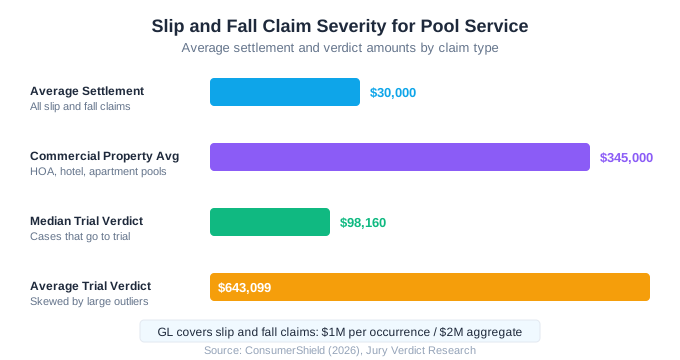
Slip and fall liability is the second most common claim type for pool service companies, behind only vehicle accidents. Every time your tech walks across a wet pool deck, drags a vacuum hose through a backyard, or leaves equipment near a walkway, you create potential exposure. The average slip and fall settlement is approximately $30,000 according to ConsumerShield 2026 data, but cases involving serious injury on commercial property average $345,000 nationally. Premises liability verdicts that go to trial average $643,099 according to Jury Verdict Research.
The legal complexity for pool service companies is that you are an independent contractor working on someone else is property. Both you and the property owner may share liability, and courts in states like Florida have ruled that property owners cannot delegate away their duty to maintain safe premises. Understanding where your liability starts and ends, what your GL policy covers, and how to reduce your exposure protects both your business and your customers.
This guide covers the legal framework for slip and fall claims involving pool service companies, real settlement data, what general liability insurance covers, and the specific risk reduction steps that Corey Adams, Pool Founder co-founder and 15-year industry veteran, has used across thousands of service visits.
How Does Premises Liability Apply to Pool Service Companies?
Premises liability is the legal principle that property owners and occupiers owe a duty of care to people on their property. For pool service companies, the analysis gets complicated because you are neither the property owner nor a typical visitor. You are an independent contractor performing work that inherently creates hazards, specifically wet surfaces, chemical handling, and equipment placement on a residential or commercial property.
Who Is Liable When Someone Slips on a Wet Pool Deck?
Liability depends on who created the hazard and who had a duty to address it. If your tech splashed water onto a deck during service and a homeowner slips on that water, your company likely bears primary liability because you created the hazardous condition. If the pool deck was already wet from rain or pool use and a third party slips while your tech is present, the property owner typically bears primary liability. Florida courts have specifically held that businesses cannot avoid slip-and-fall liability simply by hiring an independent contractor, under the doctrine of non-delegable duties.
The Non-Delegable Duty Doctrine
Some duties cannot be delegated to independent contractors. Property owners have a non-delegable duty to maintain safe premises for invitees. This means even if your pool service company created a hazardous condition, the property owner may still share liability. Conversely, as the service provider, you have your own independent duty not to create hazards or leave the premises in a dangerous condition. Both parties can be named in a lawsuit, and both may be found liable.
| Scenario | Primary Liability | Secondary Liability |
|---|---|---|
| Tech splashes water on deck, customer slips | Pool service company | Property owner (non-delegable duty) |
| Homeowner slips on deck wet from pool use | Property owner | None (not service-related) |
| Guest trips over vacuum hose left by tech | Pool service company | Property owner may share |
| Tech leaves chemical bucket on walkway | Pool service company | None |
| Deck tile was cracked before service, guest falls | Property owner | Pool service if knew and did not warn |
| Child slips on deck while tech is servicing | Property owner (supervision) | Pool service if created hazard |
What Does General Liability Cover for Slip and Fall Claims?
General liability insurance is designed to cover exactly this type of claim. Third-party bodily injury occurring in connection with your business operations is the core coverage of a GL policy. Unlike water quality claims, slip and fall claims do not typically trigger pollution exclusions, making GL your most reliable coverage for these incidents.
What GL Covers
- Medical expenses for the injured party (Medical Payments coverage, typically $5,000 to $10,000, pays regardless of fault)
- Legal defense costs if a lawsuit is filed (paid in addition to your policy limits)
- Settlement or judgment amounts up to your policy limits ($1M per occurrence / $2M aggregate is standard)
- Property damage caused by the fall, such as broken phones, glasses, or personal items
What GL Does Not Cover
- Injuries to your own employees (covered by workers compensation)
- Injuries caused by your vehicle (covered by commercial auto)
- Intentional acts or gross negligence
- Claims exceeding your policy limits (covered by umbrella insurance)
- Punitive damages in most states
$67/mo
Median GL premium for pool service companies
Source: Insureon
Your GL policy includes a "Medical Payments" provision that pays small medical bills ($5,000 to $10,000) regardless of fault. This is a goodwill tool. If a customer has a minor slip, your carrier can pay their medical bills quickly without litigation. This often prevents small incidents from becoming lawsuits.
What Are the Most Common Slip and Fall Scenarios for Pool Companies?
Slip and fall claims against pool service companies cluster around five predictable scenarios. Each has a specific prevention protocol that, when followed consistently, reduces your exposure significantly.
Wet Deck Surfaces
Water splashed during brushing, vacuuming, or backwashing creates slick surfaces on pool decks. Travertine, stamped concrete, and smooth tile are especially dangerous when wet. The risk window extends beyond your service visit if water pools in low spots. Always squeegee or alert the homeowner to wet areas before leaving.
Equipment and Hose Tripping Hazards
Vacuum hoses, chemical buckets, test kits, and pole handles left on walkways or deck areas create tripping hazards. This is the most preventable claim category. Stage equipment in one location, keep hoses out of foot traffic paths, and never leave equipment unattended where people walk.
Chemical Spills on Hard Surfaces
Muriatic acid or liquid chlorine spilled on a deck creates a slip hazard and a chemical burn risk. Always carry chemicals in sealed secondary containers, never set open containers on the deck, and clean any spill immediately with water. Document the cleanup.
Gate and Access Path Hazards
Uneven pavers, loose gate latches, and obstructed paths between the gate and pool equipment are common trip points. While these are typically the property owner is responsibility, if you notice a hazard and fail to warn the owner or avoid it, you may share liability. Note hazards in your service report.
Post-Service Window
The 30 to 60 minutes after your tech leaves is the highest-risk window. The deck may still be wet, chemicals may still be settling, and the homeowner returns to a pool area they assume is in normal condition. A departure notification that includes "deck may be wet, please use caution" creates both a safety measure and a liability shield.
How Do You Reduce Slip and Fall Risk on Every Service Visit?
Reducing slip and fall risk is about building habits into every service visit, not about reacting after an incident. The following protocol adds less than two minutes to each stop and dramatically reduces your exposure.
- 1Arrival scan: Walk the deck and note any pre-existing hazards (cracked tiles, standing water, loose items) in your service log before starting work.
- 2Equipment staging: Place all tools and chemicals in a single area away from walkways and foot traffic. Never leave a hose stretched across a walking path.
- 3Active awareness: If anyone is present at the property, alert them that the deck area may be wet during service. A verbal heads-up takes five seconds.
- 4Chemical containment: Transport chemicals in sealed secondary containers. Never open a jug of acid on the deck. Pour at the equipment pad over concrete, not over the pool deck.
- 5Departure cleanup: Before leaving, walk the deck area. Pick up all equipment, push standing water off high-traffic areas with a squeegee if practical, and close all gates.
- 6Departure note: Send a service completion notification that includes a caution about wet surfaces. This creates a timestamped record that you warned the customer.
Document pre-existing hazards at every visit. If a customer has a cracked deck tile and someone eventually trips on it, your service log showing you noted the hazard and were not the cause protects you from being named in the claim.
What Should You Do When a Slip and Fall Incident Occurs?
When an injury occurs on a property you service, whether during your visit or after, your response in the first 48 hours shapes the outcome. The goal is to ensure the injured party gets help, preserve all evidence, and report the incident to your carrier without making admissions of fault.
- 1Ensure safety first: If you are present, help the injured person and call 911 if the injury is serious. Basic human decency is never a liability.
- 2Do not admit fault: Saying "I am sorry you fell" is fine. Saying "I should have cleaned up that water" is an admission. Be compassionate without accepting blame.
- 3Document everything immediately: Take photos of the exact location, the surface condition, any equipment or chemicals present, and the surrounding area. Note the time, weather conditions, and who was present.
- 4Get the injured party information: Name, contact information, and a description of what happened from their perspective. Do not argue about what occurred.
- 5Report to your insurance carrier within 24 hours: Even if the injury seems minor, report it. Small claims become large claims when injuries worsen or attorneys get involved.
- 6Preserve all records: Service logs, photos, communication with the customer, and any relevant records from the last 90 days on that property.
If the customer contacts you about a slip and fall that happened after you left, do not visit the property to investigate without first notifying your insurance carrier. Your carrier may want to send their own adjuster, and your investigation could inadvertently compromise evidence.
How Does Your Service Contract Limit Slip and Fall Exposure?
Your service agreement is your first line of defense in a slip and fall claim. Specific contract provisions can limit your exposure, establish shared responsibility with the property owner, and create notice requirements that protect both parties.
Key Contract Provisions
- Assumption of risk clause: The customer acknowledges that pool areas are inherently wet and slippery, and that service activities may temporarily increase this condition.
- Indemnification clause: The property owner agrees to maintain safe premises and indemnify your company for claims arising from pre-existing property conditions.
- Notice of hazards: The customer agrees to notify you of known hazards before service visits, such as broken deck tiles, loose railings, or aggressive pets.
- Limitation of liability: Cap your liability at the value of the service contract or your insurance coverage limits. Courts enforce these provisions in many states when the language is clear.
- Authorized access areas: Define exactly where your techs are authorized to go. If a claim arises in an area outside your service scope, the contract establishes you had no business being there.
These clauses do not eliminate liability, but they establish a framework that makes claims harder to pursue and easier to defend. Have a local attorney review your service agreement annually to ensure your provisions comply with your state is contract law.
Ready to streamline your pool service business?
Pool Founder gives you route optimization, automated invoicing, chemical tracking, and everything else you need to run a more profitable pool business.
Frequently Asked Questions
Can a pool service company be sued if a customer slips on a wet deck after service?
Yes. If your service created the wet condition and you did not warn the customer or take steps to mitigate the hazard, you can be held liable under negligence theory. A departure notification warning of wet surfaces is your best defense.
What is the average settlement for a slip and fall at a pool?
The average slip and fall settlement is approximately $30,000, but cases on commercial property average $345,000 nationally. Severe cases that go to trial produce a median verdict of $98,160 and an average of $643,099 according to Jury Verdict Research.
Does my general liability insurance cover slip and fall claims?
Yes. Unlike chemical-related claims that may trigger pollution exclusions, slip and fall claims are core GL coverage. A standard policy covers $1 million per occurrence and $2 million aggregate, plus legal defense costs.
Is the property owner liable if someone slips while I am servicing their pool?
Potentially yes. Property owners have a non-delegable duty to maintain safe premises. Both you and the property owner can be named in a claim. Liability is allocated based on who created the hazard and who had a duty to address it.
How can I prove I did not cause a slip and fall hazard?
Document pre-existing conditions at arrival, photograph the service area, and log departure conditions. A timestamped service report showing the deck condition before and after your visit is strong evidence that you did not create the hazard.