The Jump From One Truck to Two Changes Everything
Going from a solo pool tech to running a multi-tech operation is the single biggest transition in pool service. It changes your finances, your daily work, your stress levels, and your identity. You stop being "the pool guy" and start being "the pool business owner." Most people are not ready for how different those two jobs are.
The financial math is where most solo operators get stuck. You are making $75,000-$100,000 running 60 pools by yourself. Why would you take on the risk and cost of an employee? Because a solo operation has a ceiling. You cannot grow past what you can personally service. A multi-tech operation can.
$200K-$400K
Seller's Discretionary Earnings for a 2-3 truck pool service operation
Source: KMF Business Advisors 2026
Corey Adams, Pool Founder co-founder and 15-year pool service veteran, made this transition himself. "The first three months after hiring my first tech were the hardest in my career. I made less money, worked more hours, and questioned the decision every day. By month six, I understood why it was the best decision I ever made."
What Does the Financial Math Look Like for Hiring Your First Tech?
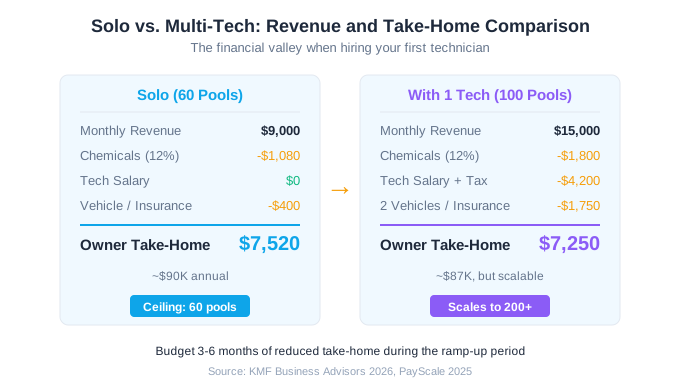
The financial reality of your first hire is this: your revenue goes up, your expenses go up faster, and your take-home pay temporarily goes down. This is normal. It is the cost of building capacity. Understanding the math in advance prevents panic when you see your first payroll bill.
| Line Item | Solo (60 Pools) | With 1 Tech (100 Pools) |
|---|---|---|
| Monthly Revenue | $9,000 | $15,000 |
| Chemical Costs (12%) | $1,080 | $1,800 |
| Tech Salary + Payroll Tax | $0 | $3,500-$4,200 |
| Workers Comp ($2-4 per $100 payroll) | $0 | $70-$140 |
| Second Vehicle (payment + fuel + insurance) | $0 | $800-$1,200 |
| Software, Admin, Insurance | $400 | $550 |
| Owner Take-Home | $7,520 | $5,110-$8,050 |
At 100 pools, the math starts working. But between 60 and 90 pools, there is a valley where you are paying for a full-time tech who has not filled their route yet. Plan for 3-6 months of reduced take-home during the ramp-up period.
Have 3 months of operating expenses saved before you hire. At minimum, that means $10,000-$15,000 in cash to cover payroll, vehicle costs, and chemicals during the ramp-up period when your new tech is not yet running a full route.
When Is the Right Time to Hire Your First Pool Tech?
Hire when you are consistently at 80% of your solo capacity and turning away new customers or delaying starts. For most solo operators, that means 50-55 weekly pools. Do not wait until you are at 70 pools and drowning. Training a new tech takes 2-4 weeks, and you need time to do it right.
55% of pool service businesses planned to hire more employees in 2025, according to the Skimmer State of Pool Service Report. The demand for growth is there. The question is timing it right so you do not blow up your service quality or your bank account.
- Hire in the off-season if possible. Training during your slow months means you have time to ride along, correct mistakes, and build confidence before peak season hits.
- Do not hire when you are maxed out. If you are already running behind on routes, you do not have time to train. You will either neglect training or neglect customers. Both are bad.
- Have new customers lined up. Ideally, you have a waitlist of 10-15 prospective customers who you can onboard once your tech is trained and ready to run a route.
- Your pricing must support it. If your average rate is $120/month, the margin per pool may not cover employee costs. Make sure your pricing allows 15-25% profit after labor.
What Operational Changes Does a Multi-Tech Operation Require?
Running a multi-tech operation requires systems that a solo operation never needed. When it was just you, everything lived in your head. Routes, customer preferences, chemical dosing, gate codes. With a second person on the road, all of that needs to be documented and accessible.
Standard Operating Procedures (SOPs)
Write down your service process step by step. What does a tech do at every single stop? What chemicals do they test for? What do they log? What photos do they take? Your tech should be able to open an app and follow the checklist without calling you for every pool.
Route Management
You now need to split your customer base into two routes. Give your tech the simpler, more predictable pools first. Keep the problem accounts, the commercial jobs, and the picky customers on your route until they are trained enough to handle complexity.
Quality Control
Require photo documentation at every stop. Water chemistry readings should be logged digitally. Spot-check your tech's work by visiting 2-3 of their pools per week unannounced. The goal is not micromanagement. It is catching issues before customers notice them.
Communication System
Your tech needs a way to report equipment issues, customer requests, and chemical shortages in real time. Text messages work for two people but break down at three. Pool service software with tech-facing apps handles this at scale.
How Do You Train a New Pool Technician?
Training a pool tech takes 2-4 weeks of ride-alongs and supervised solo work before they should be on a route alone. The biggest mistake owners make is rushing this timeline because they need the help immediately. A poorly trained tech damages customer relationships faster than no tech at all.
- 1Week 1: Ride-along. The new tech shadows you on your full route. They observe every step, ask questions, and start learning pool types, chemical dosing, and equipment basics.
- 2Week 2: Supervised work. The tech does the work while you watch and correct. You handle the testing and chemicals while they handle the physical work (skimming, brushing, baskets).
- 3Week 3: Partial independence. The tech runs 5-8 straightforward pools solo while you handle the rest. Review their work at end of day through photos and chemistry logs.
- 4Week 4: Full route with check-ins. The tech runs their complete route. You spot-check 2-3 pools daily and review all service reports. Address any quality issues immediately.
$18-$21/hr
average hourly wage for pool technicians in 2025
Source: PayScale / Indeed 2025
Pay during training should be the same as regular pay. A tech earning $18-$21 per hour during training costs you $1,440-$1,680 for a two-week ride-along period. That is a real cost, but it is far less expensive than losing customers because an untrained tech damaged a pool or delivered poor service.
What Is the Mindset Shift From Tech to Business Owner?
The hardest part of going multi-tech is not the money or the operations. It is the mindset. You built this business by being great at cleaning pools. Now the business needs you to be great at managing people, selling, and building systems. Those are completely different skills.
- Accept imperfection. Your tech will never clean pools exactly like you do. They will be 80-90% as good, and that has to be okay. Chasing perfection leads to micromanagement, which drives good employees away.
- Value your time differently. An hour on the route earns you $35-$50. An hour spent selling, building systems, or training earns you much more long-term. Get off the truck.
- Think in systems, not tasks. Instead of "I need to fix this customer's pump," think "how do we handle equipment issues so I am not the one fixing every pump."
- Invest in people. Your tech is not an expense. They are the person who determines whether your customers stay or leave. Pay fairly, train thoroughly, and treat them as a partner in building the business.
The pool service owners who scale successfully are the ones who realize their job changed. You are no longer the best technician. You are the person who builds and manages a team of technicians. If you cannot make that shift, you will stay solo forever.
What Are the Common Mistakes When Going Multi-Tech?
Most pool service owners make the same mistakes during this transition. Knowing them in advance does not make the transition easy, but it helps you avoid the most expensive errors.
- 1Hiring too late. Waiting until you are at 70+ pools and overwhelmed means your service quality has already dropped. Customers cancel during your training period, making the financial valley even deeper.
- 2Hiring the wrong person. Prioritize reliability and work ethic over pool experience. You can teach someone to clean pools in two weeks. You cannot teach someone to show up on time.
- 3Not raising prices first. If your average rate does not support an employee's cost, you need to raise prices before hiring. A 10-15% rate increase on existing accounts funds the margin you need.
- 4Keeping all the good pools for yourself. If your tech only gets the difficult, low-paying accounts, they will hate the job and quit. Split routes fairly.
- 5No written expectations. "Clean the pools well" is not a job description. Define exactly what a completed service looks like, how chemicals should be logged, and what happens when there is a problem.
The most expensive mistake of all is going back to solo after a failed first hire. Some owners try once, it goes badly, and they never try again. The issue was almost never "hiring is bad." It was hiring the wrong person, training poorly, or not having the financial cushion to survive the ramp-up.
Ready to streamline your pool service business?
Pool Founder gives you route optimization, automated invoicing, chemical tracking, and everything else you need to run a more profitable pool business.
Frequently Asked Questions
How much does it cost to hire a pool technician?
The all-in cost of a pool technician is $3,500-$4,500 per month including salary ($18-$21/hour), payroll taxes (employer portion of FICA), workers comp insurance ($2-$4 per $100 of payroll), and vehicle expenses for their route. Budget an additional $1,500-$2,500 for training period costs before they are generating full revenue.
How many pools does my tech need to run to cover their cost?
At $150/month per pool with $20 in chemical costs per pool, each pool contributes $130 toward overhead. A tech costing $4,000/month (salary plus overhead) needs about 31 pools to cover their direct cost. At 45-50 pools, they are generating meaningful profit for the business.
Should I hire a contractor or an employee for my pool route?
52% of pool technicians are classified as employees versus 32% as contractors, according to the 2025 State of Pool Service Report. Employees give you more control over quality, scheduling, and customer relationships. Contractors are simpler to set up but create misclassification risk if you control how and when they work.
How do I split routes when I hire my first tech?
Give your new tech a route of straightforward residential pools that are geographically clustered. Keep the commercial accounts, problem pools, and highest-value customers on your route initially. As they gain experience, gradually transfer more complex accounts. Split routes so both people have a fair mix of easy and hard stops.
What if my first hire does not work out?
It happens. Have a 90-day probation period with clear performance expectations. If they are not meeting quality standards by week 6, it probably will not improve. Cut your losses, absorb the route back temporarily, and hire again. One bad hire should not stop you from building a team.