Every Pool Business Hits the Same Walls at the Same Stages
Growing a pool service business is not a smooth upward line. It is a series of plateaus separated by painful transitions where what got you here stops working. The owner running 30 pools faces completely different problems than the one running 80. And the jump to 150+ pools requires a different person, not just a bigger truck.
76% of all pool service businesses are solo operations, what the industry calls "solopoolneurs." Only 8% reach the multi-tech stage with multiple trucks and real company infrastructure. The ones that make it past each milestone do so by recognizing what is breaking and fixing it before it destroys their service quality or their sanity.
76%
of pool service businesses are solo operations earning $0-$150K annually
Source: PoolDial: 5 Stages of Pool Service Business Growth
Corey Adams, Pool Founder co-founder and 15-year pool service veteran, has been through every stage. "The hardest part is not the work. It is realizing that the skills that made you a great tech are not the same skills that make you a great business owner. You have to level up or get stuck."
The Three Growth Phases at a Glance
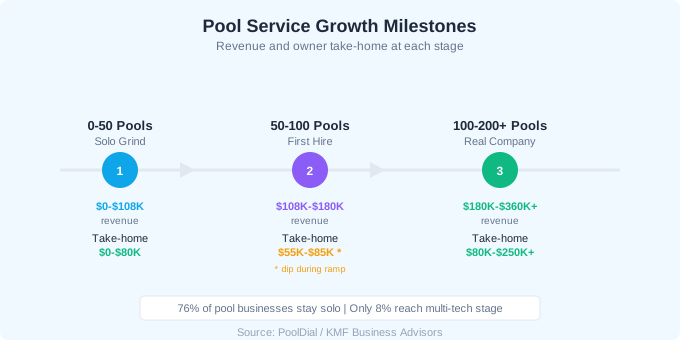
Phase One: 0-50 Pools. The Solo Grind.
From zero to 50 pools, the business is you. You are the tech, the salesperson, the bookkeeper, and the customer service department. This phase is about survival: getting enough customers to pay your bills, building a reputation, and figuring out your systems before you need them.
The primary constraint at this stage is time. A solo tech working five days per week can handle 50-70 pools on optimized routes. At 50 pools and $150/month, gross revenue is about $90,000 annually. After expenses, most solo operators take home $60,000-$75,000.
What Breaks at 30-50 Pools
- Your time runs out. At 50 pools you are servicing pools 8+ hours per day, five days per week. There is no time left for sales, admin, or equipment repairs without working weekends.
- Manual tracking fails. Tracking chemicals, customer notes, and billing in a notebook or basic spreadsheet starts producing errors. You miss a stop, double-bill someone, or forget a customer request.
- Quality slips on busy days. When your route is full and a green pool or equipment emergency appears, something has to give. You either rush stops or skip one entirely.
- You cannot take a day off. No backup means every sick day, vacation day, or family emergency means pools do not get serviced.
What to Fix Before Moving to Phase Two
- Get pool service software in place for scheduling, billing, and customer records. Do this before you hire, not after.
- Standardize your service process so it is teachable. Write down exactly what happens at every stop.
- Raise prices on any account below your minimum rate. You need margin to afford your first hire.
- Build a cash reserve of 2-3 months of operating expenses. Hiring is expensive and revenue does not double overnight.
Phase Two: 50-100 Pools. The First Hire.
The jump from solo to multi-tech is the hardest transition in pool service. You go from doing the work to managing someone who does the work. Your cost structure changes overnight. You now have payroll, workers comp, a second vehicle to maintain, and a human being whose quality of work reflects directly on your business.
A 2-person operation running 80-100 pools generates $144,000-$180,000 in annual revenue at $150/pool/month. But your margins tighten because you are adding $35,000-$45,000 in labor costs plus vehicle expenses, workers comp insurance, and additional chemical inventory.
55%
of pool service businesses planned to hire more employees in 2025
Source: Skimmer 2025 State of Pool Service Report
What Breaks at 60-100 Pools
- Quality control becomes a problem. Your tech does not clean pools the way you do. Without checklists and photo documentation, service quality varies by who is on the route.
- Communication gaps appear. Customer requests get lost between you and your tech. Equipment issues go unreported. Chemicals run low without warning.
- Cash flow gets tighter. You went from keeping everything you earn to splitting revenue across payroll, taxes, and increased overhead. Many owners feel poorer at 80 pools than they did at 50.
- Training takes longer than expected. A new tech needs 2-4 weeks of ride-alongs before they can run a route solo. That is 2-4 weeks of paying two people to do one person's work.
Do not hire when you are maxed out. Hire when you are at 80% capacity. You need time to train, and your new tech needs room to make mistakes without destroying your customer base.
Phase Three: 100+ Pools. Building a Real Company.
At 100+ pools with 2-3 techs, you are no longer a technician who has employees. You are a business owner who manages a service operation. This is where most pool companies either break through to real profitability or stall because the owner cannot let go of the day-to-day route work.
A 3-person operation with 150 pools generates $270,000 in annual revenue. A 4-5 person operation pushing past 200 pools can hit $360,000-$500,000+. More importantly, a 2-3 truck operation can produce $200,000-$400,000 in Seller's Discretionary Earnings (SDE), which is what the business is worth if you sell.
What Breaks at 100-150 Pools
- You are the bottleneck. Every decision runs through you. Every customer complaint, every supply order, every scheduling change. You cannot grow past what you can personally manage.
- Hiring becomes ongoing. Techs leave. Techs underperform. You need a pipeline for finding, training, and retaining people. One-off hiring does not work at this scale.
- Financial complexity increases. Payroll taxes, workers comp audits, multiple insurance policies, equipment depreciation. You need a bookkeeper or accountant, not just a bank account.
- Customer expectations outpace your systems. 150 customers means 150 different communication preferences, billing arrangements, and service histories. Without software handling most of this, you drown in admin.
What to Fix at This Stage
- Get off the route. Your job is to manage, sell, and grow. Every hour you spend cleaning pools is an hour not spent on higher-value work.
- Build repeatable hiring and training processes. Create a written onboarding manual and a 2-week training program.
- Delegate billing and customer communication to software or an office person. You should not be sending invoices manually at 100+ pools.
- Start tracking KPIs: revenue per tech, pools per day, churn rate, chemical cost per pool. You need data to manage at this scale.
What Financial Milestones Should You Hit at Each Stage?
Revenue is the number everyone focuses on, but the financial milestone that matters most at each stage is different. In Phase One, it is break-even. In Phase Two, it is margin preservation. In Phase Three, it is owner income independent of route work.
| Stage | Pool Count | Annual Revenue | Owner Take-Home |
|---|---|---|---|
| Solo startup | 0-30 | $0-$54K | $0-$40K |
| Solo optimized | 30-60 | $54K-$108K | $40K-$80K |
| First hire | 60-100 | $108K-$180K | $55K-$85K (dip during ramp) |
| Multi-tech | 100-200 | $180K-$360K | $80K-$150K |
| Small company | 200+ | $360K+ | $120K-$250K+ |
Notice the dip at "first hire." Your take-home often drops when you add your first employee because payroll and overhead jump before the additional pool count catches up. This is the valley of death for pool businesses. If you do not have a cash reserve, it can force bad decisions like rushing the tech onto solo routes before they are ready.
The jump from solo to multi-tech temporarily reduces your income. Plan for 3-6 months of lower take-home while your new tech ramps up. The payoff comes when they are running a full route and you are free to sell and grow.
What Decisions Unlock the Next Level of Growth?
At each stage, there are one or two decisions that unlock the next level. Get these right and growth accelerates. Miss them and you plateau.
| Current Stage | Key Decision | Why It Matters |
|---|---|---|
| 0-30 pools | Commit to a tight service area | Route density determines long-term profitability. Spreading out kills efficiency. |
| 30-50 pools | Raise prices to build margin | You need 15-25% margin to absorb the cost of your first hire. Underpriced accounts make scaling impossible. |
| 50-70 pools | Hire before you are maxed out | Training takes 2-4 weeks. If you wait until you are drowning, quality crashes during the transition. |
| 70-100 pools | Get off the truck | Every hour on the route is an hour not spent selling, managing, or building systems. Your highest-value work is no longer cleaning pools. |
| 100+ pools | Build systems, not heroics | The business needs to run without you doing everything. SOPs, software, and delegation are the only path forward. |
The hardest of these for most pool service owners is getting off the truck. You started this business because you are good at cleaning pools. The business needs you to be good at running a company instead. That is a fundamentally different skill set, and it feels uncomfortable until you see the results.
How Do You Know Which Stage You Are Really In?
Your stage is not just about pool count. It is about how your business operates. Some 40-pool operations run like Phase Two businesses because the owner has great systems. Some 80-pool operations run like Phase One because the owner still does everything manually.
- You are in Phase One if: You personally clean every pool, handle every customer call, send every invoice, and cannot take a day off without pools going unserviced.
- You are in Phase Two if: You have at least one employee on a route, but you are still heavily involved in day-to-day operations and quality control depends on you being present.
- You are in Phase Three if: Routes run without you on a truck. You have repeatable processes for hiring, training, and customer management. Your job is growing the business, not servicing it.
Be honest about where you are. The fixes for Phase One problems are different from Phase Two problems. Buying software will not fix a hiring problem. And hiring will not fix a pricing problem. Diagnose your actual stage, then apply the right solutions.
Ready to streamline your pool service business?
Pool Founder gives you route optimization, automated invoicing, chemical tracking, and everything else you need to run a more profitable pool business.
Frequently Asked Questions
How many pools can a solo pool tech handle?
A solo tech on optimized routes can handle 50-70 pools per week on a weekly service schedule. The sweet spot before quality suffers is around 55-65 pools. At that point you should be preparing to hire your first technician.
When should a pool service business hire its first employee?
Hire when you are consistently at 80% capacity (roughly 50-55 pools on a solo route) and turning away or delaying new customers. You need 2-4 weeks to train a new tech, so hiring at 80% gives you runway. Waiting until you are at 100% means quality drops during training.
How much does a pool service owner make at 100 pools?
With a multi-tech operation at 100 pools ($150/month each), gross revenue is about $180,000 annually. After payroll, chemicals, vehicles, and insurance, owner take-home is typically $55,000-$85,000. The lower end reflects the cost of a recent first hire. The higher end assumes the operation is stabilized.
What is the biggest mistake pool service owners make when growing?
Hiring too late and not having systems in place before the first hire. If you bring on a tech without standardized service procedures, route management software, and quality control checklists, you end up fixing their mistakes instead of growing the business.
How do pool service businesses scale past 100 pools?
The owner has to transition from doing the work to managing the work. That means getting off the truck, building repeatable hiring and training processes, using software for scheduling and billing, and tracking KPIs like revenue per tech and churn rate. Growth past 100 pools is a management challenge, not a labor challenge.