Key Takeaway
$120K - $210K
Annual revenue per technician range for pool service companies, depending on route density and service mix
Source: Financial Models Lab, industry broker data
15 - 25
Pool stops per technician per day on a well-optimized residential route
Source: Superior Pool Routes, operator surveys
$175
Average monthly revenue per residential pool service account nationally
Source: Pool & Hot Tub Alliance, AQUA Magazine
Revenue per technician (RPT) is the single best metric for measuring operational efficiency in a pool service company. It tells you whether your routes are dense enough, your pricing is high enough, and your techs are productive enough to generate the margin you need to grow. A technician running a full residential route of 100 accounts at $175 per month generates $210,000 in gross annual revenue. When RPT falls below $120,000 on a full-time route, something is broken in your scheduling, drive time, or account mix.
This report breaks down RPT benchmarks by company size, identifies the operational factors that drive higher or lower RPT, and shows how technology and route optimization directly impact the number. Whether you are evaluating your current team productivity or deciding when to hire your next technician, these benchmarks give you a concrete target to measure against.
What Is a Good Revenue Per Technician for Pool Service?
A good annual revenue per technician for a pool service company is $150,000 to $210,000 for a full-time tech running a residential maintenance route. Excellent operations push above $200,000 per tech by combining tight route density, higher-than-average pricing, and consistent upselling of repair work. Below $120,000 per tech signals that routes are too spread out, pricing is too low, or the technician is not completing enough stops per day.
| RPT Range (Annual) | Performance Level | Typical Cause |
|---|---|---|
| Under $100,000 | Poor | Part-time routes, excessive drive time, or underpricing |
| $100,000 - $120,000 | Below average | Low route density or too few accounts per route |
| $120,000 - $150,000 | Average | Standard residential routes with moderate density |
| $150,000 - $200,000 | Good | Dense routes, competitive pricing, some repair revenue |
| $200,000+ | Excellent | Tight routes, premium pricing, active upselling |
These benchmarks assume a full-time technician working five days per week, year-round (or with seasonal adjustment in northern markets). A single technician running 80 to 120 accounts at $150 to $200 per month hits the $150,000 to $210,000 range. The spread is driven primarily by pricing differences between markets and route density. A tech in Phoenix servicing $180/month accounts in a tight subdivision will hit $200,000+ easily. A tech in a rural market with $130/month accounts and 20-minute drives between stops may struggle to reach $120,000.
How Does RPT Vary by Company Size?
Revenue per technician tends to be highest for solo operators and decreases slightly as companies add technicians, then recovers once the operation reaches scale with proper management systems. The pattern exists because solo operators cherry-pick the densest, highest-paying routes, while growing companies must fill new routes that start with lower density. At scale, dedicated routing software and account managers restore RPT by optimizing across all routes simultaneously.
| Company Size | Typical RPT (Annual) | Stops Per Tech Per Day | Key Factor |
|---|---|---|---|
| Solo operator (1 tech) | $130,000 - $200,000 | 18 - 25 | Owner efficiency, densest routes |
| Small (2-3 techs) | $120,000 - $175,000 | 15 - 22 | New routes still filling, growing pains |
| Mid-size (4-7 techs) | $140,000 - $190,000 | 18 - 25 | Route optimization kicks in at scale |
| Large (8+ techs) | $150,000 - $210,000 | 20 - 25 | Dedicated routing, office management, repair upsells |
Why does RPT dip when you hire your second and third technician?
The RPT dip at the two to three technician stage is one of the most common growing pains in pool service. When you hire your second tech, you split your existing route or assign them new accounts that are geographically scattered. Their route is not as dense as yours was when you had 100 perfectly organized stops. It takes three to six months to fill a new route to capacity and optimize the stop order. During that ramp period, the new tech's RPT drags down your company average.
The solution to the RPT dip is not to delay hiring. It is to have 60 to 80 accounts ready before bringing on a new tech, and to use route optimization software to build the densest possible route from day one. Pool Founder's AI-powered route builder creates optimized routes automatically as you add accounts, eliminating the scattered-route problem.
What Drives Higher Revenue Per Technician?
Five factors explain 90% of the variance in RPT between pool service companies: route density, pricing, stops per day, service mix, and upsell revenue. The biggest lever is route density because it determines how many stops a tech can physically complete in a day. A tech who drives five minutes between stops instead of fifteen can service three to five more pools per day, which adds $6,000 to $12,000 in annual revenue per tech.
1. Route density (minutes between stops)
Route density is measured by average drive time between stops. Top-performing pool companies maintain an average of three to seven minutes between stops. At five minutes between stops, a tech can complete 22 to 25 pools in an eight-hour day. At fifteen minutes between stops, that drops to 12 to 16 pools. The revenue difference is $80,000 to $100,000 per tech per year. Route optimization software that minimizes drive time is the single highest-ROI technology investment for improving RPT.
2. Pricing per account
The national average for residential pool service is approximately $175 per month, but pricing varies from $125 to $250 depending on the market, pool size, and service level. A tech running 100 accounts at $200/month generates $240,000 annually vs. $150,000 at $125/month. Raising prices by $25 per account across a 100-pool route adds $30,000 in annual revenue with zero additional labor.
3. Stops completed per day
Productive pool technicians complete 15 to 25 stops per day depending on pool type, service scope, and drive time. The industry sweet spot is 18 to 22 stops for full-service residential maintenance. Below 15 stops per day, the tech is either driving too much or spending too long at each pool. Above 25 stops, service quality often suffers. Each additional stop per day at $175/month adds roughly $9,000 in annual revenue per tech.
4. Service mix (maintenance vs. repair)
Technicians who handle minor repairs in the field, like replacing a pump timer, swapping out a cartridge filter, or fixing a leaking o-ring, generate 15% to 30% more revenue per day than techs who only do maintenance. Repair work bills at $85 to $150 per hour vs. the $35 to $50 effective hourly rate of maintenance stops. Training techs to identify and upsell common repairs is one of the fastest ways to increase RPT.
5. Technology and mobile tools
Pool service companies using route optimization software report saving 30 to 60 minutes per tech per day in drive time, which translates to two to four additional stops and $18,000 to $36,000 in additional annual revenue per tech. Mobile service logging that takes seconds per stop (vs. minutes with paper) adds another one to two stops per day. The combined technology impact on RPT is $25,000 to $50,000 per tech per year.
How Do You Calculate Revenue Per Technician?
Revenue per technician is calculated by dividing total service revenue by the number of full-time equivalent (FTE) technicians. If your company generates $600,000 in annual service revenue with three full-time technicians, your RPT is $200,000. Part-time technicians should be converted to FTE equivalents. A tech working three days per week is 0.6 FTE.
| Metric | Formula | Example |
|---|---|---|
| Annual RPT | Total annual service revenue / FTE technicians | $600,000 / 3 techs = $200,000 |
| Monthly RPT | Total monthly service revenue / FTE technicians | $50,000 / 3 techs = $16,667 |
| Daily RPT | Daily service revenue / techs working that day | $2,500 / 3 techs = $833 |
| RPT per stop | Total service revenue / total stops completed | $600,000 / 15,600 stops = $38.46 |
Should you include repair revenue in RPT calculations?
Yes, but track it separately. Your total RPT should include all revenue generated by that technician (maintenance + repairs + chemical sales). But you should also know your maintenance-only RPT to benchmark route efficiency independently of repair volume. A tech with high total RPT but low maintenance RPT might have great sales skills but an inefficient route. A tech with high maintenance RPT but low repair revenue might have a great route but is missing upsell opportunities.
Track RPT monthly and review it with your team quarterly. A tech whose RPT drops 10% in a single month likely has route changes, excessive callbacks, or scheduling gaps that need immediate attention. Pool Founder's profitability dashboard shows RPT per technician in real time so you can spot problems before they compound.
What Is the Revenue Impact of Route Optimization on RPT?
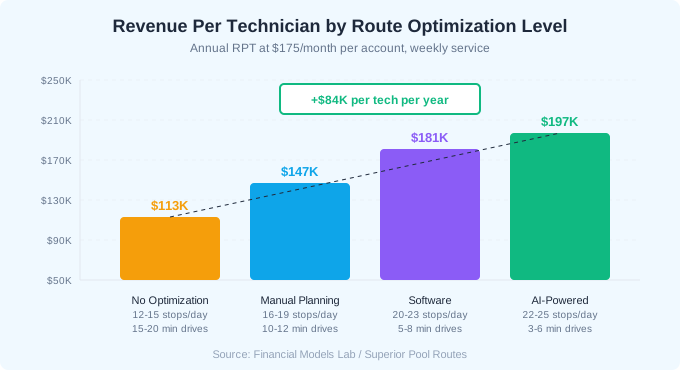
Route optimization is the highest-leverage tool for improving RPT because it attacks the biggest time waster in pool service: windshield time. A pool technician who spends two hours per day driving instead of three hours saves 250 hours per year. At an effective billing rate of $40 per stop, that recovered hour per day translates to two to three additional stops and $18,000 to $27,000 in additional annual revenue per technician.
| Scenario | Avg. Drive Between Stops | Stops Per Day | Annual Revenue Per Tech |
|---|---|---|---|
| No optimization (scattered) | 15 - 20 min | 12 - 15 | $100,800 - $126,000 |
| Basic optimization (manual) | 10 - 12 min | 16 - 19 | $134,400 - $159,600 |
| Software optimization | 5 - 8 min | 20 - 23 | $168,000 - $193,200 |
| AI-powered optimization | 3 - 6 min | 22 - 25 | $184,800 - $210,000 |
The table assumes $175/month per account with weekly service. The difference between no optimization and AI-powered optimization is $84,000 per tech per year. For a three-technician company, that is $252,000 in additional annual revenue from route efficiency alone. This is why route optimization software pays for itself within the first month for most pool service companies.
Pool Founder uses AI-powered route optimization that automatically rebalances routes as you add or remove customers. Operators report saving 30-60 minutes per tech per day in drive time, translating directly to higher RPT and more stops per day.
When Should You Hire Based on RPT Benchmarks?
The right time to hire a new technician is when your current techs are consistently completing 22 or more stops per day and your RPT exceeds $180,000 per tech annually. At that point, your routes are at capacity and turning away new customers costs more than the expense of a new hire. Hiring too early dilutes RPT and margin. Hiring too late means lost growth and burned-out technicians.
What RPT signals that you need another technician?
- Stops per day consistently above 22. Your tech is at capacity and adding more stops will degrade service quality.
- RPT above $180,000. Your routes are dense and profitable enough to split without killing margin.
- Waitlist of 10+ prospective customers. You are turning away revenue that a new tech could capture.
- Service complaints rising. Rushed stops lead to missed chemicals, skipped baskets, and unhappy customers.
- No capacity for repair work. Your maintenance route is so full that you cannot fit in the profitable repair jobs.
How do you maintain RPT when adding a new technician?
Accumulate 60 to 80 accounts before hiring so the new tech starts with a viable route. Reassign the most geographically scattered accounts from your existing routes to the new tech to improve density for everyone. Use route optimization software to rebuild all routes after the reassignment. Set a 90-day ramp target: the new tech should hit $10,000 per month in revenue by month three. Track their RPT weekly during the ramp period and adjust their route aggressively until density targets are met.
Corey Adams learned this lesson the hard way. When he hired his second technician, he split his perfectly dense route in half. Both halves immediately became less efficient because neither had the density of the original. The fix was rebuilding both routes from scratch using geographic clustering, which took two weeks of reorganization but restored RPT for both techs within 60 days.
Ready to streamline your pool service business?
Pool Founder gives you route optimization, automated invoicing, chemical tracking, and everything else you need to run a more profitable pool business.
Frequently Asked Questions
What is the average revenue per technician in pool service?
The average revenue per technician in pool service is $120,000 to $180,000 per year for a full-time tech on a residential maintenance route. Top-performing operations with dense routes and competitive pricing reach $200,000+ per tech. The primary drivers are route density, pricing per account, stops per day, and whether the tech also handles repair work.
How many pool stops should a technician complete per day?
A productive pool technician should complete 15 to 25 stops per day on a residential maintenance route. The industry sweet spot is 18 to 22 stops, which balances productivity with service quality. Techs completing fewer than 15 stops typically have route density problems or are spending too long at each pool. Above 25, service quality tends to decline.
How does route density affect revenue per technician?
Route density is the biggest driver of RPT. A tech with 5-minute drives between stops can complete 22-25 pools per day, generating $185,000-$210,000 annually. A tech with 15-minute drives completes only 12-15 pools per day, generating $100,000-$126,000. The difference is $84,000 per tech per year, which is why route optimization software has the highest ROI of any technology investment for pool companies.
When should a pool service company hire another technician?
Hire when your current techs consistently complete 22+ stops per day, RPT exceeds $180,000, and you have a waitlist of 10+ prospective customers. Have 60-80 accounts ready before the new hire starts so they begin with a viable route. Use route optimization software to rebuild all routes after adding the new tech to maintain density for everyone.
How does technology improve revenue per technician?
Route optimization software saves 30-60 minutes per tech per day in drive time, translating to 2-4 additional stops and $18,000-$36,000 in additional annual revenue per tech. Mobile service logging adds another 1-2 stops per day by replacing paper-based workflows. The combined technology impact on RPT is $25,000-$50,000 per tech per year.
Sources & References
- Financial Models Lab - Pool Maintenance KPIs and Revenue Benchmarks
- Financial Models Lab - Pool Maintenance Owner Income Analysis
- Superior Pool Routes - Technician Productivity Benchmarks
- ServiceTitan - Field Service Metrics for Tracking Performance
- Pool & Hot Tub Alliance - Industry Research and Data
- PoolDial - Pool Service Business Growth Stages