Why Are Referrals the Most Profitable Way to Grow a Pool Service Business?
Referral programs generate 3-5x higher conversion rates than other marketing channels according to referral marketing research. Wharton Business School found that referred customers are $0.45 more profitable per day than non-referred customers, their acquisition cost is $23.12 less, and companies with active referral programs see 86% more revenue growth year-over-year. For pool service companies specifically, referrals are even more valuable because a neighbor referring you to a neighbor adds route density, not just another account.
Despite these numbers, most pool service companies run referral programs badly or not at all. They mention referrals once and forget about it, offer vague incentives ("we'll take care of you"), never follow through on rewards, and wonder why nobody sends them business. This guide covers exactly how to structure, launch, and maintain a referral program that grows your route consistently.
What Referral Incentive Should You Offer?
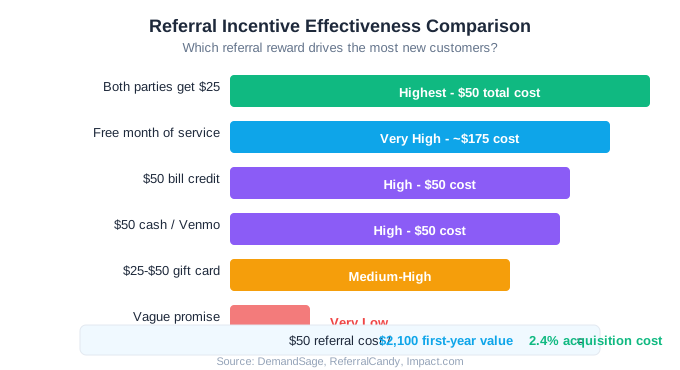
The incentive needs to be specific, valuable enough to motivate action, and simple enough to explain in one sentence. Research shows that cash or percentage discounts outperform points-based rewards by approximately 40% in conversion rate. For pool service, the most effective incentive is a direct credit applied to the referring customer's next bill.
| Incentive Type | Amount | Effectiveness | Cost to You |
|---|---|---|---|
| Bill credit for referrer | $25-$50 off next month | High | $25-$50 per acquisition |
| Bill credit for both parties | $25 off each | Highest | $50 per acquisition |
| Free month of service | 1 month free (~$175) | Very High | High, but locks in long-term customer |
| Cash payment | $50 check or Venmo | High | $50 per acquisition |
| Gift card | $25-$50 to local restaurant | Medium-High | $25-$50 per acquisition |
| Vague "we'll take care of you" | Unknown | Very Low | $0 (because nobody refers) |
The dual incentive (both the referrer and the new customer get a credit) consistently outperforms single-sided incentives. It gives the referring customer a tangible reason to bring it up with their neighbor AND gives the new customer a financial nudge to say yes. "$25 off your bill and $25 off their first month" is the sweet spot for most pool service companies.
Think about the math: a new weekly service customer at $175/month generates $2,100/year. Spending $50 total ($25 to each party) to acquire that customer means your referral acquisition cost is 2.4% of the first-year value. That is cheaper than any other marketing channel.
When Is the Best Time to Ask for Referrals?
Timing your referral ask dramatically affects participation rates. The best time to ask is immediately after a positive experience, when the customer is already in an advocacy mindset. There are specific trigger moments in the pool service relationship where a referral request feels natural rather than forced.
The Five Best Moments to Ask for a Referral
- 1Right after a customer compliments your service ("Thanks! Know anyone else who needs their pool taken care of? I'll give you both $25 off.")
- 2After leaving a positive Google review (they just went out of their way to praise you publicly, the referral ask is a natural extension)
- 3After resolving a problem quickly (a customer whose green pool you recovered in 48 hours is a powerful advocate)
- 4During the spring opening visit (excitement about pool season, talking to neighbors about summer plans)
- 5After their first 30 days of service (they have seen consistent quality and are telling friends about their "new pool guy")
Do not ask during the initial sales conversation, during a service complaint, or during billing discussions. These moments have the wrong emotional context. Wait until the customer is happy and engaged with your service.
The single best referral trigger for pool service: when a customer's neighbor comments on how good their pool looks. Train your customers to recognize this moment by saying: "If your neighbors ever ask about your pool, just send them my way and I'll knock $25 off your next month."
How Do You Actually Launch the Program?
A referral program launch does not need to be complicated. Over-engineering it delays the start and adds friction. You can launch with a text message, an email, and a conversation at the next service visit. Here is the step-by-step process.
Launch Week Checklist
- 1Define your incentive: "$25 off for you and $25 off for your friend when they sign up for weekly service"
- 2Create a simple tracking method: spreadsheet with columns for referring customer, referred name, signup date, and reward status
- 3Send a launch email to all current customers explaining the program in 3-4 sentences with clear terms
- 4Send a follow-up text message with the same offer (text gets higher open rates than email)
- 5Mention the program in person at every service visit for the next two weeks
- 6Print referral cards to leave at each house: your company info, the offer, and space for the referring customer's name
- 7Add the referral program to your website and email signature
Keep the terms simple. "Refer a friend who signs up for weekly service, and you both get $25 off next month. No limit on referrals." Complicated rules with restrictions, expiration dates, and fine print kill participation. Simple and generous wins.
How Do You Track Referrals Without Making It Complicated?
Tracking does not require software. A simple spreadsheet or note in your customer management system works fine for companies under 200 accounts. The key is capturing who referred whom, when the new customer signed up, and when the reward was fulfilled. Unfulfilled rewards are the fastest way to kill a referral program.
Simple Tracking Method
- Ask every new lead: "How did you hear about us?" Make this question mandatory in your intake process.
- If they mention a name, record it immediately. Do not rely on remembering later.
- Log the referral in a spreadsheet: date, referring customer, new customer name, service start date
- Set a reminder to apply the credit within 7 days of the new customer's first service
- Notify the referring customer when their credit is applied: "Your $25 referral credit has been applied to your next bill. Thanks for the recommendation!"
Fulfillment speed matters. Apply the reward within the first billing cycle after the new customer starts service. Delayed rewards make customers feel like the program is not real and stop referring. Quick fulfillment with a thank-you notification reinforces the behavior and encourages them to refer again.
If you use pool service management software, check if it has a referral tracking feature built in. Many modern platforms let you tag accounts with a referral source and automatically apply credits, eliminating the manual tracking work.
What Conversion Rate Should You Expect from Referrals?
The overall referral program conversion rate (percentage of referred leads who become paying customers) sits at 3-5% median across all industries, with top-performing programs hitting 8% or higher. Home services referrals convert even better because the recommendation comes with high trust and local relevance. For pool service specifically, expect 15-30% of referred leads to convert to paying customers, because the referral comes from a neighbor who can point at their own clean pool as proof.
| Metric | Average | Good Program | Great Program |
|---|---|---|---|
| Customers who refer at least once | 10-15% | 20-25% | 30%+ |
| Referred leads per active referrer | 1-2/year | 2-3/year | 4+/year |
| Referral lead-to-customer conversion | 15-20% | 20-30% | 30%+ |
| New customers from referrals per month | 1-2 | 3-4 | 5+ |
| Cost per acquisition via referral | $40-$60 | $30-$50 | Under $30 |
A realistic goal for a pool company with 50-80 weekly accounts and an active referral program: 3-5 new customers per quarter from referrals. That is 12-20 new customers per year at an acquisition cost of $25-$50 each, adding $25,200-$42,000 in annual recurring revenue. No other marketing channel offers that combination of low cost and high lifetime value.
3-5x
higher conversion rate for referred leads versus other marketing channels
Source: DemandSage Referral Marketing Statistics 2026
How Do You Keep the Program Active After Launch?
Most referral programs die within 60 days of launch. The initial burst of enthusiasm fades, customers forget the program exists, and the operator stops mentioning it. Keeping a referral program active requires regular reminders through multiple channels. Think of it like watering a plant, not lighting a firework.
Monthly Referral Program Maintenance
- Mention the program in every monthly or quarterly email newsletter
- Leave a referral card at each house once per quarter
- When a referral converts, text the referring customer: "Your neighbor just signed up! $25 credit on your next bill."
- Share referral success stories (with permission): "Thanks to [customer] for referring their neighbor on Oak St!"
- Run quarterly bonus promotions: "Double referral credit this month, $50 for you and $50 for your friend"
- Personally thank your top referrers once a year (a handwritten note goes further than you think)
The customers who refer the most are typically your longest-tenured, happiest accounts. Identify your top five referrers and treat them well. A small holiday gift, priority scheduling, or a handwritten thank-you card turns a good referrer into a referral machine who sends you 3-5 new customers per year.
What Are the Most Common Referral Program Mistakes?
Corey Adams has seen dozens of pool companies launch referral programs that fail. The failures are almost always the same mistakes repeated. Avoiding these gives you a significant head start over competitors whose referral programs exist only on a dusty flyer in their truck.
| Mistake | Why It Kills Referrals | Fix |
|---|---|---|
| Vague or no incentive | No motivation to take action | Specific dollar amount: "$25 off your next bill" |
| Not asking regularly | Customers forget the program exists | Mention it monthly via email, text, or in person |
| Slow or no reward fulfillment | Customers feel cheated, stop referring | Apply credit within one billing cycle, send confirmation |
| Too many rules and restrictions | Complexity creates friction and confusion | Keep terms to 2-3 sentences maximum |
| Only asking once at launch | One-time push has short shelf life | Systematic monthly reminders across all channels |
| Not tracking referral sources | Cannot measure ROI or identify top referrers | Ask every new lead "How did you hear about us?" |
| Requiring a contract from the new customer | Scares away the referred prospect | Let the new customer try month-to-month first |
Ready to streamline your pool service business?
Pool Founder gives you route optimization, automated invoicing, chemical tracking, and everything else you need to run a more profitable pool business.
Frequently Asked Questions
How much should you offer for a pool service referral?
$25-$50 credit for both the referring customer and the new customer is the most effective structure. The dual incentive outperforms single-sided rewards. At $50 total cost per referral, your acquisition cost is about 2.4% of the new customer's first-year revenue of $2,100.
What is a good referral conversion rate for pool service?
Expect 15-30% of referred pool service leads to become paying customers. This is significantly higher than the 3-5% median across all industries because pool service referrals come from trusted neighbors with visible proof (their own clean pool). A good program generates 3-5 new customers per quarter.
When is the best time to ask pool customers for referrals?
Ask immediately after a positive interaction: when they compliment your service, after they leave a good review, after you resolve a problem quickly, or during the spring opening visit. Do not ask during complaints or billing conversations.
How do you track pool service referrals?
Start with a simple spreadsheet logging the referring customer, referred name, signup date, and reward status. Ask every new lead "How did you hear about us?" and record the answer. Apply credits within one billing cycle and notify the referrer when it is applied.
Why do pool service referral programs fail?
The three most common reasons: vague incentives that do not motivate action, asking only once at launch instead of consistently, and slow or missing reward fulfillment. Keep the incentive specific and generous, remind customers monthly, and apply credits promptly.
Should you offer cash or a service credit for referrals?
Service credits are more cost-effective because the margin on a month of service is higher than the face value of the credit. A $25 service credit costs you roughly $10-$15 in actual labor and chemicals. Cash payments cost the full $25. However, some customers prefer cash. Test both and see which generates more referrals in your market.