Why Monthly Billing Is the Foundation of a Valuable Pool Business
Monthly billing is the single biggest operational change you can make to your pool service business. It smooths your cash flow, eliminates the invoice-chasing cycle, and directly increases what your business is worth when you sell it. Pool routes with 80% or more customers on autopay are considered "low risk" by buyers and command premium valuation multiples of 10x to 12x monthly recurring revenue, compared to 6x to 8x for routes billing per visit with manual collections.
Over half of small businesses are owed money from unpaid invoices at any given time, averaging $17,500 per business according to the 2025 Intuit QuickBooks Late Payments Report. In pool service, where the average residential account is $140 to $160 per month, just 10 late-paying customers can tie up $1,500 or more in receivables every single month. Monthly autopay billing eliminates that problem almost entirely.
Corey ran pool routes for 15 years before building Pool Founder. The shift from per-visit invoicing to monthly autopay billing was the single biggest improvement to his cash flow and quality of life as a business owner. This guide is built from that experience, backed by current industry data.
What Is the Recurring Revenue Model for Pool Service?
A recurring revenue model means your customers pay a fixed monthly fee for pool maintenance rather than being invoiced after each individual visit. The monthly rate covers a set number of weekly visits (typically four), labor, travel, and often a base chemical allowance. Customers are charged automatically on the same date each month, usually through a stored credit card or ACH payment on file.
This is different from per-visit billing, where you complete a service, generate an invoice, send it to the customer, and wait for payment. Per-visit billing creates a collection cycle for every single stop on your route. With 80 accounts, that can mean 80 invoices per week, 320 per month, each one a potential late payment or follow-up call.
| Factor | Per-Visit Billing | Monthly Recurring Billing |
|---|---|---|
| Invoices generated | 1 per visit (320+/mo for 80 accounts) | 1 per customer per month (80/mo) |
| Payment timing | After service, net 15-30 days | Automatic on billing date |
| Cash flow pattern | Volatile, seasonal swings up to 55% | Predictable, under 3% variance |
| Collections effort | Active: calls, emails, follow-ups | Passive: autopay handles it |
| Valuation multiple | 6-8x monthly revenue | 10-12x monthly revenue |
Businesses using recurring billing see up to a 30% increase in revenue stability, according to industry data from pool route brokers. The reduced risk of late payments simplifies financial planning and lets you make hiring, equipment, and growth decisions with confidence instead of guesswork.
How Does Monthly Billing Smooth Cash Flow?
Monthly billing eliminates the two biggest cash flow killers in pool service: seasonal revenue swings and late payments. On autopay, your revenue arrives on the same day every month regardless of weather, holidays, or whether a customer remembered to open your invoice. Up to 30% of pool service businesses face significant revenue drops during the off-season, but monthly billing spreads that income evenly across all 12 months.
What Does Seasonal Revenue Look Like Without Monthly Billing?
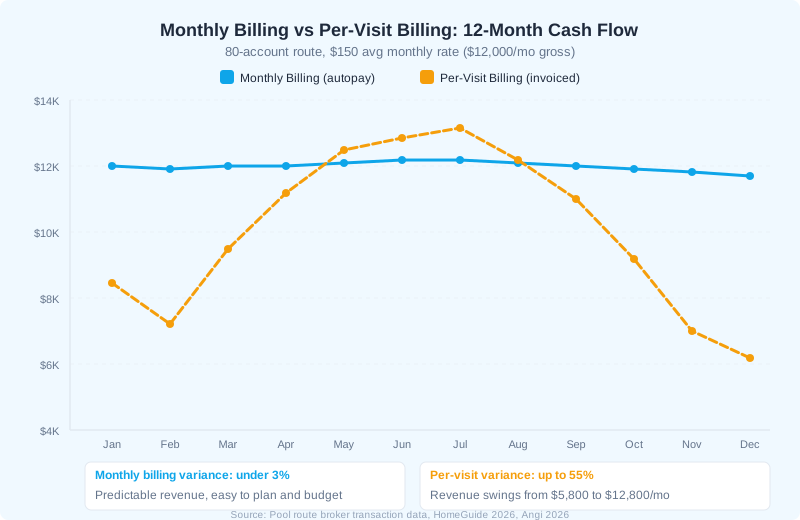
Without monthly billing, your revenue follows customer demand. Summer months spike as every pool gets weekly service. Winter months crater as customers skip visits, cancel temporarily, or disappear until spring. For a route billing per visit, revenue can swing from $12,800 in July down to $5,800 in December. That is a $7,000 monthly gap you have to cover with savings, credit, or side work.
Monthly billing changes this math completely. Customers pay the same rate year-round. Your January revenue looks almost identical to your June revenue. You still adjust visit frequency seasonally, but the billing stays flat. The result is a predictable income stream you can actually budget against, with variance under 3% month to month.
How Much Time Do Late Payments Actually Cost?
US small businesses receive payment an average of 8.2 days after the agreed-upon deadline, according to the 2025 Intuit QuickBooks Late Payments Report. For pool service companies billing per visit, that means every invoice you send is likely to arrive over a week late. With 320 invoices per month, even spending 5 minutes per follow-up on just the worst offenders adds up to hours of unpaid collections work every week.
56%
of small businesses are owed money from unpaid invoices at any given time
Source: Intuit QuickBooks 2025 Late Payments Report
Companies that automate their accounts receivable processes see a 22% reduction in days sales outstanding and process invoices 87% faster, according to Quadient. Autopay takes this even further by removing the invoice-and-wait cycle entirely. The customer card is charged. The payment clears. You move on.
How Do You Set Monthly Rates for Pool Service?
Setting a monthly rate starts with your per-visit cost and annual service schedule. You calculate your total annual revenue per customer under per-visit billing, then divide by 12 to get the flat monthly rate. This gives the customer a predictable bill and gives you predictable income, even during months when you visit less frequently.
What Is the Formula for Converting Per-Visit to Monthly Rates?
Take your per-visit rate, multiply it by the total number of visits you will perform across the entire year, then divide by 12. If you charge $45 per visit and service weekly during the 8-month peak season (32 visits) and biweekly during the 4-month off-season (8 visits), that is 40 visits per year. 40 visits times $45 equals $1,800 per year, divided by 12 equals $150 per month.
| Scenario | Per-Visit Rate | Annual Visits | Annual Revenue | Monthly Rate |
|---|---|---|---|---|
| Weekly year-round | $38 | 52 | $1,976 | $165 |
| Weekly peak + biweekly off-season | $45 | 40 | $1,800 | $150 |
| Weekly 8 months only | $50 | 32 | $1,600 | $133 |
| Florida (weekly, 52 weeks) | $35 | 52 | $1,820 | $152 |
The most transparent billing approach is a base service rate that covers time, travel, and expertise, with chemicals billed as a separate line item based on actual usage. This protects your margins when chemical costs spike and shows buyers exactly where your profit comes from.
Should You Include Chemicals in the Monthly Rate?
Pool route brokers recommend separating chemicals from your base service rate. When you bundle everything into one flat fee, your margin erodes every time chemical costs go up. Separating them protects your profit and makes your route more attractive to buyers. According to Sealey Business Brokers, routes that bill "Base Service + Chemicals" are "significantly more attractive" because the buyer can see that profit is protected regardless of chemical price changes.
A common structure is a $120 to $150 base monthly rate for service, plus $20 to $40 per month for chemicals based on actual usage. The customer still gets one monthly charge, but your books show the breakdown clearly. This matters both for daily operations and for eventual sale.
How Does Monthly Billing Reduce Collections Headaches?
Monthly autopay billing reduces collections work to near zero by removing the manual invoice-and-wait cycle entirely. Instead of generating hundreds of invoices and chasing payments, you store a card or bank account on file and charge it automatically each month. The customer agrees once. Every future payment happens without anyone lifting a finger.
What Collection Rate Can You Expect with Autopay?
Customers enrolled in autopay pay on time every cycle without follow-up. Companies using automated AR processes report a 29% reduction in bad debt write-offs and a 22% drop in days sales outstanding, according to Quadient and Resolve Pay. For a pool service company, this translates directly into fewer awkward phone calls, fewer "the check is in the mail" conversations, and more time on the truck or growing your business.
29%
reduction in bad debt write-offs with automated billing
Source: Resolve Pay 2025
How Do You Get Existing Customers onto Autopay?
The transition does not have to happen overnight. Start with new customers by making autopay the default for every new account. For existing customers, roll it out in batches. Send a clear email explaining the change, give 30 days notice, and offer a small incentive if needed. Many pool companies offer a $5 to $10 monthly discount for autopay enrollment, which pays for itself many times over in eliminated collections time.
- 1Make autopay the default for all new customers starting immediately
- 2Send existing customers a 30-day notice explaining the switch to monthly autopay billing
- 3Offer a small discount ($5-$10/month) as an incentive for early enrollment
- 4Follow up personally with your top 20% of accounts by revenue to ensure smooth transition
- 5Set a firm cutoff date. After that date, all accounts are on autopay or they receive a convenience fee for manual billing
Within 60 to 90 days, most companies can get 80% or more of their accounts onto autopay. The remaining holdouts typically come around once they see how easy it is, or when they realize the convenience fee for manual billing is not worth the hassle.
How Does Recurring Revenue Affect Your Business Valuation?
Recurring revenue is the single strongest driver of valuation multiple expansion for service businesses. A project-based service company might sell for 2x to 3x seller discretionary earnings (SDE), while a similar business with 60% recurring revenue can sell for 4x to 5x SDE, according to BisValue. In pool service specifically, the difference between per-visit billing and monthly recurring billing can mean a 30% to 50% increase in what your route sells for.
What Valuation Multiples Do Pool Routes Command?
Pool routes are valued at a multiple of monthly recurring revenue, typically between 6x and 12x. The multiple depends on autopay penetration, customer retention, route density, and how dependent the route is on the owner. Routes with 80% or more autopay penetration and 90% or higher annual customer retention consistently command the top end of that range at 10x to 12x, according to Sealey Business Brokers and DealStream.
| Route Characteristic | Typical Multiple | Example Value (80 accounts, $12K/mo) |
|---|---|---|
| Per-visit billing, manual collections | 6-8x | $72,000-$96,000 |
| Monthly billing, partial autopay (50-79%) | 8-10x | $96,000-$120,000 |
| Monthly billing, 80%+ autopay | 10-12x | $120,000-$144,000 |
| Monthly billing, 95%+ autopay, systems-driven | 12x+ | $144,000+ |
The math is straightforward. An 80-account route generating $12,000 per month is worth $72,000 at a 6x multiple (per-visit billing, manual collections) or $144,000 at a 12x multiple (monthly autopay, high retention, systems-driven). Same route, same customers, same revenue. The billing model alone can double the sale price.
Buyers price uncertainty. When revenue repeats with clear renewal behavior, the buyer can model the future with fewer assumptions. Per-visit revenue depends on pipeline timing and seasonal demand, so buyers apply a larger "risk discount" even when headline revenue looks impressive.
Why Do Buyers Pay More for Recurring Revenue?
Buyers pay more because recurring revenue is predictable. A route with 80 customers on monthly autopay has a known, bankable income stream. The buyer knows exactly how much revenue will arrive next month. With per-visit billing, the buyer has to estimate future demand, account for seasonal drops, and budget for collections overhead. That uncertainty translates directly into a lower offer price.
This pattern holds across every service industry. In the alarm security industry, one-time installation fees are valued at just 0.75x revenue, while recurring monitoring services are valued at 2.00x revenue, a 2.67x premium for the recurring component. Pool service is no different. Most service businesses trade between 3.0x and 6.0x EBITDA, but those with strong recurring revenue consistently exceed that range, according to KMF Business Advisors.
How Do You Transition from Per-Visit to Monthly Billing?
Transitioning your entire customer base from per-visit to monthly billing takes planning, but the process is simpler than most owners expect. The key is to communicate clearly, set firm deadlines, and use software that automates the billing itself so you are not creating a bigger administrative burden during the switch.
What Is the Step-by-Step Process for Switching?
- 1Calculate your monthly rates. Use the annual-revenue-divided-by-12 formula for each customer based on their current service plan and visit frequency.
- 2Set up billing software with autopay. Choose a platform that supports stored payment methods, automatic recurring charges, and customer notifications. Pool Founder handles all of this in one-click billing.
- 3Notify customers 30 days in advance. Send a clear, professional email explaining the change, the new monthly rate, and the benefits to them (predictable cost, no surprise invoices, priority service).
- 4Collect payment methods. Include a link to your customer portal where they can enter their card or bank account information. Make it as frictionless as possible.
- 5Start new customers on monthly autopay immediately. Every new account from this point forward should default to monthly billing with a card on file.
- 6Set a cutoff date for existing customers. After 60-90 days, all accounts move to monthly billing. Holdouts receive a convenience fee for manual invoicing or transition off your route.
How Do You Handle Customers Who Resist the Change?
Most resistance comes from customers who do not understand the change or assume it will cost them more. Address this head-on. Show them their annual cost under both models. In most cases, the monthly rate is equal to or lower than what they were paying per visit because you can offer a small discount for the payment guarantee. Frame the change as a benefit: no more surprise invoices, no more writing checks, automatic service without any effort on their end.
For the small percentage who refuse, set a convenience fee for manual billing ($10 to $15 per month). This covers your additional administrative cost for generating, sending, and tracking individual invoices. Most holdouts will switch to autopay within one billing cycle once they see the fee.
What Tools Make Monthly Billing Work?
Monthly recurring billing requires software that can store payment methods securely, charge customers automatically on a set schedule, handle failed payment retries, and send receipts without manual intervention. Trying to run monthly billing with manual processes defeats the purpose. The goal is to remove yourself from the billing cycle entirely.
What Should Pool Service Billing Software Include?
- Stored payment methods with PCI-compliant card and ACH storage
- Automatic recurring charges on a set billing date each month
- Failed payment retries that automatically reattempt declined cards
- Customer notifications with automatic receipts and payment confirmations
- Customer portal where customers can update their own payment information
- Reporting that shows collection rates, outstanding balances, and autopay enrollment percentage
Pool Founder's billing system was built specifically for this workflow. Customers are enrolled in autopay during onboarding, invoices generate automatically based on your service schedule, and payments are collected without any manual steps. The owner dashboard shows your autopay enrollment rate, collection rate, and outstanding receivables in real time.
Digital payment adoption in the pool service industry sits at an estimated 40-45%. Companies that move to 80%+ autopay enrollment put themselves in the top tier of operational efficiency and route valuation.
Ready to streamline your pool service business?
Pool Founder gives you route optimization, automated invoicing, chemical tracking, and everything else you need to run a more profitable pool business.
Frequently Asked Questions
How much does a pool service company charge per month?
Most residential pool service companies charge $140 to $160 per month for weekly maintenance in 2026, according to HomeGuide and Angi. Rates vary by region, pool size, and whether chemicals are included. Florida-style markets average $150 per month for weekly service.
Is monthly or per-visit billing better for pool service?
Monthly billing is better for both the business and the customer. The business gets predictable cash flow with under 3% monthly variance, eliminates collections overhead, and commands higher valuation multiples (10-12x vs 6-8x). The customer gets predictable costs with no surprise invoices.
How do you get pool customers to switch to autopay?
Start by making autopay the default for all new customers. For existing customers, send a 30-day notice explaining the change, offer a small discount ($5-$10/month) for enrollment, and set a firm cutoff date. Most companies reach 80%+ autopay enrollment within 60-90 days.
How much more is a pool route worth with recurring revenue?
Pool routes with monthly autopay billing and 80%+ autopay penetration typically sell for 10-12x monthly recurring revenue, compared to 6-8x for routes using per-visit billing. For an 80-account route generating $12,000 per month, that is the difference between a $72,000 and $144,000 sale price.
Should pool service companies include chemicals in the monthly rate?
Pool route brokers recommend billing chemicals separately from your base service rate. This protects your margin when chemical costs rise and makes your route more attractive to buyers, who can see that profit is protected regardless of chemical price changes. A common structure is $120-$150 base rate plus $20-$40 for chemicals.
What percentage of pool service customers should be on autopay?
Industry benchmarks consider 80% or more autopay enrollment as "low risk" for route valuation purposes. Routes with 95%+ autopay penetration command premium multiples of 12x or higher. Digital payment adoption across the pool service industry is currently estimated at 40-45%, so reaching 80%+ puts you well ahead of average.
Sources & References
- Intuit QuickBooks — 2025 US Small Business Late Payments Report
- Sealey Business Brokers — Pool Route Valuation Guide
- BisValue — Recurring Revenue vs Project Revenue Valuation
- KMF Business Advisors — EBITDA Multiples for Service Businesses 2026
- DealStream — Pool Service Business Rules of Thumb
- HomeGuide — 2026 Pool Maintenance Costs
- Angi — Pool Maintenance Cost 2026
- Quadient — 20 Key AR Statistics Shaping Accounts Receivable 2025
- Resolve Pay — 17 Statistics Linking AR Automation to Lower Bad Debt
- ClearlyAcquired — How Recurring Revenue Impacts Business Valuation
- Pool Pros National — Pool Service Pricing Structures