Raising Prices Is Not the Problem. Communicating It Badly Is.
Every pool service business needs to raise prices. Chemical costs go up. Fuel goes up. Insurance premiums increase. If your rates stay flat year over year, your profit margin shrinks until you are working harder for less money. The question is not whether to raise prices. It is how to tell your customers without losing them.
Most pool service owners dread the price increase conversation. They delay it for years, lose margin every month, and then deliver the news so poorly that customers leave anyway. A well-written price increase letter, sent at the right time and framed around value, retains 95-98% of your customer base while protecting your business.
95-98%
of customers typically stay after a reasonable 5-10% price increase with proper notice
Source: Service Autopilot Pool Service Pricing Guide
Corey Adams, Pool Founder co-founder and 15-year pool service veteran, sends annual price increases to every customer. "I send my increase letter every January. Same time every year. My customers expect it now. I lose maybe 2-3 accounts out of 200. The revenue from the increase more than covers the loss."
When Is the Best Time to Send a Price Increase Letter?
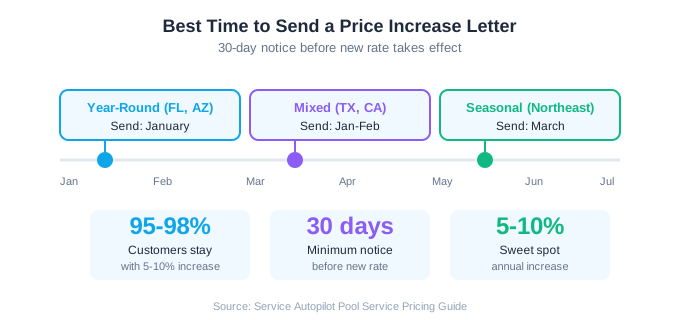
Send your price increase letter 30 days before the new rate takes effect. This gives customers enough time to process the change and adjust their budget. Springing a price increase on the same invoice it takes effect creates complaints and cancellations that could have been avoided.
The best timing depends on your market. In year-round markets like Florida and Arizona, January or February works well because it is the slow season and customers have time to consider it before peak season. In seasonal markets, send it before the season starts so the new rate is already in place when service resumes.
| Market Type | Best Time to Send | Effective Date | Why |
|---|---|---|---|
| Year-round (FL, AZ) | January | February 1 | Slow season, low emotions, before peak |
| Seasonal (Northeast) | March | April 1 (season start) | New rate from day one of service |
| Mixed (TX, CA) | January-February | March 1 | Before spring ramp-up |
Never raise prices right after a service issue. If you had a missed stop, a water chemistry problem, or a customer complaint in the last 30 days, resolve that first. Raising prices when a customer is already unhappy is the fastest way to lose them.
Version 1: The Short Email (For Most Customers)
This version works for email delivery to your general customer base. It is direct, respectful, and takes 30 seconds to read. Most customers do not need a long explanation. They need to know the new price, when it starts, and a brief reason why.
Subject: Update to Your Pool Service Rate<br><br>Hi [Customer Name],<br><br>Thank you for being a valued customer of [Company Name]. I wanted to give you advance notice that your monthly pool service rate will adjust from [current rate] to [new rate], effective [date].<br><br>This adjustment reflects increased costs for chemicals, fuel, and insurance that have gone up over the past year. We remain committed to the same high-quality service you have come to expect from our team.<br><br>If you have any questions, please do not hesitate to reach out. We appreciate your continued trust in our service.<br><br>Best regards,<br>[Your Name]<br>[Company Name]<br>[Phone Number]
This email follows the key principles: lead with the new price and effective date, briefly explain why, keep the tone professional and respectful, and close by thanking the customer. Do not over-explain or apologize. You are running a business, and cost increases are normal.
Version 2: The Detailed Letter (For Long-Term and High-Value Customers)
Some customers deserve a more detailed communication. Long-term accounts, high-value customers, and anyone paying a premium rate should get more context. This version frames the increase around the value they receive and the costs that have changed.
Subject: Important Update Regarding Your Pool Service<br><br>Dear [Customer Name],<br><br>As we head into [year/season], I want to personally update you on some changes to our service rates. Effective [date], your monthly pool service rate will adjust from [current rate] to [new rate].<br><br>Over the past year, several of our operating costs have increased significantly:<br>- Pool chemical costs have risen 10-15% across all major suppliers<br>- Fuel prices remain elevated, affecting every route we run<br>- Insurance premiums increased at our annual renewal<br>- Technician wages have increased to retain our experienced team<br><br>Despite these increases, we have held our rates steady for [time since last increase]. This adjustment allows us to continue providing the thorough, reliable service your pool requires without cutting corners.<br><br>Here is what continues to be included in your service:<br>- Weekly full-service maintenance with chemical treatment<br>- Water chemistry testing and balancing at every visit<br>- Equipment inspection and basic troubleshooting<br>- Digital service reports after each visit<br>- Priority scheduling for repairs and add-on services<br><br>Your pool is important to us, and maintaining the quality you expect is our top priority. If you would like to discuss this change or have any questions about your service, I am always available by phone or email.<br><br>Thank you for your continued trust in [Company Name]. We look forward to another great year of keeping your pool in excellent condition.<br><br>Sincerely,<br>[Your Name], Owner<br>[Company Name]<br>[Phone] | [Email]
The detailed letter does three things the short email does not. It itemizes the specific costs that increased (giving the customer a rational basis for the change). It lists the services they continue to receive (reinforcing value). And it includes a personal touch from the owner (building relationship).
How Much Should You Raise Prices?
Annual increases of 5-10% are the sweet spot for pool service. At $150/month, a 5% increase is $7.50/month. A 10% increase is $15/month. Most customers absorb these amounts without serious pushback. Going above 10% in a single increase requires a stronger justification or risks losing accounts.
| Current Rate | 5% Increase | 8% Increase | 10% Increase |
|---|---|---|---|
| $120/mo | $126 | $130 | $132 |
| $150/mo | $158 | $162 | $165 |
| $180/mo | $189 | $194 | $198 |
| $200/mo | $210 | $216 | $220 |
If you have not raised prices in two or more years, a single 10-15% increase may be necessary. Frame it clearly: "It has been two years since our last rate adjustment, and operating costs have increased significantly during that time." Customers understand that holding prices for two years was a benefit they already received.
Round your new rate to clean numbers. $150 to $160 feels cleaner than $150 to $157.50. Customers perceive round numbers as more deliberate and professional.
What Mistakes Should You Avoid in a Price Increase Letter?
The way you communicate a price increase matters as much as the amount. These are the most common mistakes pool service owners make that turn a routine business update into a customer retention crisis.
- Do not apologize. "I'm sorry to inform you" makes it sound like you did something wrong. Price increases are normal business. State the facts confidently.
- Do not blame the customer. "Due to the increased time your pool requires" singles the customer out and invites an argument. Frame increases as company-wide adjustments.
- Do not bury the number. Start with the new price and effective date. Hiding it in paragraph three makes it feel sneaky. Transparency builds trust.
- Do not raise prices on the same day you send the letter. Same-day increases feel like ambushes. A 30-day notice period is the minimum for maintaining trust.
- Do not negotiate individually. If one customer talks you down, word spreads. Apply the increase uniformly across all accounts. The only exception is a genuine hardship situation where you choose to make a goodwill adjustment.
- Do not over-explain. A five-paragraph essay about your rising costs sounds defensive. State the increase, give a brief reason, and move on.
How Do You Handle Customer Pushback?
Expect 5-10% of customers to contact you about the increase. Most are just acknowledging it, not threatening to leave. Of those who do push back, most will stay if you respond calmly and professionally. Here is how to handle the three most common responses.
"That is too much. Can you keep my old rate?"
"I understand, and I appreciate your loyalty. This adjustment applies across all of our accounts to keep our service quality consistent. I would be happy to review your current service plan to make sure you are getting the best value for your needs." Do not cave. If you give one customer the old rate, you will have to give everyone the old rate.
"I can find someone cheaper."
"I understand price is a factor. We have built our service around reliability, thoroughness, and consistent water chemistry, which is why many of our customers have been with us for years. If you do decide to look around, we are always here if you want to come back." Let them go. Price shoppers churn regardless.
"I want to cancel."
"I am sorry to hear that. I will process your cancellation effective [date]. If your situation changes, we would be glad to have you back." Be gracious. Many cancelled customers return within 2-3 months after trying a cheaper provider and getting worse service.
2-5%
of customers typically cancel after a reasonable price increase, and the revenue gain from the remaining 95-98% more than offsets the loss
Source: Service Autopilot Pool Service Pricing Guide
Should You Raise Prices Every Year?
Yes. Annual price increases should be a standard part of your business operations, not a panic response to rising costs. When you raise prices every year, customers expect it. It becomes routine rather than surprising. And small annual increases are far easier to absorb than a large catch-up increase after three years of flat rates.
- Set a calendar reminder. Pick a month (January works for most markets) and send your increase letter at the same time every year.
- Track your cost increases. Keep a running total of how much your chemicals, fuel, insurance, and labor costs have changed over the year. This gives you the data to justify the increase if anyone asks.
- Match inflation at minimum. Even a 3-5% annual increase keeps your revenue growing with the cost of living. Flat pricing in an inflationary environment means you take a pay cut every year.
- Communicate value year-round. Service reports, proactive communication about water chemistry, and responsive customer service make price increases feel justified. If the only time you communicate is to ask for more money, pushback will be higher.
Think of it this way: at 100 pools and $150/month, a 5% annual increase adds $750/month or $9,000/year to your revenue. If you lose 3 customers (2-3% churn), you lose $5,400/year. Net gain: $3,600/year. And you can fill those 3 spots with new customers at the higher rate.
Ready to streamline your pool service business?
Pool Founder gives you route optimization, automated invoicing, chemical tracking, and everything else you need to run a more profitable pool business.
Frequently Asked Questions
How much notice should you give for a pool service price increase?
Give at least 30 days notice before the new rate takes effect. This is the industry standard and gives customers time to process the change. Sending the letter 30-45 days in advance is ideal. Same-day or same-week notice creates complaints and cancellations that could have been avoided.
How often should a pool service company raise prices?
Annually. Small annual increases of 5-10% are far easier for customers to absorb than large catch-up increases every 3-5 years. Set a consistent time each year (January or February for year-round markets, pre-season for seasonal markets) and make it routine.
What percentage of customers leave after a price increase?
A reasonable 5-10% price increase with proper 30-day notice typically results in 2-5% customer churn. The revenue gained from the 95-98% who stay more than offsets the lost accounts. The customers who leave over a small price increase are usually the lowest-value accounts.
Should I send a price increase letter by email or mail?
Email works for most customers and is faster, cheaper, and trackable. Use a physical letter for high-value accounts, customers you know do not check email, or any customer you have had for 5+ years where a personal touch matters. Some companies send both to ensure the message is received.
How do I justify a pool service price increase to customers?
Reference specific cost increases that are easy for customers to understand: chemical costs, fuel prices, insurance premiums, and technician wages. Do not apologize or over-explain. State the new price, give a brief reason, and reinforce the value of the service they receive. Most customers understand that prices go up over time.
What if I have not raised prices in three years?
A 10-15% increase may be needed to catch up. Frame it clearly: "Our rates have remained unchanged for three years while operating costs have increased significantly." If a 15% jump feels too steep, consider a two-step approach: 8-10% now and another 5-7% in six months.
Sources & References
- Service Autopilot: How to Successfully Complete a Pool Service Price Increase
- Jobber Academy: Price Increase Letter Tips and Templates
- CPO Class: Sample Pool Service Price Increase Letter
- HouseCall Pro: How to Write a Price Increase Letter
- InvoiceQuick: How to Inform Customers of a Price Increase (2025 Guide)