Why Do Pool Service Companies Need Non-Compete Agreements?
Non-compete agreements in pool service exist because your customer list is your most valuable asset. A tech who runs 80 pools on your route for two years knows every customer by name, knows their gate codes, knows their pool quirks, and knows exactly what they pay. When that tech leaves and starts their own company or joins a competitor, they can take 30 to 50 of those customers in a month. At $150 per month per pool, that is $54,000 to $90,000 in annual recurring revenue walking out your door.
The problem is that non-compete agreements are governed by state law, and the rules vary dramatically. California bans them entirely. Minnesota passed a complete ban effective July 2023. Florida enforces them aggressively. Texas enforces them with limitations. The FTC attempted a federal ban in 2024, but after court challenges, the commission voluntarily dismissed its final appeal in September 2025 and abandoned the nationwide rule entirely. That means enforcement remains a state-by-state patchwork, and getting it wrong means your agreement is worthless when you need it most.
Corey Adams, Pool Founder co-founder and 15-year pool service veteran, has seen both sides of non-compete disputes. This guide covers the current legal landscape, what courts actually enforce for service businesses, and practical alternatives that protect your customer base even in states that ban non-competes.
Which States Ban or Restrict Non-Compete Agreements?
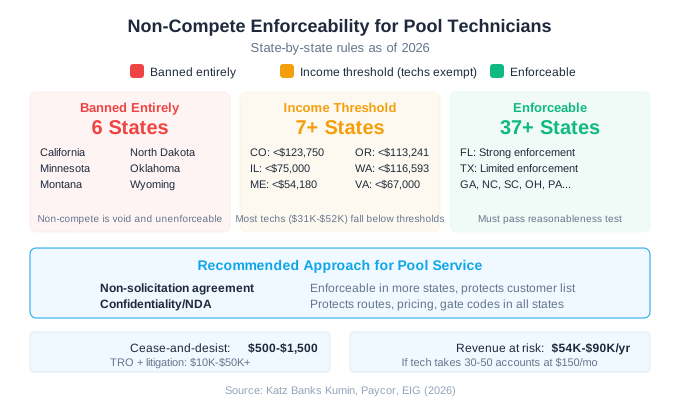
The enforceability of non-compete agreements varies by state, and the landscape continues to shift. As of 2026, six states ban non-competes entirely, several impose income thresholds or duration limits, and the rest enforce them if they meet reasonableness standards. Pool service owners need to know their state is rules before drafting an agreement.
States That Ban Non-Competes Entirely
California, Minnesota, Montana, North Dakota, Oklahoma, and Wyoming prohibit non-compete agreements in employment. In these states, a non-compete clause in your employee agreement is void and unenforceable. California is particularly strict: even asking an employee to sign one can expose you to liability. If you operate in these states, skip to the section on non-solicitation agreements, which are your alternative.
States With Significant Restrictions
| State | Key Restriction | Practical Impact |
|---|---|---|
| Colorado | Banned for employees earning under $123,750/year | Most pool techs are exempt, only managers may qualify |
| Illinois | Banned for employees earning under $75,000/year | Most pool techs are exempt from non-competes |
| Maine | Banned for employees earning under $54,180/year | All hourly pool techs are exempt |
| Maryland | Banned for employees earning under $19.88/hour | Most entry-level techs are exempt |
| Oregon | Banned for employees earning under $113,241/year | Nearly all pool techs are exempt |
| Virginia | Banned for low-wage employees under $67,000/year | Many techs are exempt |
| Washington | Banned for employees earning under $116,593/year | Nearly all pool techs are exempt |
In states with income thresholds, most pool technicians earning $15 to $25 per hour ($31,200 to $52,000 annually) fall below the threshold and cannot be bound by non-competes. The agreements may still apply to route managers, operations managers, and other higher-earning roles.
What Makes a Pool Service Non-Compete Enforceable?
In states that allow non-competes, courts apply a "reasonableness" test. A non-compete must protect a legitimate business interest, be reasonable in scope, duration, and geographic area, not impose undue hardship on the employee, and not harm the public interest. For pool service companies, the legitimate business interest is typically your customer relationships and confidential business information like route details and pricing.
Duration Limits
Courts generally enforce non-competes lasting 6 months to 2 years. For pool service, 12 months is the sweet spot. It covers one full seasonal cycle and gives you time to solidify the customer relationship with a new tech. Agreements lasting more than 2 years are frequently struck down as unreasonable for service businesses where the skill set is readily transferable.
Geographic Scope
Geographic restrictions must match your actual service area. If your routes cover a 25-mile radius from your shop, a 25-mile non-compete is defensible. A 100-mile radius when you only service one county will not hold up. Some pool service companies define the restriction by listing the specific zip codes or municipalities where they operate, which is more precise and more enforceable than a radius.
Activity Scope
The non-compete should be limited to pool service and related activities, not all employment. A court will not enforce an agreement that prevents a pool tech from working in any capacity. The restriction should specifically prohibit providing pool cleaning, maintenance, repair, and chemical treatment services to customers served by the tech during their employment.
The narrower your non-compete, the more likely a court will enforce it. A 12-month restriction covering pool service within your service area for customers the tech directly served is far more enforceable than a 2-year blanket ban on working in pool service anywhere in the state.
Are Non-Solicitation Agreements a Better Option?
Non-solicitation agreements are enforceable in more states and are often a better fit for pool service companies. While a non-compete prevents a former employee from working in the industry altogether, a non-solicitation agreement only prevents them from contacting or soliciting your specific customers. The employee is free to start their own pool business or join a competitor as long as they do not poach your existing accounts.
Why Non-Solicitation Works Better for Pool Service
- Enforceable in more states, including several that restrict or ban non-competes
- Protects what matters most: your customer relationships and route revenue
- Courts view them as less restrictive, making enforcement more likely
- Employees are more willing to sign because they can still work in the industry
- Focuses on the specific harm you are trying to prevent: customer theft
How to Structure a Pool Service Non-Solicitation Agreement
A strong non-solicitation agreement for pool service should prohibit the former employee from directly or indirectly soliciting, contacting, or providing pool service to any customer they personally serviced or had access to customer information for during their employment. Duration should match your non-compete terms: 12 months is standard. Include a provision that the employee will not use your customer lists, route sheets, pricing information, gate codes, or other confidential business information.
Even in California, which bans non-competes, you can protect trade secrets and confidential information under the California Trade Secrets Act. Customer lists, pricing data, and route information may qualify as trade secrets if you take reasonable steps to keep them confidential.
What Happens When a Former Employee Violates a Non-Compete?
Enforcement is where most pool service owners drop the ball. Having a signed non-compete means nothing if you do not enforce it. When a former tech starts soliciting your customers, you need to act quickly, typically within 30 to 60 days, or a court may view your delay as evidence that you did not consider the non-compete important enough to enforce.
Enforcement Steps
- 1Send a cease-and-desist letter: Have an attorney send a formal letter referencing the specific agreement, the prohibited conduct, and demanding immediate compliance. This resolves many situations without litigation.
- 2Document the violation: Gather evidence of which customers were contacted or taken. Customer statements, service records showing account transfers, and social media posts are common evidence.
- 3File for a temporary restraining order (TRO): If the former employee ignores the cease-and-desist, file for a TRO to immediately stop the solicitation while litigation proceeds.
- 4Pursue damages: You can recover lost profits from customers who left, the cost of acquiring replacement customers, and in some cases attorney fees if your agreement includes a prevailing party clause.
Enforcement costs vary. A cease-and-desist letter runs $500 to $1,500. Filing for a TRO and pursuing litigation can cost $10,000 to $50,000 or more. Factor this into your risk calculation. If a departing tech takes 40 accounts worth $72,000 per year, the enforcement cost is justified.
How Should You Protect Confidential Business Information?
Regardless of whether your state allows non-competes, you should always have a confidentiality agreement (also called a non-disclosure agreement or NDA) with every employee. Customer lists, route sheets, pricing information, gate codes, and service history are all confidential business information. A confidentiality agreement prevents former employees from using or sharing this information even if they are free to compete.
What Qualifies as Confidential in Pool Service
- Customer names, addresses, and contact information
- Gate codes and property access details
- Service pricing and contract terms for each customer
- Route sheets and stop sequences
- Chemical treatment protocols and pool-specific notes
- Internal pricing formulas, markup structures, and vendor relationships
- Financial information including revenue, margins, and employee compensation
Operational Steps to Protect Information
Courts will only protect information you treat as confidential. If your customer list is taped to the dashboard of every truck, it is not a trade secret. Use software with individual logins and access controls. Limit tech access to only the customer information needed for their route. Revoke access immediately upon termination. These operational steps are as important as the legal agreement because they establish that you took reasonable measures to protect the information.
What Should a Pool Service Non-Compete Package Include?
Rather than relying on a single non-compete clause, build a comprehensive protection package that uses multiple overlapping agreements. Even if one provision is struck down, the others continue to protect your business.
Recommended Agreement Components
- 1Non-compete clause: 12-month restriction on providing pool service within your service area (in states that allow it)
- 2Non-solicitation clause: 12-month restriction on soliciting your customers, applicable even in many states that restrict non-competes
- 3Confidentiality/NDA: Indefinite protection for customer lists, pricing, routes, and access codes
- 4Return of property clause: Requires return of all company materials, including any customer information stored on personal devices
- 5Adequate consideration: For existing employees, provide additional compensation, a bonus, or other consideration in exchange for signing. In many states, continued employment alone is insufficient consideration.
Have a local employment attorney review your agreements. Non-compete law changes frequently, and a provision that was valid two years ago may not be today. An annual review costs $500 to $1,000 and is far cheaper than discovering your agreement is unenforceable when you need it.
Ready to streamline your pool service business?
Pool Founder gives you route optimization, automated invoicing, chemical tracking, and everything else you need to run a more profitable pool business.
Frequently Asked Questions
Are non-compete agreements enforceable for pool technicians?
It depends on your state. California, Minnesota, Oklahoma, Montana, North Dakota, and Wyoming ban them entirely. Many other states ban them for employees below income thresholds that most pool techs fall under. In states that allow them, the agreement must be reasonable in duration, scope, and geography.
Did the FTC ban non-compete agreements?
No. The FTC proposed a federal ban in April 2024, but after court challenges, the commission voluntarily dismissed its final appeal in September 2025 and formally abandoned the nationwide rule. Non-compete enforcement remains governed by individual state laws.
What is the difference between a non-compete and a non-solicitation agreement?
A non-compete prevents the employee from working in pool service within a defined area for a set period. A non-solicitation agreement only prevents them from contacting or soliciting your specific customers. Non-solicitation agreements are enforceable in more states and are often more practical for pool service companies.
How long should a pool service non-compete last?
Twelve months is the standard that most courts enforce for service businesses. It covers a full seasonal cycle and gives you time to rebuild the customer relationship. Agreements over 2 years are frequently struck down as unreasonable.
Can a pool tech take my customers if they do not have a non-compete?
Without a non-compete or non-solicitation agreement, a former employee is generally free to compete and solicit your customers. However, if they took your customer list, route data, or other confidential information, you may have a trade secret claim regardless of any non-compete.
How much does it cost to enforce a non-compete agreement?
A cease-and-desist letter costs $500 to $1,500. Filing for a temporary restraining order and pursuing litigation can cost $10,000 to $50,000 or more. The cost is justified when a departing tech threatens to take a significant portion of your route revenue.