Are You Measuring Marketing or Just Spending Money?
Most pool service companies know how much they spend on marketing. Very few know what they get back. They run Google Ads, post on Facebook, hand out door hangers, and hope the phone rings. When it does, they have no idea which channel produced the call, what it cost, or whether that customer will stay long enough to pay back the acquisition cost. That is not marketing. That is gambling.
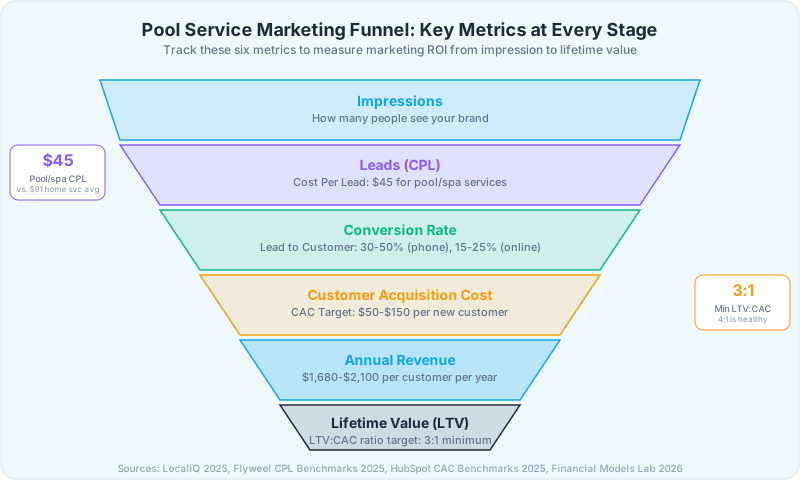
Pool and spa services have one of the best cost per lead rates in home services at $45.15, well below the $90.92 average for all home service categories according to LocaliQ. That means pool service companies have a built-in acquisition advantage. But only if you track the metrics that tell you where your money is working and where it is wasted. Six metrics give you the complete picture: leads, cost per lead (CPL), conversion rate, customer acquisition cost (CAC), lifetime value (LTV), and return on marketing spend (ROMS).
Corey Adams, Pool Founder co-founder and 15-year pool service veteran: "I spent $2,000 on Facebook ads one spring. Got a lot of likes. Got almost zero customers. The next year I put $1,500 into Google Ads and door hangers in neighborhoods I already serviced. I got 22 new customers. Same budget, completely different result. The only way I knew the difference was tracking the numbers."
What Marketing Metrics Should Pool Service Companies Track?
There are six marketing metrics that matter for pool service companies. You do not need a marketing degree or expensive analytics software to track them. You need a spreadsheet, consistent tracking habits, and the discipline to review the numbers monthly. These six metrics connect the dots from marketing spend to revenue.
| Metric | What It Measures | Pool Service Benchmark | How to Calculate |
|---|---|---|---|
| Leads | Total inbound inquiries | 10-30/month (small co.) | Count all calls, forms, emails, referrals |
| Cost Per Lead (CPL) | What each lead costs you | $45 (pool/spa) | Marketing spend / total leads |
| Conversion Rate | Leads that become customers | 30-50% (phone) | New customers / total leads |
| CAC | Total cost to acquire a customer | $50-$150 | Total marketing + sales cost / new customers |
| LTV | Total revenue from a customer | $5,040-$8,400 (3-4 yr avg) | Avg monthly rate x avg months retained |
| ROMS | Return on marketing spend | 5:1 or higher | Revenue from marketing / marketing spend |
What Is a Good Cost Per Lead for Pool Service?
A good cost per lead for pool service companies is $30 to $60, with $45.15 being the industry average according to LocaliQ benchmarks. This is significantly better than the overall home services average of $90.92. The low CPL exists because pool service has strong local search intent. People searching "pool service near me" are ready to buy, which means the leads convert at higher rates and cost less to generate.
CPL by Marketing Channel
| Channel | Avg CPL | Lead Quality | Best For |
|---|---|---|---|
| Google Ads (search) | $35-$65 | High intent | Filling schedule gaps, spring ramp-up |
| Google Business Profile | $0 (organic) | Very high intent | Year-round baseline leads |
| Facebook/Instagram ads | $30-$60 | Medium intent | Brand awareness, seasonal promotions |
| Referral program | $25-$50 (referral bonus) | Highest quality | Year-round, best conversion rate |
| Door hangers | $15-$40 | Medium intent | Dense neighborhoods you already service |
| Nextdoor | $0-$25 | High trust | Local community reputation |
| Thumbtack/HomeAdvisor | $40-$80 | Variable quality | Quick volume, lower conversion |
$45.15
average cost per lead for pool and spa services, nearly half the $90.92 home services average. Pool companies have a built-in acquisition cost advantage.
Source: LocaliQ 2025 Home Services Benchmarks
CPL alone does not tell you if a channel is working. A $25 CPL from Thumbtack that converts at 10% costs you $250 per customer. A $60 CPL from Google Ads that converts at 50% costs you $120 per customer. Always pair CPL with conversion rate to calculate CAC.
How Do You Calculate Customer Acquisition Cost for Pool Service?
Customer Acquisition Cost (CAC) measures the total cost to turn a stranger into a paying customer. It includes your marketing spend plus the time and resources spent on the sales process: phone calls, on-site estimates, follow-up texts, and the first service visit where you do an assessment. For pool service companies, a healthy CAC is $50 to $150 per new recurring customer.
The CAC Formula
CAC = (Total Marketing Spend + Sales Time Cost) / Number of New Customers Acquired. If you spent $1,000 on marketing in March, spent 10 hours on sales calls and estimates (valued at $50/hour = $500), and acquired 12 new customers, your CAC is ($1,000 + $500) / 12 = $125 per customer.
| CAC Range | What It Signals | Action |
|---|---|---|
| Under $50 | Excellent. Referrals and organic leads dominating. | Maintain what is working. Invest savings into retention. |
| $50-$100 | Healthy. Marketing channels are efficient. | Optimize conversion rate to push CAC lower. |
| $100-$150 | Acceptable. Common for paid advertising channels. | Monitor LTV:CAC ratio closely. Should be 3:1+. |
| $150-$250 | Elevated. May be overspending or under-converting. | Audit conversion rate. Improve phone scripts and follow-up. |
| Over $250 | Dangerous. Acquisition cost exceeds first-year margin. | Pause paid channels. Focus on referrals and organic. |
The critical relationship is between CAC and LTV. A $150 CAC is acceptable if your average customer stays for 3 years and generates $6,300 in revenue (LTV:CAC ratio of 42:1). That same $150 CAC is a problem if customers only stay 4 months and generate $600. Always evaluate CAC in the context of customer retention.
What Is Customer Lifetime Value for Pool Service?
Customer Lifetime Value (LTV) is the total revenue a customer generates over their entire relationship with your company. For pool service, LTV depends on three variables: monthly service rate, average customer lifespan in months, and upsell revenue from repairs, equipment, and add-on services. According to Financial Models Lab, the average monthly revenue per pool customer is $168, and the average customer relationship lasts 3 to 5 years.
LTV Calculation Examples
| Scenario | Monthly Rate | Avg Retention | Upsell Revenue | Total LTV |
|---|---|---|---|---|
| Budget residential | $130/mo | 24 months | $200/yr | $3,520 |
| Standard residential | $155/mo | 36 months | $400/yr | $6,780 |
| Premium residential | $185/mo | 48 months | $600/yr | $11,280 |
| Pool + spa combo | $225/mo | 42 months | $500/yr | $11,200 |
The LTV:CAC Ratio
The benchmark for a healthy business is an LTV:CAC ratio of at least 3:1. That means every dollar you spend acquiring a customer returns at least $3 in lifetime revenue. A 4:1 ratio is considered strong. Pool service companies typically achieve 10:1 or higher LTV:CAC ratios because the recurring revenue model generates high LTV relative to moderate acquisition costs.
The fastest way to increase LTV is not to raise prices. It is to reduce churn. Extending average customer retention from 24 months to 36 months at $155/month adds $1,860 to every customer LTV. Retention improvements multiply across your entire customer base.
3:1
minimum LTV:CAC ratio for a healthy, sustainable business. Pool service companies with strong retention often achieve 10:1 or higher.
Source: HubSpot 2025 CPL and CAC Benchmarks
How Do You Calculate Return on Marketing Spend?
Return on Marketing Spend (ROMS) is the ultimate marketing metric. It tells you how much revenue your marketing produces for every dollar spent. The formula is: ROMS = Revenue Generated from Marketing / Total Marketing Spend. A 5:1 ROMS means you generated $5 in revenue for every $1 spent on marketing. For pool service companies with recurring revenue, ROMS should be calculated using first-year revenue, not LTV, to stay conservative.
ROMS by Marketing Channel
| Channel | Typical ROMS | Time to See Results | Scalability |
|---|---|---|---|
| Google Business Profile | 20:1+ | 1-3 months | Limited (one profile per location) |
| Referral program | 15:1+ | Immediate | Limited by customer base size |
| Google Ads | 5:1 to 10:1 | 1-4 weeks | High (increase budget to scale) |
| Door hangers | 3:1 to 8:1 | 1-2 weeks | Moderate (limited by geography) |
| Facebook/Instagram | 2:1 to 5:1 | 2-8 weeks | Moderate (audience saturation) |
| Thumbtack/HomeAdvisor | 2:1 to 4:1 | Immediate | Moderate (competitive bidding) |
Track ROMS monthly by channel. When a channel drops below 3:1 ROMS consistently, reduce spend and reallocate to higher-performing channels. When a channel maintains 8:1+ ROMS, invest more until returns begin to diminish. This data-driven allocation replaces the guesswork that wastes most small business marketing budgets.
Monthly Marketing Tracking Template
At minimum, track these numbers monthly in a spreadsheet: total marketing spend by channel, total leads generated by channel (ask every caller "How did you find us?"), total new customers acquired by channel, first-year revenue from new customers, and ROMS by channel. This takes 30 minutes per month and gives you the data to double down on what works and cut what does not.
What Marketing Budget Should a Pool Service Company Set?
The standard recommendation for service companies is 5-8% of gross revenue on marketing. A pool company doing $200,000 in annual revenue should budget $10,000 to $16,000 per year for marketing. However, the right budget depends on your growth goals, your current CAC, and which channels are producing results.
| Revenue | 5% Budget | 8% Budget | Expected New Customers (at $100 CAC) |
|---|---|---|---|
| $100,000 | $5,000/yr | $8,000/yr | 50-80 per year |
| $200,000 | $10,000/yr | $16,000/yr | 100-160 per year |
| $500,000 | $25,000/yr | $40,000/yr | 250-400 per year |
| $1,000,000 | $50,000/yr | $80,000/yr | 500-800 per year |
Budget Allocation by Season
Do not spread your budget evenly across 12 months. Allocate 50-60% of your annual marketing budget to March through May when search volume and buying intent peak. Reduce spend to 10-15% during summer when you are likely at capacity. Allocate 15-20% to fall for retention campaigns. Reserve 10-15% for winter planning and early-bird promotions.
The most common marketing mistake pool companies make is spending money without tracking results. A $500/month Google Ads campaign with proper tracking and a 5:1 ROMS generates $2,500/month in revenue. The same $500/month without tracking could generate $0 and you would never know. Measurement is not optional.
Ready to streamline your pool service business?
Pool Founder gives you route optimization, automated invoicing, chemical tracking, and everything else you need to run a more profitable pool business.
Frequently Asked Questions
What is the average cost per lead for pool service companies?
The average cost per lead for pool and spa services is $45.15, which is one of the lowest in home services (the overall home services average is $90.92). Google Ads typically generates pool service leads at $35-$65 per lead, while referral programs produce leads at $25-$50 per lead.
What is a good customer acquisition cost for pool service?
A healthy CAC for pool service companies is $50 to $150 per new recurring customer. This includes marketing spend and sales time costs. At a $150/month average service rate, a $100 CAC is recouped within the first month of service. Always compare CAC to customer lifetime value for the complete picture.
How much should a pool service company spend on marketing?
The standard recommendation is 5-8% of gross revenue. A pool company doing $200,000/year should budget $10,000-$16,000 annually. Allocate 50-60% of the annual budget to spring (March-May) when search volume and buying intent are highest.
What is customer lifetime value for pool service?
Average customer LTV for pool service is $5,040 to $8,400 based on a $140-$175/month rate and 36-48 month average retention. Premium accounts with upsell revenue (repairs, equipment) can reach $10,000+ in LTV. The key driver of LTV is retention duration, not monthly rate.
Which marketing channel has the best ROI for pool companies?
Google Business Profile optimization combined with review generation offers the highest ROI at near-zero cost. For paid channels, Google Ads targeting "pool service near me" and related keywords produces 5:1 to 10:1 ROMS. Referral programs produce 15:1+ ROMS but are limited by your current customer base size.
How do you track which marketing channel produces customers?
Ask every caller "How did you find us?" and record the answer. Use separate tracking phone numbers for Google Ads, print materials, and your website. Tag leads in your CRM or spreadsheet by source. Review monthly to see which channels produce the most customers at the lowest CAC.