When Is the Right Time to Hire Your First Pool Technician?
Most solo pool service owners hit the hiring wall somewhere between 60 and 80 accounts. You are maxed out at 12-15 pools per day, turning away new customers, and one sick day means skipping stops or working until dark. The math is simple: your truck can only visit so many pools, and your body can only take so much chlorine and Florida sun. Hiring your first employee is the single biggest operational leap you will make, and getting it wrong costs more than getting it right.
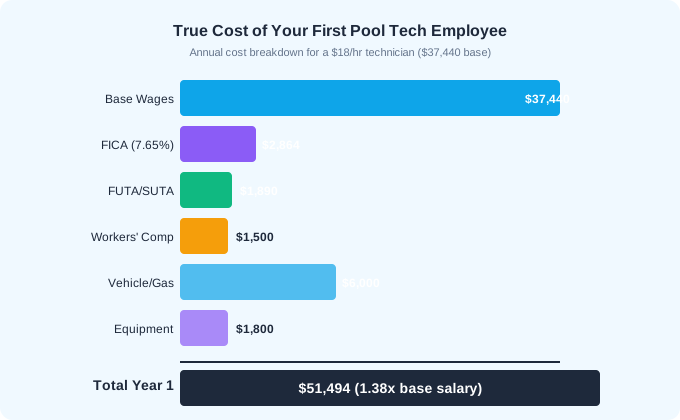
This guide covers every legal, financial, and practical step from applying for your EIN to handing your new tech the keys on day one. The total first-year cost of a pool technician runs 1.25x to 1.4x their base salary once you factor in payroll taxes, workers' compensation, vehicle expenses, and equipment. For an $18/hr technician, that is roughly $51,000, not $37,000. Know that number before you post the job listing.
If you are currently servicing 60+ pools solo and turning away leads, you are leaving $30,000-$50,000 in annual revenue on the table. A technician who can handle 15 pools per day at $150 average monthly revenue per pool generates $27,000/year in gross revenue for those 15 accounts alone.
What Legal Setup Do You Need Before Hiring?
Before you interview a single candidate, you need five things in place: an Employer Identification Number (EIN), state employer registration, workers' compensation insurance, a payroll system, and labor law postings. Skipping any of these creates liability that can cost thousands in penalties.
EIN and Federal Registration
An EIN is your business tax ID for employer purposes. Apply free on IRS.gov and receive it instantly online. You will also need to register with the Electronic Federal Tax Payment System (EFTPS) for depositing payroll taxes. Both are free and take under 30 minutes combined.
State Employer Registration
Every state requires separate registration for state income tax withholding and State Unemployment Tax Act (SUTA) contributions. In Florida, there is no state income tax withholding, but you still need to register with the Department of Revenue for reemployment tax. Texas and Nevada are similar. California, Arizona, and most other pool states require both withholding and unemployment registration.
Workers' Compensation Insurance
Almost every state requires workers' comp the moment you hire your first employee. Pool service is classified as a moderate-risk trade due to chemical handling, heat exposure, and vehicle operation. Expect to pay $1,200-$2,400 per year per technician depending on your state's rates and your claims history. In California, average workers' comp costs about $82/month for a two-person business according to The Hartford.
| Requirement | Cost | Time to Complete | Where to Apply |
|---|---|---|---|
| EIN | Free | 10 minutes | IRS.gov |
| EFTPS Registration | Free | 10 minutes | EFTPS.gov |
| State Employer ID | Free | 15-30 minutes | State revenue department |
| Workers' Comp | $100-200/month | 1-3 days | Insurance broker or Hartford/GEICO |
| Labor Law Posters | $25-50 | 5 minutes | DOL.gov or compliance vendor |
| Payroll Software | $40-80/month | 1 hour setup | Gusto, QuickBooks Payroll |
Do not skip workers' comp to save money. If a technician is injured on the job without coverage, you are personally liable for all medical costs and lost wages. A single chemical burn or vehicle accident claim can exceed $50,000.
What Is the True Cost of Your First Employee?
The base hourly wage is only 70-80% of what you will actually spend. Employer payroll taxes add 7.65% for FICA (Social Security and Medicare matching), FUTA adds $42 per year per employee after the 5.4% credit, and SUTA adds 2-5% of the first $7,000-$15,000 in wages depending on your state. Layer on workers' comp, vehicle costs, equipment, and onboarding time and you reach 1.25-1.4x the base salary.
When Does the Hire Pay for Itself?
A technician servicing 15 pools per day at $150 average monthly billing generates $2,250/month in revenue from those accounts. Your total monthly cost for the employee is approximately $4,300 (salary, taxes, vehicle, supplies). The breakeven point is around 29 accounts on their route. Most pool companies can load a new technician to 40-60 accounts within 60-90 days if you have a backlog of leads, meaning the hire generates positive cash flow within the first quarter.
60-90 days
typical time to load a new technician route to profitability (40-60 accounts)
The hidden cost most owners forget is their own time. Training a new technician takes 2-4 weeks of ride-alongs, which means you are servicing fewer pools yourself during that period. Budget for the revenue dip. If you normally service 15 pools per day and spend 10 days doing ride-alongs, that is 75 pools of deferred or rescheduled service.
How Do You Find and Recruit Your First Pool Tech?
The number one recruiting mistake pool service owners make is posting a generic job listing on Indeed and waiting. The best candidates for your first hire are people who already work outdoors, understand physical labor, and want stable year-round work. Target those people specifically.
Best Recruiting Channels for Pool Technicians
- Indeed and ZipRecruiter: Post with specific pay range and benefits. Listings with salary ranges get 30% more applicants according to Indeed data.
- Facebook Marketplace and local groups: Post in "[City] Jobs" groups. Many blue-collar workers find jobs through Facebook, not traditional job boards.
- Craigslist: Still effective for trade positions in most markets. Free to post in many cities.
- Trade school partnerships: Contact local vocational programs and community colleges with maintenance or trades programs.
- Referrals from your network: Ask landscapers, pest control techs, and HVAC companies if they know anyone looking for outdoor work. Offer a $200-$500 referral bonus.
- Nextdoor: Post in your service area. Neighbors often know someone looking for work.
What Should Your Job Listing Include?
Your job listing needs to answer the five questions every candidate has: how much does it pay, what are the hours, do I need experience, what vehicle do I drive, and is this year-round. Be specific. A listing that says "$17-20/hr, M-F 7am-3pm, company truck provided, no experience needed, year-round work" will outperform a vague "pool technician wanted" posting every time.
For your first hire, prioritize reliability and work ethic over pool experience. You can teach someone to balance water chemistry in two weeks. You cannot teach someone to show up on time every day.
What Does a 30-Day Onboarding Plan Look Like?
A structured onboarding plan is the difference between a technician who is productive in 30 days and one who is still making mistakes at 90 days. Your first employee does not have another tech to shadow long-term, so the training needs to be concentrated and systematic.
Week 1: Ride-Along and Observation
- Days 1-2: Complete all HR paperwork (W-4, I-9, direct deposit, employee handbook acknowledgment)
- Days 1-5: Full ride-along on your route. New hire observes every step at every pool.
- Cover chemical testing, brushing, skimming, filter cleaning, equipment checks
- Explain your chemical protocols and documentation requirements
- Introduce your software (route management, customer notes, service reports)
Week 2: Supervised Hands-On
- New hire performs service while you observe and correct
- Start with simple residential pools, no complex equipment
- Review chemical readings together after each pool
- Practice using the service software to log visits and readings
- Test their knowledge on safety protocols and chemical handling
Weeks 3-4: Gradual Independence
- Assign a small route (8-10 pools) they service independently
- You spot-check 2-3 pools per day by visiting after them
- Review all service reports and chemical readings daily
- Increase route size by 2-3 pools per day as quality is confirmed
- By end of week 4: technician should handle 12-15 pools independently
Document your training process. Even if your first hire is the only employee for a while, having a written training checklist makes your second and third hire dramatically easier. It also protects you legally by showing you trained employees on safety procedures.
How Do You Set Up Payroll Correctly?
For a single employee, payroll software is worth every penny. Gusto starts at approximately $40/month plus $6/employee and handles federal, state, and local tax filings, direct deposit, W-2 generation, and new hire reporting automatically. QuickBooks Payroll starts at $45/month plus $6/employee and integrates directly with QuickBooks Online if you already use it for accounting.
| Payroll Software | Monthly Cost (1 employee) | Key Features | Best For |
|---|---|---|---|
| Gusto | $46/mo | Auto tax filing, benefits admin, onboarding | Companies wanting HR tools built in |
| QuickBooks Payroll | $51/mo | Same-day direct deposit, QB integration | Already using QuickBooks for accounting |
| Square Payroll | $35/mo + $6/emp | Simple interface, tip tracking | Owners wanting simplicity |
| Manual (not recommended) | $0 software | You calculate and file everything | Nobody, the penalty risk is not worth it |
Payroll Tax Deposit Schedule
New employers with a payroll tax liability under $50,000 during the lookback period deposit payroll taxes monthly, due by the 15th of the following month. Once your liability exceeds that threshold, you switch to semi-weekly deposits. Your payroll software handles this automatically, which is why manual payroll is a bad idea for anyone without an accounting background.
In 2026, the Social Security wage base is $184,500 with a combined employer/employee rate of 12.4% (you pay 6.2%). Medicare is 1.45% each, no wage cap. These numbers change annually, which is another reason to use software that updates automatically.
What Equipment Does Your New Tech Need?
Your new technician needs a vehicle, a test kit, a pole and attachments, chemicals, and a phone with your service software installed. Budget $1,500-$3,000 for the initial equipment loadout if you already have a vehicle. If you need to acquire a vehicle, add $15,000-$30,000 for a used truck or van.
Essential Equipment Checklist
- Taylor K-2005 or K-2006 test kit ($80-$120)
- Telescoping pole, 8-16 ft ($40-$80)
- Leaf rake, wall brush, vacuum head ($60-$100)
- Chemical supply: chlorine tabs, liquid chlorine, muriatic acid, soda ash, CYA ($200-$400 initial stock)
- Leaf canister/bag for vacuuming ($30-$50)
- 5-gallon bucket, hose, backwash hose ($30-$50)
- Safety equipment: chemical-resistant gloves, safety glasses, sunscreen ($40-$60)
- Uniform shirts with company logo (2-3 shirts, $50-$100)
- Smartphone with service software app installed
$1,500-$3,000
initial equipment loadout cost per technician (excluding vehicle)
On the vehicle question: providing a company truck is the strongest recruiting and retention tool you have. It eliminates $400-$700/month in personal fuel and wear costs for the technician. If cash is tight, start with a mileage reimbursement at the IRS standard rate (70 cents per mile in 2026) and transition to a company vehicle when the route supports it.
How Do You Protect Yourself Legally?
Beyond workers' comp and payroll compliance, you need two documents before your technician starts: an employee handbook and a signed acknowledgment of your chemical safety procedures. These protect you in disputes, unemployment claims, and liability situations.
Employee Handbook Essentials
- Work hours, overtime policy, and pay schedule
- Dress code and uniform requirements
- Vehicle use policy (company truck rules, personal vehicle reimbursement)
- Chemical handling and safety procedures
- Customer interaction expectations
- Termination policy and at-will employment statement
- Non-compete or non-solicitation clause (if enforceable in your state)
- Phone and GPS tracking disclosure
The non-solicitation clause is particularly important in pool service. If a technician leaves and takes your customers, you lose both the employee and the revenue. A non-solicitation agreement that prevents the technician from soliciting your customers for 12-24 months after departure is enforceable in most states and standard in the industry.
Have an employment attorney review your handbook and any non-compete or non-solicitation agreements before use. State laws vary significantly on enforceability. A $500-$1,000 attorney review is cheap insurance against a $50,000 customer loss.
What Are the Most Common First-Hire Mistakes?
After talking with dozens of pool service owners who have been through this process, the same mistakes come up repeatedly. Avoid these and your first hire will go significantly smoother.
- 1Hiring too late. If you are turning away 5+ leads per month, you needed an employee last month. The lost revenue from delayed hiring exceeds the cost of hiring too early.
- 2Paying below market. An $18/hr tech in a $20/hr market will leave within 90 days. The $4,000 annual savings is wiped out by $6,000+ in replacement costs.
- 3No written training plan. Winging it leads to inconsistent service, callbacks, and customer complaints that damage your reputation.
- 4Skipping workers' comp. One injury claim without coverage can bankrupt a small pool company.
- 5Classifying employees as 1099 contractors to avoid payroll taxes. The IRS penalties for misclassification are severe and pool technicians almost always fail the independent contractor test.
- 6No vehicle policy. Unclear rules about personal use of company vehicles, fuel cards, and maintenance responsibilities create conflict.
- 7Expecting perfection immediately. A good technician needs 30-60 days to hit full productivity. Set expectations accordingly and check their work daily during the first month.
$4,000-$6,000
average cost to replace a pool technician (recruiting, training, lost productivity)
Ready to streamline your pool service business?
Pool Founder gives you route optimization, automated invoicing, chemical tracking, and everything else you need to run a more profitable pool business.
Frequently Asked Questions
How many pools do I need before hiring my first employee?
Most pool service owners hire their first employee when they reach 60-80 accounts and are turning away new business. The financial breakeven for a new technician is typically 29-35 accounts on their route. If you have a waiting list of leads, hire sooner rather than later.
Should I hire a pool technician as a W-2 employee or 1099 contractor?
Almost always W-2. Pool technicians who use your chemicals, drive your routes, follow your schedule, and represent your brand fail the IRS independent contractor test on all three factors (behavioral control, financial control, type of relationship). Misclassification penalties include back taxes, FICA, and fines up to $1,000 per worker.
How much does it really cost to hire a pool technician?
Budget 1.25-1.4x the base salary for total cost. An $18/hr technician with a $37,440 base salary costs approximately $51,000 in the first year after adding FICA, FUTA/SUTA, workers' comp, vehicle expenses, and equipment.
What is the biggest risk when hiring your first pool employee?
The biggest financial risk is misclassifying them as a 1099 contractor or skipping workers' compensation insurance. The biggest operational risk is not having a structured training plan, which leads to callbacks, customer complaints, and early turnover.
Do I need workers compensation insurance for one pool technician?
Yes, in almost every state. Workers' comp is required from the first employee in most states, and pool service is classified as moderate-risk due to chemical exposure, heat, and vehicle operation. Expect $100-$200/month per technician.
How long does it take to train a new pool technician?
A structured 30-day program gets most technicians to independent operation: one week of ride-alongs, one week of supervised work, and two weeks of gradually increasing independence with daily quality checks. Full proficiency with complex equipment and troubleshooting takes 60-90 days.