Why Does Worker Classification Matter for Pool Companies?
Every pool service owner faces the same temptation: classify technicians as 1099 independent contractors to avoid payroll taxes, workers' comp, and unemployment insurance. The savings look attractive on paper. You skip the 7.65% FICA match, the SUTA contributions, and the $100-$200/month workers' comp premium per tech. But the IRS, Department of Labor, and state agencies have very specific rules about who qualifies as a contractor, and most pool technicians do not.
Misclassification is not a gray area for typical pool service arrangements. If you set the route, supply the chemicals, provide training, and the technician works exclusively for your company, they are an employee under the IRS test. The penalties for getting this wrong include back taxes, employer FICA contributions you should have paid, interest, and fines up to $1,000 per misclassified worker for intentional violations.
In May 2025, the DOL retracted the Biden-era independent contractor rule and reverted to the traditional economic realities test. This means the longstanding IRS 3-factor test remains the primary framework for classification decisions in 2026.
How Does the IRS 3-Factor Test Work?
The IRS evaluates worker classification using three categories: behavioral control, financial control, and type of relationship. No single factor determines the outcome. The IRS looks at the totality of the arrangement. However, in pool service, the typical technician arrangement checks the "employee" box in nearly every factor across all three categories.
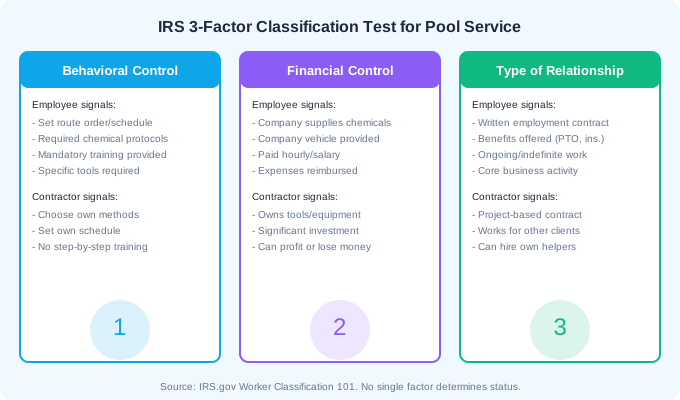
The key principle: it is not about what you call the relationship. A signed "independent contractor agreement" does not override the actual working arrangement. The IRS looks at how the work is actually performed, not what the paperwork says.
What Is the Behavioral Control Test?
Behavioral control asks one question: does the company have the right to direct and control how the worker does the work? The more instructions and training you provide, the more likely the worker is an employee. The IRS specifically cites instructions about when, where, and how to work, what tools to use, and what order to follow.
How Pool Service Fails the Behavioral Test
In a typical pool service company, you set the route order. You dictate which chemicals to use and how much. You provide training on your service procedures. You specify which pools to visit on which days. You require service reports documenting what was done. Every one of these facts points toward employee status.
| Factor | Typical Pool Service Arrangement | Classification Signal |
|---|---|---|
| Route and schedule | Company sets daily route order and schedule | Employee |
| Chemical protocols | Company specifies products, dosages, methods | Employee |
| Training provided | Company trains on procedures and safety | Employee |
| Service standards | Company dictates quality expectations | Employee |
| Software/reporting | Company requires app check-ins and reports | Employee |
A true independent contractor pool tech would choose their own route order, bring their own chemicals, decide their own service methods, and determine their own schedule. That describes a subcontractor running their own business, not a technician on your payroll.
What Is the Financial Control Test?
Financial control examines who controls the business aspects of the work: who provides tools and supplies, whether the worker has a significant investment in their own equipment, whether the worker can make a profit or suffer a loss, and how the worker is paid.
How Pool Service Fails the Financial Test
- Company provides chemicals and supplies: This is an employee signal. A contractor provides their own materials.
- Company provides vehicle or reimburses mileage: Employee signal. Contractors use their own vehicle as a business investment.
- Worker is paid hourly or per-stop with a guaranteed minimum: Employee signal. Contractors invoice for completed work and bear the risk of non-payment.
- Company reimburses expenses: Employee signal. Contractors absorb their own business expenses.
- Worker has no opportunity for profit or loss beyond hours worked: Employee signal. Contractors can profit from efficiency or lose money on bad estimates.
The "significant investment" factor is where some pool companies try to create contractor status by requiring technicians to buy their own equipment. But a $500 test kit and some poles is not a significant investment compared to the company's investment in the customer base, brand, software, and chemical inventory. The IRS sees through this arrangement.
Paying per-stop instead of hourly does not automatically make someone a contractor. If the company controls the route, provides supplies, and the worker has no real opportunity for business profit or loss, per-stop pay is just a different compensation structure for an employee.
What Is the Relationship Type Test?
The relationship type test looks at the overall nature of the arrangement: written contracts, benefits, permanence of the relationship, and whether the work performed is a key aspect of the business.
Key Relationship Factors for Pool Service
| Factor | Employee Signal | Contractor Signal |
|---|---|---|
| Duration | Ongoing, indefinite work | Project-based, defined end date |
| Exclusivity | Works only for your company | Works for multiple clients |
| Core activity | Pool service IS your business | Work is supplemental to business |
| Benefits | Company offers PTO, insurance, etc. | No employee-type benefits |
| Hiring ability | Cannot hire own helpers | Can hire and pay own assistants |
The "key aspect of the business" factor is the nail in the coffin for most pool service contractor arrangements. Your business is pool service. The technician performs pool service. That work is not ancillary or supplemental. It is the core activity of your company, which strongly indicates an employment relationship.
The one arrangement that can legitimately be 1099 is a pool technician who runs their own business, services pools for multiple companies, provides their own chemicals and equipment, sets their own schedule, invoices for completed work, and has their own customers. This describes a subcontractor, not a route technician.
What Are the Penalties for Misclassification?
Misclassification penalties come from multiple agencies simultaneously: the IRS, Department of Labor, and your state tax and labor agencies. The financial exposure is significant, especially for intentional misclassification.
IRS Penalties Under Section 3509
For unintentional misclassification, Section 3509(a) penalties include 1.5% of wages for federal income tax withholding you should have collected, 20% of the employee's FICA taxes you should have withheld, and 100% of the employer's FICA match (7.65% of wages). For intentional misclassification, Section 3509 relief is eliminated entirely, making you liable for the full withholding amounts plus penalties up to $1,000 per misclassified worker.
| Penalty Type | Unintentional | Intentional |
|---|---|---|
| Federal income tax | 1.5% of wages | Full withholding amount |
| Employee's FICA | 20% of amount | Full amount |
| Employer's FICA match | 100% of amount | 100% of amount |
| Per-worker fine | None | Up to $1,000 per worker |
| Lookback period | 3 years | Up to 6 years |
Department of Labor Exposure
The DOL can pursue back wages, overtime pay, and benefits owed under the Fair Labor Standards Act. If a misclassified worker was working over 40 hours per week without overtime pay (common in pool service during peak season), you owe 1.5x their regular rate for every overtime hour, retroactively for up to 3 years.
A pool company with 5 misclassified technicians earning $18/hr over 3 years could face $40,000-$80,000 in combined IRS penalties, back FICA taxes, state penalties, and DOL back wages. This amount can and does put small pool companies out of business.
When Can You Legitimately Use 1099 Contractors?
There are legitimate 1099 relationships in the pool service industry. The key is that the contractor must genuinely operate as an independent business, not just be called one on paper.
Legitimate 1099 Arrangements in Pool Service
- Subcontracted repair specialist: A licensed plumber or electrician you call for specific repairs. They have their own business, serve multiple clients, bring their own tools, and invoice you.
- Overflow route coverage: Another pool service company covers your routes during vacation or emergency. They are a separate business with their own insurance and customers.
- Seasonal specialist: A pool opening/closing contractor who works for multiple companies during spring and fall, provides their own equipment, and sets their own schedule.
- Equipment installer: A contractor who installs pumps, heaters, or salt systems. They run their own installation business with multiple clients.
- Marketing or website contractor: A freelancer who builds your website or manages your social media. Clearly a separate business.
Notice the pattern: every legitimate contractor arrangement involves someone running their own business with multiple clients, their own equipment, and control over how they do the work. The moment someone works exclusively on your routes, with your chemicals, following your procedures, on your schedule, they are an employee.
How Do You Transition from 1099 to W-2?
If you currently have technicians classified as 1099 contractors who should be W-2 employees, transitioning voluntarily is far better than being caught in an audit. The IRS Voluntary Classification Settlement Program (VCSP) allows employers to reclassify workers with significantly reduced penalties.
Steps to Transition
- 1Consult a tax attorney or CPA to assess your exposure and determine whether the VCSP applies to your situation.
- 2Set up your payroll system with proper employer registrations (EIN, state withholding, SUTA, workers' comp).
- 3File IRS Form 8952 to apply for the VCSP if eligible. This limits your penalty to 10% of the employment tax liability for the most recent year.
- 4Convert workers to W-2 status going forward with proper onboarding, W-4 collection, and payroll withholding.
- 5Issue W-2 forms instead of 1099-NEC forms for the new tax year.
The VCSP is only available to employers who are not currently under audit. If you receive an audit notice, the voluntary program is no longer an option and penalties increase substantially. This is why proactive reclassification is strongly recommended over waiting.
The VCSP penalty is roughly 10% of one year of employment taxes. For a $40,000/year technician, that is approximately $600-$800 per worker. Compare that to the $10,000-$15,000+ per worker exposure in a full audit with intentional misclassification findings.
Ready to streamline your pool service business?
Pool Founder gives you route optimization, automated invoicing, chemical tracking, and everything else you need to run a more profitable pool business.
Frequently Asked Questions
Can I pay pool technicians per pool stop and classify them as 1099?
No. The payment method (hourly, salary, per-stop) does not determine classification. The IRS looks at behavioral control, financial control, and the type of relationship. If you set the route, provide chemicals, require training, and the tech works exclusively for you, they are an employee regardless of how you calculate their pay.
What if my technician signed an independent contractor agreement?
A signed contract does not override the actual working arrangement. The IRS and DOL look at the reality of how work is performed, not what the paperwork says. A contract calling someone a contractor while treating them as an employee actually increases your intentional misclassification risk.
How does the IRS find out about misclassification?
Common triggers include a former worker filing for unemployment (they cannot collect if classified as 1099), a worker filing an SS-8 form asking the IRS to determine their status, a state audit triggered by workers' comp claims, or an IRS payroll tax audit. Any of these can expose the misclassification.
What is the IRS Voluntary Classification Settlement Program?
The VCSP allows employers to voluntarily reclassify workers from 1099 to W-2 with reduced penalties, typically 10% of one year of employment tax liability. You must not be under audit to qualify. File IRS Form 8952 to apply.
Can pool route owners who buy routes be 1099 contractors?
It depends on the arrangement. A route owner who purchased their own customer base, provides their own chemicals and equipment, sets their own schedule, and operates under their own business name may qualify as a contractor. But a route owner who follows your brand standards, uses your chemicals, and operates under your company name is likely an employee.
Sources & References
- IRS - Worker Classification 101: Employee or Independent Contractor
- IRS - Behavioral Control
- IRS - Independent Contractor (Self-Employed) or Employee
- ADP - 9 Consequences of Misclassifying Your 1099 Contractors
- SDO CPA - W-2 vs 1099: Tax Differences, IRS Rules & Penalties (2026)
- Multiplier - Independent Contractor Misclassification: 2026 Guide