What Is Customer Lifetime Value and Why Does It Matter for Pool Service?
Customer lifetime value (CLV) is the total revenue a single customer generates over their entire relationship with your company. For a pool service customer paying $150 per month who stays for 6 years, the CLV is $10,800. That one number changes everything about how you spend on marketing, how aggressively you fight churn, and how much you should invest in service quality.
Pool service is a recurring revenue business where the average customer stays 4 to 7 years. That makes CLV especially powerful as a metric. A repeat customer spends 67% more than a new customer on average. Service agreements increase customer lifetime value by 40-60%. Reducing churn by just 5% can increase profits by 25-95% according to research from Bain & Company.
$7,200-$12,600
typical lifetime value of a weekly residential pool service customer
67%
more spent by repeat customers compared to new customers
Source: Bain & Company
40-60%
increase in CLV from implementing service agreements
Source: Superior Pool Routes
4-7 years
average retention period for recurring pool service customers
Source: Pool route broker data, Sealey Business Brokers
How Do You Calculate Customer Lifetime Value for Pool Service?
The basic CLV formula is: Average Monthly Revenue x Average Customer Lifespan in Months. A customer paying $150/month who stays for 5 years (60 months) has a CLV of $9,000. For a more accurate picture, factor in upsell revenue from repairs, equipment upgrades, and seasonal services like opening and closing.
Simple CLV Formula
CLV = (Average Monthly Service Revenue) x (Average Customer Lifespan in Months). This gives you a baseline. For pool service, this calculation is straightforward because revenue is predictable and monthly.
Advanced CLV Formula
CLV = (Average Monthly Revenue + Average Monthly Upsell Revenue) x (Average Lifespan in Months) x (Gross Margin %). This version accounts for the additional revenue customers generate beyond their base service and the actual profit margin on that revenue.
| Variable | Example Value | Where to Find It |
|---|---|---|
| Monthly service revenue | $150 | Average from your billing records |
| Monthly upsell revenue | $25 | Repairs, chemicals, equipment / total customers / 12 |
| Customer lifespan | 60 months (5 years) | Average tenure of churned customers |
| Gross margin | 65% | Revenue minus direct service costs |
| Simple CLV | $9,000 | $150 x 60 months |
| Advanced CLV | $6,825 | ($150 + $25) x 60 x 0.65 |
How Does CLV Vary by Customer Type?
Not all pool customers are worth the same amount. A weekly residential customer generates dramatically different lifetime value than a bi-weekly customer or a commercial account. Understanding these differences helps you decide where to focus your acquisition efforts and which customer segments deserve the most attention when they call with a complaint.
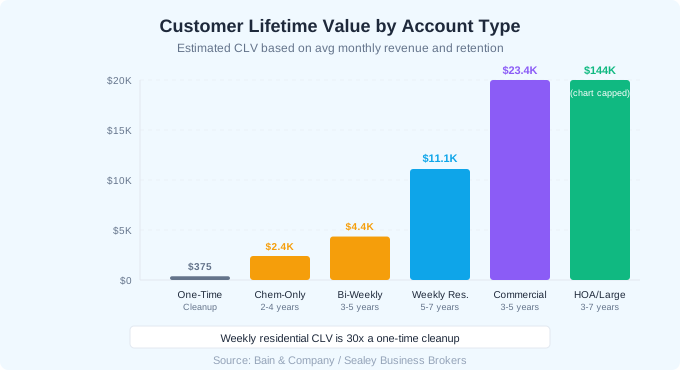
| Customer Type | Avg Monthly Revenue | Avg Lifespan | Estimated CLV |
|---|---|---|---|
| Weekly residential | $125-$175 | 5-7 years | $7,500-$14,700 |
| Bi-weekly residential | $75-$100 | 3-5 years | $2,700-$6,000 |
| Chemical-only service | $50-$75 | 2-4 years | $1,200-$3,600 |
| Commercial (small) | $300-$600 | 3-5 years | $10,800-$36,000 |
| Commercial (large/HOA) | $1,000-$3,000 | 3-7 years | $36,000-$252,000 |
| One-time cleanup only | $250-$500 | One visit | $250-$500 |
The difference between a weekly residential customer ($7,500+ CLV) and a one-time cleanup ($250-500) is 15x to 30x. This is why converting one-time customers to recurring accounts is one of the highest-leverage activities in pool service. Every green pool cleanup is an opportunity to pitch weekly maintenance.
Commercial accounts have the highest CLV but also require more expertise, insurance coverage, and compliance management. A single HOA contract at $2,000/month for 5 years is worth $120,000 in lifetime value.
How Does CLV Change Your Marketing Decisions?
When you know your CLV, you can calculate exactly how much you can spend to acquire a customer and still be profitable. If your average CLV is $9,000 and your gross margin is 65%, a customer is worth $5,850 in gross profit over their lifetime. Spending $200 to acquire that customer is not an expense. It is an investment with a 29x return.
The LTV-to-CAC ratio (which uses CLV as the LTV input) should be at least 3:1 for a healthy business. Most pool companies have ratios of 20:1 or higher because they underinvest in marketing. That is not efficient. It means you are leaving growth on the table because you could afford to spend 5x or 10x more on acquisition and still maintain healthy margins.
| Decision | Without CLV Data | With CLV Data |
|---|---|---|
| Marketing budget | "We can afford $500/month" | "A $200 CAC on $9,000 CLV = 45x return. We should spend $2,000/month." |
| Referral bonus | "$25 seems like a lot to pay" | "$50 per referral for a $9,000 customer is 0.5% of CLV. Pay it." |
| Handling complaints | "That customer is always difficult" | "That customer is worth $9,000. Solve the problem." |
| Price increases | "We might lose customers" | "If we lose 5% of customers but raise prices 10%, revenue increases." |
| Retention efforts | "We can replace churned customers" | "Losing 10 customers at $9,000 CLV = $90,000 in lost future revenue." |
How Does Retention Rate Affect CLV?
Retention rate is the single biggest driver of CLV. A 5% improvement in retention can increase profits by 25-95% according to Bain & Company. In pool service, the math is direct. If your average customer stays 5 years instead of 4 years, CLV increases by 20%. If they stay 7 years instead of 5, CLV increases by 40%.
| Annual Retention Rate | Avg Customer Lifespan | CLV at $150/month |
|---|---|---|
| 80% | 4.5 years | $8,100 |
| 85% | 6 years | $10,800 |
| 90% | 9 years | $16,200 |
| 95% | 18 years | $32,400 |
| 97% | 30+ years | $54,000+ |
The compounding effect of retention is staggering. Going from 85% to 95% annual retention quadruples customer lifespan from 6 years to 18 years. That is the difference between a $10,800 customer and a $32,400 customer. Every percentage point of retention you gain has an outsized impact on your business value.
Well-run pool service companies maintain 85-95% annual retention, meaning customers stay 6 to 18 years on average. If your retention is below 85%, fixing that is worth more than any marketing campaign.
What Increases Customer Lifetime Value Beyond Retention?
CLV has two components: how long a customer stays and how much they spend per month. Most pool companies focus only on retention, but increasing average revenue per customer is equally powerful. A customer who adds equipment repair service, chemical delivery, or an annual drain-and-fill to their base cleaning package can increase their monthly spend by 20-40%.
Strategies to Increase CLV
- Convert one-time customers to recurring: Offer a discounted first month of weekly service after every one-time cleanup.
- Add equipment services: Offer filter cleaning, pump repair, and heater maintenance as add-ons to existing accounts.
- Seasonal upsells: Pool openings, winterization, acid washes, and tile cleaning are high-margin services that increase annual revenue per customer.
- Chemical delivery: Customers who buy chemicals from you spend $50-100/month more and are less likely to churn.
- Annual maintenance plans: Package quarterly equipment inspections with weekly service for a premium monthly rate.
- Price increases: A $10/month price increase on 100 customers adds $12,000/year in revenue with zero acquisition cost.
How Does CLV Affect Your Company Valuation?
Pool route valuations are directly tied to customer lifetime value. Buyers and brokers value pool routes at 10-14x monthly billing for well-retained accounts. A route with 100 customers at $150/month and 90%+ retention might sell for $150,000-$210,000. That valuation is based on the expected lifetime revenue those customers will generate under the new owner.
Acquirers, especially private equity firms running roll-up strategies, explicitly analyze CLV when making acquisition offers. Higher CLV means higher multiples. If your customers stay longer, spend more, and churn less than the industry average, your business commands a premium valuation. SPS PoolCare, now the largest pool service company with 195+ acquisitions, evaluates customer retention data as a core part of their due diligence.
| Retention Rate | Monthly Billing (100 customers) | Typical Valuation Multiple | Route Value |
|---|---|---|---|
| Below 80% | $15,000 | 8-10x monthly | $120,000-$150,000 |
| 80-85% | $15,000 | 10-12x monthly | $150,000-$180,000 |
| 85-90% | $15,000 | 12-14x monthly | $180,000-$210,000 |
| 90%+ | $15,000 | 14-16x monthly | $210,000-$240,000 |
Corey Adams, Pool Founder co-founder and 15-year pool veteran: "When I was running routes, I never thought about customer lifetime value. I was focused on filling tomorrow's schedule. Once I calculated that each weekly customer was worth over $10,000, I stopped cutting corners on service quality. That one shift changed everything."
Ready to streamline your pool service business?
Pool Founder gives you route optimization, automated invoicing, chemical tracking, and everything else you need to run a more profitable pool business.
Frequently Asked Questions
What is the average customer lifetime value for pool service?
The average CLV for a weekly residential pool service customer is $7,200 to $12,600, based on $125-175/month over 4-7 years. Commercial accounts can range from $10,800 to $252,000+ depending on the contract size and retention period.
How do you calculate CLV for a pool service business?
Use the formula: CLV = Average Monthly Revenue x Average Customer Lifespan in Months. For a more complete picture, add average monthly upsell revenue and multiply by your gross margin percentage. A customer paying $150/month for 5 years has a simple CLV of $9,000.
How long does the average pool service customer stay?
The average pool service customer stays 4 to 7 years with well-run operations. Companies with 90%+ annual retention keep customers for 9+ years on average. The industry benchmark for good retention is 85-90%, which translates to a 6-9 year average customer lifespan.
How does CLV affect pool route valuation?
Pool routes are typically valued at 10-14x monthly billing for well-retained accounts. Higher CLV, driven by longer retention and higher monthly revenue, directly increases your route valuation. Routes with 90%+ retention command premium multiples of 14-16x.
What is a good LTV-to-CAC ratio for pool service?
The standard benchmark is 3:1, meaning you earn $3 in lifetime value for every $1 spent on acquisition. Most pool companies have ratios of 20:1 or higher because they underinvest in marketing, which means they have room to grow faster by increasing acquisition spending.
How much does improving retention increase CLV?
Improving annual retention from 85% to 95% quadruples average customer lifespan from 6 years to 18 years, tripling CLV. Bain & Company research shows that a 5% increase in retention can boost profits by 25-95%. In pool service, retention is the highest-leverage metric you can improve.
Sources & References
- Bain & Company / Harvard Business Review: The Value of Customer Retention
- Superior Pool Routes: Recurring Revenue Models and Customer Lifetime Value
- First Page Sage: Average Customer Lifetime Value for Service Companies
- DealStream: Pool Service Business Rules of Thumb
- Sealey Business Brokers: Pool Route Retention Benchmarks
- Consero Global: CLV and Recurring Revenue Businesses