Why Does Customer Acquisition Cost Matter for Pool Companies?
Customer acquisition cost is the total amount you spend to win one new customer. Pool and spa companies pay an average of $45.15 per lead through Google Ads, the lowest of any home services category, but that lead cost is only part of the equation. When you factor in close rates, sales time, and marketing overhead, the true cost to acquire a recurring pool service customer typically lands between $150 and $350.
Most pool company owners have never calculated their CAC. They know they spent money on ads or a truck wrap, but they can't tell you exactly what each new customer cost them. That's a problem, because CAC determines whether your growth is profitable or whether you're buying customers at a loss.
Customer acquisition cost (CAC) has increased 60% across industries over the past five years, driven by higher ad costs, more competition, and privacy changes that make tracking harder. Pool companies that measure CAC by channel can redirect spend to what actually works.
$45.15
average cost per lead for Pool & Spa companies through Google Ads
Source: LocaliQ 2025 Search Ad Benchmarks
$150-$350
typical full customer acquisition cost for recurring pool service
Source: Financial Models Lab, industry estimates
3:1
target LTV-to-CAC ratio for healthy unit economics
Source: Stripe, Wall Street Prep
How Do You Calculate Customer Acquisition Cost?
CAC equals your total sales and marketing spend divided by the number of new customers acquired in the same period. If you spent $3,000 on marketing last month and signed 15 new recurring customers, your CAC is $200. The formula is simple, but the inputs matter. Include everything: ad spend, website hosting, referral bonuses, your time spent on sales calls, printed materials, and any software you use for lead management.
The CAC Formula
CAC = Total Marketing & Sales Costs / Number of New Customers Acquired. For pool companies, calculate this monthly and by channel. Your Google Ads CAC will differ from your referral CAC, and knowing the difference is how you optimize spend.
| Cost Category | Include in CAC | Example |
|---|---|---|
| Advertising spend | Yes | Google Ads, Facebook Ads, LSAs |
| Marketing software | Yes | CRM, email platform, review tools |
| Referral bonuses | Yes | $25-50 per referral paid to existing customers |
| Vehicle wrap (amortized) | Yes | $2,500 wrap / 60 months = $42/month |
| Sales labor | Yes | Time spent on estimates, follow-ups, closing |
| Website hosting/SEO | Yes | Monthly hosting, content creation costs |
| Technician labor | No | Service delivery, not acquisition |
| Chemicals and equipment | No | Operational cost, not marketing |
What Does CAC Look Like by Channel for Pool Companies?
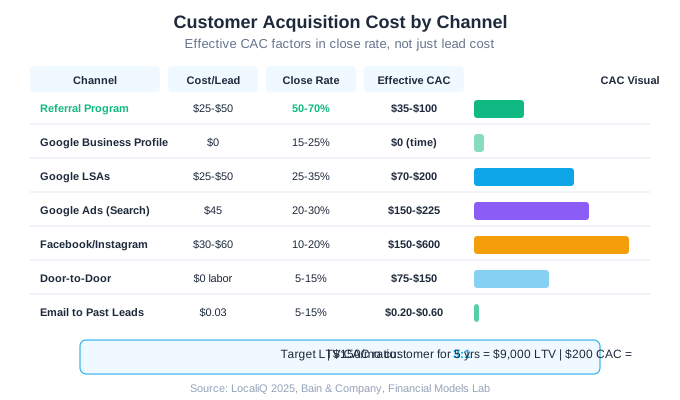
Not all channels produce customers at the same cost. Google Ads delivers pool leads at $45.15 each, but if your close rate is 25%, you need four leads to win one customer, making your true CAC closer to $180 from that channel alone. Referrals cost $25-50 in bonus payouts but close at 50-70%, cutting effective CAC in half. Understanding per-channel CAC tells you where to invest more and where to cut.
| Channel | Cost Per Lead | Typical Close Rate | Effective CAC |
|---|---|---|---|
| Google Ads (Search) | $45 | 20-30% | $150-$225 |
| Google Local Services Ads | $25-$50 | 25-35% | $70-$200 |
| Facebook/Instagram Ads | $30-$60 | 10-20% | $150-$600 |
| Referral program | $25-$50 bonus | 50-70% | $35-$100 |
| Google Business Profile (organic) | $0 | 15-25% | $0 (time only) |
| Door-to-door flyers | $0.10-$0.50 each | 2-5% | $5-$25 per door |
| Vehicle wrap (amortized) | $42/month | Varies | $0.48 per 1,000 views |
| Email to past leads | $0.03/email | 5-15% | $0.20-$0.60 |
Cost per click for Pool & Spa companies increased over 46% in 2025 according to LocaliQ data. If your Google Ads CAC keeps climbing, shift more budget to referrals and organic channels that compound over time.
How Does CAC Compare to Customer Lifetime Value?
Customer lifetime value (LTV) is the total revenue a customer generates over their entire relationship with you. For pool service, a customer paying $150/month who stays for 5 years has an LTV of $9,000. The LTV-to-CAC ratio tells you whether you can afford to keep acquiring customers at your current cost. The widely accepted benchmark is 3:1, meaning you earn $3 for every $1 spent on acquisition.
| LTV:CAC Ratio | What It Means | Action |
|---|---|---|
| Below 1:1 | Losing money on every customer | Stop spending, fix pricing or retention |
| 1:1 to 2:1 | Breaking even or barely profitable | Reduce CAC or increase retention |
| 3:1 | Healthy unit economics | Maintain and optimize |
| 5:1 or higher | Underinvesting in growth | Increase marketing spend to grow faster |
If your average customer stays 5 years at $150/month, your LTV is $9,000. A $200 CAC gives you a 45:1 ratio, which means you are massively underinvesting in growth. That is common in pool service. Most operators rely on word of mouth, spend almost nothing on acquisition, and grow slowly as a result. Knowing your ratio tells you how aggressively you can afford to acquire.
45:1
LTV:CAC ratio for a pool customer paying $150/mo for 5 years with $200 CAC
What Is a Good CAC for a Pool Service Company?
A good CAC for a pool service company is $100 to $250 for a recurring weekly service customer. At $150/month in service revenue, even a $250 CAC pays back within two months. The real danger is not knowing your CAC and accidentally spending $500+ per customer on channels with low close rates. Companies running Facebook ads without tracking conversions frequently fall into this trap.
Your target CAC depends on the customer type. A weekly recurring customer who pays $150/month and stays for years justifies a higher acquisition cost than a one-time green pool cleanup. Commercial accounts generating $500-$2,000/month in revenue can justify $500+ in acquisition costs because the payback period is still short and the lifetime value is enormous.
| Customer Type | Avg Monthly Revenue | Target CAC | Payback Period |
|---|---|---|---|
| Weekly residential | $125-$175 | $100-$250 | 1-2 months |
| Bi-weekly residential | $75-$100 | $75-$150 | 1-2 months |
| Commercial contract | $500-$2,000 | $250-$750 | 1-2 months |
| One-time cleanup | $250-$500 | $50-$100 | Immediate |
| Equipment repair lead | $150-$1,000 | $50-$150 | Immediate |
How Do You Reduce Customer Acquisition Cost?
The fastest way to reduce CAC is not cutting ad spend. It is improving your conversion rate. If you convert 20% of leads instead of 10%, your CAC drops by half without spending an additional dollar on marketing. The second lever is shifting spend toward lower-cost channels like referrals, organic search, and email marketing to past leads.
Seven Ways to Lower Pool Service CAC
- 1Respond to leads within 5 minutes. Speed-to-lead is the single biggest conversion factor. Companies that respond within 5 minutes are 100x more likely to make contact than those waiting 30 minutes.
- 2Build a referral program. Pay existing customers $25-50 for each referral that converts. Referred customers close at 50-70% and cost a fraction of paid advertising.
- 3Optimize your Google Business Profile. Free leads from GBP search are the lowest-cost acquisition channel available. Post weekly, respond to reviews, and keep photos current.
- 4Track conversions, not clicks. Install call tracking and form tracking so you know which ads produce actual customers, not just website visits.
- 5Retarget website visitors. Someone who visited your pricing page but did not call is warmer than a cold lead. Retargeting ads cost $2-5 CPM and convert at 2-3x the rate of cold ads.
- 6Email your unconverted leads. Most pool companies never follow up with leads that did not close. A 3-email sequence sent over 2 weeks costs almost nothing and converts 5-15% of dead leads.
- 7Raise your prices. Higher revenue per customer means your existing CAC delivers more lifetime value, improving your LTV:CAC ratio without touching marketing spend.
5-25x
how much more expensive it is to acquire a new customer vs. retaining one
Source: Bain & Company / Harvard Business Review
How Do You Track CAC Across Multiple Channels?
You need three things to track CAC by channel: a way to tag where each lead came from, a way to track which leads became customers, and a monthly summary that divides spend by conversions. Most pool service software includes a "lead source" field. Use it consistently. Every lead gets tagged: Google Ads, referral, Nextdoor, walk-in, whatever the source is.
- Use unique phone numbers for each channel (call tracking services cost $30-50/month)
- Tag every lead with its source in your CRM or pool service software
- Review monthly: total spend per channel divided by customers acquired per channel
- Include labor costs for sales activities (estimates, follow-ups, phone time)
- Track close rate by channel to identify where leads are highest quality, not just cheapest
A monthly CAC report takes 30 minutes to build and saves thousands in wasted spend. If you discover that Facebook Ads cost you $400 per acquired customer while referrals cost $50, you can reallocate that budget immediately. Most pool companies that start tracking CAC find at least one channel that is dramatically underperforming.
What Mistakes Do Pool Companies Make With CAC?
The most common mistake is not tracking CAC at all. The second most common is tracking cost per lead instead of cost per customer. A $20 lead that never converts is infinitely expensive. A $100 lead that converts to a 5-year customer paying $150/month is a bargain. Always measure CAC, not CPL, as your primary acquisition metric.
- Confusing cost per lead with cost per customer. CPL ignores close rate, which varies 5x across channels.
- Not including labor costs. If you spend 2 hours per estimate and your time is worth $75/hour, that is $150 in hidden CAC.
- Averaging across all channels. Your blended CAC hides the fact that some channels are great and some are terrible.
- Cutting the wrong channel. Cutting your highest-CPL channel might cut your highest-quality leads.
- Ignoring retention. A $50 CAC is worthless if the customer churns in 3 months. Factor in retention when evaluating channels.
Corey Adams, Pool Founder co-founder and 15-year pool veteran, puts it simply: "I used to think referrals were free. They are not. But at $35 per acquired customer versus $200+ from paid ads, they are still the best deal in the business."
Ready to streamline your pool service business?
Pool Founder gives you route optimization, automated invoicing, chemical tracking, and everything else you need to run a more profitable pool business.
Frequently Asked Questions
What is a good customer acquisition cost for a pool service company?
A good CAC for recurring pool service is $100 to $250 per customer. At $150/month in service revenue, even a $250 CAC pays back within two months. The key metric is your LTV:CAC ratio, which should be at least 3:1.
How do you calculate customer acquisition cost?
Divide your total marketing and sales costs by the number of new customers acquired in the same period. Include ad spend, referral bonuses, software costs, vehicle wrap amortization, and sales labor. Calculate monthly and by channel for the most useful data.
What is the average cost per lead for pool service companies?
Pool & Spa companies pay an average of $45.15 per lead through Google Ads, according to LocaliQ 2025 data. Google Local Services Ads range from $25 to $50 per lead. But cost per lead is not the same as cost per customer, which factors in close rates.
How does customer acquisition cost relate to lifetime value?
The LTV:CAC ratio measures whether your acquisition spending is profitable. A 3:1 ratio is the standard benchmark, meaning you earn $3 in lifetime revenue for every $1 spent on acquisition. Pool companies with strong retention often have ratios above 20:1, suggesting room to invest more in growth.
What is the cheapest way to acquire pool service customers?
Referral programs are the most cost-effective acquisition channel, delivering customers at $35 to $100 each with close rates of 50-70%. Google Business Profile optimization is free and generates organic leads. Email marketing to past leads costs $0.03 per email and converts 5-15% of unconverted prospects.
Why has customer acquisition cost increased for pool companies?
CAC has increased 60% across industries over the past five years due to rising ad costs, more competition, and privacy changes that make tracking harder. For pool companies specifically, cost per click on Google Ads for Pool & Spa increased over 46% in 2025 alone according to LocaliQ data.
Sources & References
- LocaliQ 2025 Search Ad Benchmarks for Home Services
- First Page Sage: Average Customer Acquisition Cost by Industry (B2C)
- Stripe: CAC in SaaS and Service Businesses
- Bain & Company / Harvard Business Review: Cost of Retention vs. Acquisition
- Financial Models Lab: Pool Maintenance Operating Costs
- Comrade Web: 50 Home Services Industry Statistics for 2026