Cash Flow Kills More Pool Companies Than Bad Service
Cash flow management is the difference between a pool service company that grows and one that closes in January. The pool industry is seasonal by nature, even in Sun Belt markets. Revenue peaks in summer and drops in winter. The bills do not follow the same curve. Truck payments, insurance, and loan payments stay flat twelve months a year.
The average small business can survive only 27 days without cash inflows. For seasonal service businesses like pool companies, that number is even more dangerous because your slowest month might collect 40 to 60% less than your peak month.
27 days
is how long the average small business can survive without cash inflows
Source: JPMorgan Chase Institute
Corey Adams learned this the hard way: "My second year in business, I had a great summer. Made more money than I had ever seen. By February, I was sweating payroll because I had spent like summer was going to last forever. That is when I learned to build a cash reserve and forecast, not just react."
The Seasonal Cash Flow Pattern
How Much Cash Reserve Does a Pool Company Need?
Financial advisors recommend three to six months of operating expenses as a cash reserve for most small businesses. For pool service companies with seasonal revenue swings, you should target the higher end of that range. A pool company spending $15,000 per month on overhead needs $60,000 to $90,000 in reserve.
That sounds like a big number if you are just starting out. The good news is that you do not need to build it overnight. Start with a target of one month of operating expenses and add to it every peak-season month until you hit three months. Here is a realistic timeline.
| Business Stage | Revenue/Month | Operating Expenses | Reserve Target |
|---|---|---|---|
| Solo operator (0-50 pools) | $5,000-$10,000 | $3,000-$5,000 | $9,000-$15,000 |
| Small crew (50-100 pools) | $10,000-$25,000 | $7,000-$15,000 | $21,000-$45,000 |
| Multi-route (100-200 pools) | $25,000-$50,000 | $15,000-$30,000 | $45,000-$90,000 |
| Established (200+ pools) | $50,000+ | $30,000+ | $90,000+ |
Only 39% of small businesses have less than one month of cash reserves, according to a Bluevine survey. Do not be in that group. Start setting aside 10 to 15% of every peak-season deposit into a separate savings account the day it hits your bank.
How Does Monthly Recurring Billing Smooth Cash Flow?
Monthly recurring billing is the single most powerful cash flow tool for pool service companies. When 80%+ of your customers are on flat monthly rates with autopay, your revenue becomes predictable. You know exactly how much money is arriving on the 1st, the 15th, or whatever billing date you set.
Compare that to per-visit billing, where revenue fluctuates weekly based on how many pools you complete, how many customers skip a week, and how fast they pay their invoices. The administrative overhead alone of chasing per-visit payments costs hours every week.
| Billing Method | Revenue Predictability | Collection Speed | Admin Time |
|---|---|---|---|
| Monthly + autopay | High | Same-day | Under 2 hrs/week |
| Monthly + manual pay | High | 7-14 days avg | 3-5 hrs/week |
| Per-visit invoicing | Low | 14-30 days avg | 5-8 hrs/week |
| Per-visit + autopay | Moderate | Same-day | 2-3 hrs/week |
Bill-ahead invoicing takes this a step further. Instead of billing at the end of the service period, you invoice at the beginning. The customer pays for April service in early April, not in May. This eliminates the 30 to 40 day float between doing the work and getting paid, which for a company with $30,000 in monthly billing represents $30,000 in working capital you no longer need to carry.
56%
of small businesses are owed money from unpaid invoices, averaging $17,500 per business
Source: Intuit QuickBooks, 2025
What Is a 13-Week Cash Flow Forecast and How Do You Build One?
A 13-week cash flow forecast is a rolling weekly projection of your cash inflows and outflows for the next quarter. It is the most practical financial tool for a pool company owner because it tells you, with reasonable accuracy, whether you will have enough cash to cover your obligations each week for the next three months.
Building one takes about 30 minutes per week once you set up the template. Here is how to do it.
- 1Start with your current bank balance. This is your starting cash position for week one.
- 2Project weekly inflows. For recurring monthly customers, divide their monthly payment by 4.33 weeks to get a weekly average. For per-visit customers, use your trailing 4-week average of collections.
- 3List all outflows by week. Fixed costs (rent, insurance, loan payments) go in the specific week they hit. Variable costs (chemicals, fuel, payroll) use your trailing 4-week average.
- 4Calculate net cash per week. Inflows minus outflows. Running total shows your projected bank balance each week.
- 5Update weekly. Replace the completed week with actual numbers and add a new week 13. This rolling update keeps the forecast accurate.
The 13-week forecast is your early warning system. If week 8 shows a negative balance, you have seven weeks to cut a cost, collect an overdue invoice, or line up a short-term credit line. Without the forecast, you find out when the bank account hits zero.
A simple spreadsheet works for this. You do not need accounting software or a CFO. The discipline of updating it weekly matters more than the tool you use.
How Do You Build a Cash Reserve During Peak Season?
Peak season (May through September in most markets) is when you build the reserve that carries you through the slow months. The mistake most pool company owners make is spending their summer profits on lifestyle upgrades or equipment they do not need yet. The cash reserve comes first.
The Percentage Method
Set aside a fixed percentage of every deposit during peak months. Start with 10% if cash is tight, and increase to 15 to 20% as your revenue grows. The money goes into a separate savings account that you do not touch unless your 13-week forecast shows a shortfall.
The Profit First Method
Allocate every dollar that hits your bank into separate accounts by purpose: operating expenses (50 to 60%), owner pay (20 to 30%), taxes (15%), and profit/reserve (5 to 15%). This forces you to run the business on what is left after setting aside reserves, not the other way around.
The Seasonal Adjustment Method
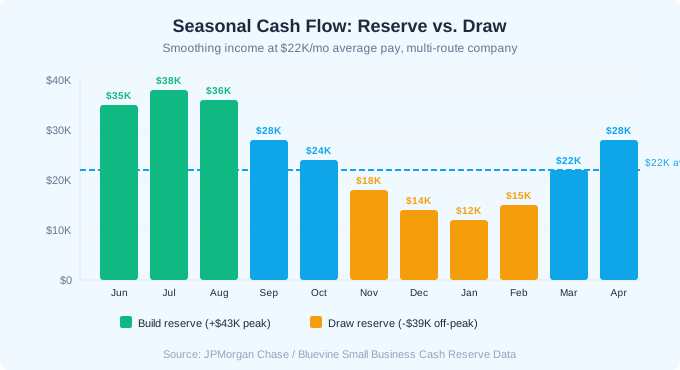
If your winter revenue is 50% of your summer revenue, calculate your average monthly revenue across all 12 months. Pay yourself that average every month, regardless of season. In summer, the excess goes to reserve. In winter, the reserve covers the gap. This smooths your personal income and builds the reserve automatically.
| Month | Revenue | Avg Monthly Pay | Reserve Contribution | Reserve Draw |
|---|---|---|---|---|
| June (peak) | $35,000 | $22,000 | +$13,000 | - |
| July (peak) | $38,000 | $22,000 | +$16,000 | - |
| August (peak) | $36,000 | $22,000 | +$14,000 | - |
| December (slow) | $14,000 | $22,000 | - | -$8,000 |
| January (slow) | $12,000 | $22,000 | - | -$10,000 |
What Fixed Costs Should You Minimize to Protect Cash Flow?
Fixed costs are what kill pool companies in the off-season because they do not flex with your revenue. Every dollar of fixed cost you can reduce or convert to a variable cost makes your business more resilient during slow months.
- Office space: Most pool companies do not need an office until they have 3+ techs. Run from home and take the home office deduction ($1,500/year simplified). That is $12,000 to $24,000 per year in rent you are not paying.
- Vehicle payments: Buy used instead of new. A $300/month payment on a used truck is $250/month less than a $550/month payment on a new one. Over 48 months, that is $12,000 in cash preserved.
- Software subscriptions: Audit every subscription quarterly. Cancel anything you are not actively using. Most pool companies need field service software, accounting software, and nothing else.
- Equipment loans: Pay cash for equipment when possible. Every loan payment is a fixed obligation that stays the same whether you are servicing 100 pools or 60.
- Payroll: In the early stages, use 1099 contractors for overflow work instead of W-2 employees. This converts your biggest fixed cost into a variable one. As you grow, hire full-time only when you have the recurring revenue to support it.
The goal is to keep your monthly fixed costs (the amount you owe even if revenue drops to zero) under 40% of your average monthly revenue. If your fixed costs exceed that, you are one bad month away from trouble.
How Should You Handle Late-Paying Customers?
Late payments are a cash flow leak that compounds over time. One customer 30 days late is manageable. Ten customers 30 days late means you are floating $3,000 to $5,000 that should be in your bank account. Here is a system that minimizes late payments without burning customer relationships.
- 1Default to autopay. Make autopay the standard at signup. Present it as the default, not an option. "We collect on the 1st via the card on file" is easier to accept than "Would you like to set up autopay?"
- 2Send reminders before the due date. A 3-day advance email reminder with the invoice amount and payment link catches most forgetful payers before they are technically late.
- 3Automate follow-up on the due date. If payment has not been received by 5 PM on the due date, send an automatic email and text. Do not wait a week.
- 4Call at 7 days past due. A friendly phone call at one week past due resolves 80% of outstanding balances. Most late payments are not intentional.
- 5Pause service at 14 days past due. Send a written notice that service will be suspended until the balance is cleared. Follow through. Continuing to service a non-paying customer signals that payment is optional.
- 6Set a hard cutoff at 30 days. Any balance over 30 days gets a final notice and a 7-day deadline before you close the account and send the balance to collections or write it off.
This system works because it is consistent and automated. Your billing software should handle steps 1 through 3 without you touching anything. You only intervene at step 4, and only for the small percentage of customers who slip past the automated reminders.
Ready to streamline your pool service business?
Pool Founder gives you route optimization, automated invoicing, chemical tracking, and everything else you need to run a more profitable pool business.
Frequently Asked Questions
How much cash reserve should a pool service company have?
Target three to six months of operating expenses. A solo operator spending $4,000 per month needs $12,000 to $24,000 in reserve. A multi-route company spending $25,000 per month needs $75,000 to $150,000. Build it gradually by setting aside 10 to 20% of peak-season revenue.
What is the best billing method for pool service cash flow?
Monthly recurring billing with autopay and bill-ahead invoicing is the best combination. Autopay eliminates payment delays, monthly billing smooths revenue, and bill-ahead means you collect before performing the work. This combination can cut your average collection time from 14 to 30 days down to same-day.
How do pool companies handle seasonal cash flow dips?
Build a cash reserve during peak season by setting aside 10 to 20% of every deposit. Use a 13-week rolling cash flow forecast to anticipate shortfalls. Keep fixed costs low so your break-even point is achievable even in slow months. Consider off-season revenue like equipment repairs, pool openings, and filter cleans.
What is a 13-week cash flow forecast?
A 13-week cash flow forecast is a rolling weekly projection of cash in and cash out for the next quarter. It shows your projected bank balance each week, giving you early warning of shortfalls. Update it weekly by replacing actual numbers for the past week and adding a new week at the end.
How do I get pool customers to pay on time?
Default to autopay at signup, send 3-day advance reminders, automate follow-up on the due date, call at 7 days past due, and pause service at 14 days. Consistency is key. With autopay and bill-ahead, you can collect from 80 to 90% of customers on the invoice date with no manual effort.
What percentage of revenue should go to a cash reserve?
During peak season, set aside 10 to 20% of every deposit into a separate savings account. At 15% of $35,000 in monthly peak revenue, you bank $5,250 per month. Over five peak months, that builds a $26,250 reserve, enough to cover three months of $8,000/month in fixed costs.
Sources & References
- JPMorgan Chase Institute - Small Business Cash Buffer Research
- Bluevine - 39% of SMBs Have Less Than a Month of Cash Reserve
- Intuit QuickBooks - Small Business Late Payments Report 2025
- Relay Financial - How Much Cash Reserves Should a Business Have
- ScaleLab CFO - Small Business Cash Flow Management 2026 Guide