Phosphates Are a Real Issue. But Not Every Pool Needs a Phosphate Remover.
Phosphates are a food source for algae. They enter pool water through fill water, landscaping fertilizer, organic debris, and certain pool chemicals. High phosphate levels do not directly cause algae, but they make it easier for algae to bloom when chlorine drops even briefly. The pool industry is split on phosphate management. Some companies treat every pool monthly. Others never test for phosphates at all. The truth is somewhere in the middle: test when you have a reason, treat when levels justify the cost, and do not turn phosphate removal into a recurring upsell that provides no value.
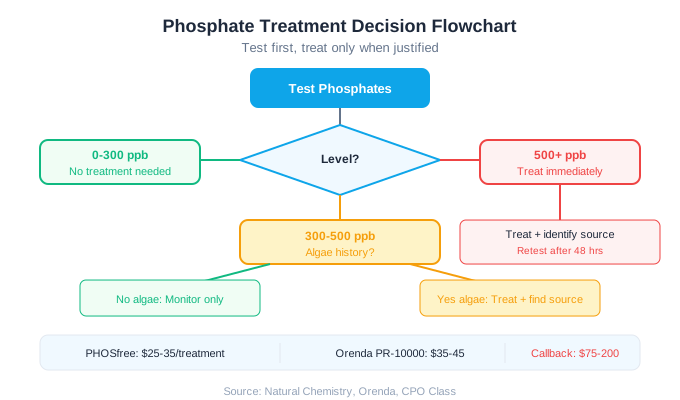
Corey Adams, Pool Founder co-founder and 15-year pool service veteran, takes a practical approach. "I test phosphates when a pool has recurring algae despite good chlorine levels. If phosphates are above 500 ppb, I treat. If they are below 300, I do not waste the customer's money. Phosphate removers work, but they are not cheap, and the phosphates come right back if the source is not addressed."
This guide covers how phosphates enter pool water, testing methods and thresholds, how lanthanum-based removers work, cost analysis, and when routine treatment makes sense versus when it does not.
What Are Phosphates and How Do They Get Into Pool Water?
Phosphates are naturally occurring compounds containing phosphorus and oxygen. In pool water, they exist as orthophosphates (the form algae can directly consume). Phosphates are measured in parts per billion (ppb), not parts per million, because even small concentrations can serve as an algae nutrient source. Pool water can accumulate phosphates from multiple sources simultaneously.
What Are the Common Sources of Phosphates in Pools?
| Source | How It Enters | Typical Contribution |
|---|---|---|
| Municipal fill water | Tap water contains phosphates from water treatment | 50-500 ppb depending on the water district |
| Lawn fertilizer | Runoff and overspray from lawn treatment enters pool | Can spike phosphates to 1,000+ ppb after application |
| Leaves and organic debris | Decomposing plant matter releases phosphates | Gradual buildup, worse in fall and spring |
| Swimmer contamination | Sweat, body oils, and sunscreen contain phosphorus compounds | Low per swimmer, cumulative on high-use pools |
| Certain pool chemicals | Some scale inhibitors and sequestrants contain phosphonates | Read product labels. Phosphonate-based products add phosphates. |
| Soil and dust | Wind-blown dirt enters the pool | Moderate. Worse in desert and agricultural areas. |
Check the label on your metal sequestrant and scale prevention products. If the active ingredient is a phosphonate (like HEDP or ATMP), you are adding phosphates to the pool every time you use them. Switch to a non-phosphonate sequestrant if phosphate management is a concern.
How Do You Test for Phosphates in Pool Water?
Phosphate testing requires a specific test kit because standard pool test kits (including the Taylor K-2006) do not measure phosphates. The Taylor K-1106 is the most common professional phosphate test kit. It uses a colorimetric method with two comparator cards: one for 0-1,000 ppb and one for 0-6,000 ppb. Some digital photometers also offer phosphate testing with compatible reagent tablets.
When Should You Test for Phosphates?
- When a pool has recurring algae despite maintaining proper free chlorine levels
- After a green pool recovery to establish a baseline before ongoing maintenance
- After heavy fertilizer application in the surrounding landscape
- On new customer pools during the initial chemistry assessment
- Quarterly as part of a comprehensive chemistry check on all pools
- Immediately when persistent algae defies normal treatment protocols
Do not test phosphates on every weekly visit. The levels change slowly unless there is a specific influx event (fertilizer runoff, heavy debris). Monthly or quarterly testing is sufficient for routine monitoring. Target the cost of testing where it provides diagnostic value.
What Do Phosphate Levels Mean?
| Phosphate Level | Status | Recommended Action |
|---|---|---|
| 0-100 ppb | Low | No treatment needed. Continue normal maintenance. |
| 100-300 ppb | Moderate | Monitor. No treatment needed if chlorine is maintained. |
| 300-500 ppb | Elevated | Consider treatment if the pool has a history of algae problems. |
| 500-1,000 ppb | High | Treat with a phosphate remover. Identify and address the source. |
| 1,000+ ppb | Very High | Treat immediately. Likely an ongoing external source (fertilizer, fill water). |
How Do Phosphate Removers Work?
Most pool phosphate removers use lanthanum chloride as the active ingredient. Lanthanum is a rare earth element that binds to phosphate ions in the water, forming lanthanum phosphate, an insoluble compound that precipitates out of solution. The lanthanum phosphate particles are then captured by the pool filter. This is a chemical removal process, not a biological one. The phosphates are permanently removed from the water.
What Happens After Adding a Phosphate Remover?
- 1The lanthanum chloride disperses through the water and binds with orthophosphate ions.
- 2Lanthanum phosphate forms as a fine, milky-white precipitate. The water will cloud slightly. This is normal.
- 3The precipitate is captured by the filter over the next 24 to 48 hours.
- 4Clean or backwash the filter 24 to 48 hours after treatment to remove the captured precipitate.
- 5Retest phosphate levels after cleaning the filter. If levels are still above target, a second treatment may be needed.
Warn the customer that the water will cloud temporarily after phosphate remover treatment. This is not a problem. It is the product working. The cloudiness clears as the filter captures the precipitate, typically within 24 to 48 hours. If you do not explain this, you will get a call.
How Much Phosphate Can Removers Handle?
Product capacity varies significantly. Natural Chemistry PHOSfree removes approximately 2,000 ppb of phosphates per liter per 10,000 gallons. Orenda PR-10000 removes approximately 10,000 ppb per liter per 10,000 gallons, making it far more concentrated and cost-effective for high-phosphate situations. Always read the product label for dosing based on your specific phosphate level and pool volume.
Is Routine Phosphate Treatment Worth the Cost?
This is the most debated question in phosphate management. The answer depends on the pool, the phosphate source, and the customer. Here is a cost-benefit analysis based on typical service pricing.
| Cost Item | Typical Cost | Frequency |
|---|---|---|
| Phosphate test (Taylor K-1106) | $3-5 per test | Monthly or quarterly |
| PHOSfree (1 liter, treats 2,000 ppb in 10,000 gal) | $25-35 per treatment | As needed |
| Orenda PR-10000 (1 liter, treats 10,000 ppb in 10,000 gal) | $35-45 per treatment | As needed |
| Annual routine treatment (quarterly) | $100-180 per year | 4 treatments per year |
| Single algae callback (chemicals + labor) | $75-200 per incident | Variable |
When Is Routine Treatment Justified?
- Pools adjacent to heavily fertilized lawns or golf courses where phosphate influx is constant
- Pools with fill water above 300 ppb phosphates (test the source water to verify)
- Pools with recurring algae despite proper chlorine management, where phosphates are the identified contributing factor
- Commercial pools with high bather loads and continuous contamination
When Is It Not Worth the Cost?
- Pools that maintain consistent FC of 2-4 ppm with no algae history
- Pools with phosphate levels consistently below 300 ppb
- As a blanket treatment on every pool on the route without testing first
- As a substitute for proper chlorine management (phosphate removal does not sanitize water)
"I have had customers ask me to treat phosphates on pools that are crystal clear and have zero algae history. That is a $35 product application that provides zero value," Corey says. "Test first. If phosphates are low and the pool is clean, the money is better spent elsewhere."
How Do You Address the Phosphate Source?
Removing phosphates without addressing the source is like bailing water without plugging the hole. The phosphates will return. After treatment, identify the source and take steps to reduce the influx. This is where the real value of phosphate management lies.
Source Reduction Strategies
| Source | Reduction Strategy |
|---|---|
| Lawn fertilizer runoff | Ask the customer to switch to phosphate-free fertilizer or to apply fertilizer when the wind is blowing away from the pool. Build a small berm or redirect drainage away from the pool deck. |
| High-phosphate fill water | Pre-treat fill water with a phosphate remover, or install a pre-filter with a phosphate removal cartridge on the fill line. |
| Leaf and organic debris | Keep pool covered when not in use. Skim and vacuum regularly. Trim overhanging branches. |
| Phosphonate-based chemicals | Switch to non-phosphonate sequestrants and scale inhibitors. Check product labels for phosphonic acid or HEDP. |
| Swimmer contamination | Encourage pre-swim showering (especially on commercial pools). This reduces phosphate and other contaminant input. |
On residential routes, the most common and impactful source is lawn fertilizer. A single fertilizer application near the pool can spike phosphates from 100 ppb to 1,000+ ppb. If the homeowner fertilizes monthly during growing season, phosphate treatment will be needed after each application unless the source is redirected.
Do Phosphates Affect Salt Cells or Other Equipment?
Phosphates at typical pool concentrations (under 1,000 ppb) do not directly damage pool equipment, salt cells, or surfaces. The concern is indirect: phosphates feed algae, and algae outbreaks create demand on the chlorine system, lead to chemical corrections that stress equipment, and can clog filters. Some manufacturers claim that high phosphates reduce salt cell efficiency, but peer-reviewed evidence for this is limited.
The Practical Impact on Service
The real cost of unmanaged phosphates is not equipment damage. It is algae callbacks. Each algae callback costs $75 to $200 in chemicals, labor, and drive time. If phosphate management prevents even one or two algae callbacks per year on a problem pool, it pays for itself. On pools with no algae history, the investment provides no measurable return.
Track phosphate levels in your service software alongside algae incidents. Over a season, you will see which pools have a phosphate-algae correlation and which do not. This data lets you target phosphate treatment where it actually matters instead of applying it blindly across your entire route.
Run a pool route?
The business side of what you just read.
Pricing, chemical costs, and the tools owners use to keep the numbers straight.
- Commercial pool service pricing2026 rate tables and the cost-plus formula
- Chemical cost per poolWhat chemicals actually cost per stop
- Chemical tracking softwareLog readings and dosing from the pool deck
- Pool service softwareRoutes, invoicing, and service reports in one app
- Free profit & rate calculatorsProfit per pool, minimum rate, break-even
Frequently Asked Questions
What causes high phosphates in a swimming pool?
The most common sources are lawn fertilizer runoff, municipal fill water, decomposing leaves and organic debris, swimmer contamination (sweat, sunscreen), and phosphonate-based pool chemicals. Fertilizer is typically the biggest single source, capable of spiking phosphates from 100 ppb to over 1,000 ppb after a single application.
At what level should you treat phosphates in a pool?
Most professionals treat when phosphates exceed 500 ppb, especially on pools with a history of algae problems. Levels below 300 ppb generally do not require treatment if chlorine is properly maintained. Some service companies use a 300 ppb threshold for pools that have had recurring algae.
How do phosphate removers work?
Most pool phosphate removers use lanthanum chloride, a rare earth element that binds with phosphate ions to form lanthanum phosphate, an insoluble precipitate. The precipitate clouds the water temporarily and is captured by the pool filter over 24 to 48 hours. Clean the filter after treatment to remove the captured material.
Do phosphates cause algae in pools?
Phosphates do not directly cause algae. They are a nutrient that algae consume for growth. A pool with high phosphates but proper chlorine levels (2-4 ppm FC) will not grow algae. However, high phosphates make algae blooms more likely and more aggressive when chlorine drops even briefly. Reducing phosphates lowers the risk of blooms during lapses in sanitizer coverage.
How much does phosphate treatment cost?
A single phosphate treatment costs $25 to $45 in product depending on the remover used and the phosphate level. PHOSfree runs about $25-35 per liter and treats 2,000 ppb in 10,000 gallons. Orenda PR-10000 runs $35-45 per liter but treats 10,000 ppb in 10,000 gallons, making it more cost-effective for high-phosphate situations.
Should I treat phosphates on every pool on my route?
No. Test first and treat only pools where phosphate levels justify the cost. Blanket-treating every pool wastes the customer money on pools that do not have a phosphate problem. Target treatment on pools above 500 ppb with algae history, and address the phosphate source to reduce the need for repeat treatments.