Which Pool Equipment Energy Upgrades Actually Pay for Themselves?
Pool equipment energy efficiency upgrades are one of the most common upsells in the service industry. Variable speed pumps, LED lights, heat pumps, automation systems. Every manufacturer claims huge savings. Some of those claims are legitimate. Others are wildly optimistic or depend on conditions that do not apply to most residential pools. The difference between a smart recommendation and a bad one comes down to knowing the actual numbers.
Corey Adams, Pool Founder co-founder and 15-year pool service veteran, has installed hundreds of energy efficiency upgrades across every brand. "I stopped recommending upgrades based on manufacturer brochures years ago. I recommend them based on what I have seen actually save money on real pools in real climates. A variable speed pump saves real money on almost every pool. A pool automation system on a 12,000-gallon residential pool with one pump and no heater? That is a $2,500 gadget that will never pay for itself."
This guide covers every major energy efficiency upgrade with documented savings data from the DOE, ENERGY STAR, and manufacturer specs. Every payback period is calculated using real installed costs and typical residential utility rates.
How Much Energy Does Pool Equipment Actually Use?
Before evaluating upgrades, you need to understand the baseline. A typical residential pool with a single-speed pump, incandescent light, and gas heater consumes 3,000 to 5,000 kWh of electricity per year for the pump alone, plus gas for heating. At the national average electricity rate of roughly $0.16 per kWh, that is $480 to $800 per year just to circulate water. The pump is the single largest energy consumer on the equipment pad, accounting for 60-75% of total pool electricity use.
| Equipment | Typical Wattage | Daily Run Hours | Annual kWh | Annual Cost |
|---|---|---|---|---|
| Single-speed pump (1.5 HP) | 1,500-2,200W | 8-12 hrs | 4,380-9,636 kWh | $700-$1,540 |
| Variable-speed pump (1.5 HP) | 200-600W avg | 8-12 hrs | 584-2,628 kWh | $93-$420 |
| Incandescent pool light | 300-500W | 4-6 hrs | 438-1,095 kWh | $70-$175 |
| LED pool light | 40-55W | 4-6 hrs | 58-120 kWh | $9-$19 |
| Gas heater (electric draw) | 50-100W | Varies | Minimal electric | $200-$500/mo gas |
| Heat pump | 1,200-2,500W | Varies | Varies | $50-$100/mo electric |
The DOE estimates that a certified ENERGY STAR in-ground pool pump uses up to 65% less energy than a standard pump and can save up to $450 per year in energy costs. That single upgrade is the highest-return investment on the pad.
Are Variable Speed Pool Pumps Worth the Upgrade?
Yes. A variable speed pump is the single most impactful energy efficiency upgrade you can recommend. The physics are straightforward. The Affinity Law states that energy consumption is proportional to the cube of pump speed. Cut the speed in half and you reduce energy use by a factor of eight. A variable speed pump running at 1,200 RPM instead of 3,450 RPM uses dramatically less electricity while still turning over the water adequately.
60-80%
Energy reduction when switching from single-speed to variable-speed pump
Source: DOE, ENERGY STAR, 2025
Since July 2021, the DOE has required all new pool pump motors at or above 0.5 THP to be variable speed. This means replacement pumps for most in-ground pools must be variable speed by law. The question is not whether to upgrade, it is which pump to choose and how to program it correctly for maximum savings.
What Is the Payback Period for a Variable Speed Pump?
| Scenario | Installed Cost | Annual Savings | Payback Period |
|---|---|---|---|
| Replace failed single-speed (incremental cost over SS) | $400-$800 | $300-$600 | 0.8-2 years |
| Proactive replacement of working single-speed | $1,200-$2,500 | $300-$600 | 2-5 years |
| Small pool (<15,000 gal) in mild climate | $1,200-$1,800 | $200-$350 | 3.5-7 years |
| Large pool (>25,000 gal) in hot climate | $1,500-$2,500 | $500-$700 | 2-4 years |
The strongest recommendation is when a single-speed pump fails. At that point the customer is buying a pump regardless, and the incremental cost of variable speed over a hypothetical single speed is $400-$800, with savings that recoup the difference in under two years. Proactive replacement of a working single-speed pump is harder to justify financially unless the pump is already 8+ years old and approaching end of life.
Programming matters as much as the hardware. A variable speed pump set to run at 3,450 RPM all day saves nothing. Most residential pools achieve adequate turnover at 1,200-1,800 RPM running 10-12 hours per day. Program the pump correctly or the customer will not see the savings you promised.
Should You Recommend LED Pool Light Upgrades?
LED pool lights use 80-87% less energy than incandescent pool lights. A typical incandescent pool light draws 300-500 watts, while an equivalent LED draws 40-55 watts and produces comparable or better illumination. At four hours of use per night, that is roughly $60-$155 per year in savings depending on your local electricity rate.
What Does an LED Pool Light Upgrade Cost?
A complete LED fixture replacement runs $700-$1,500 installed, depending on the brand, niche size, and wire run. An LED drop-in bulb that fits an existing fixture costs $100-$250 but delivers lower lumen output than a purpose-built LED fixture. The payback period for a full fixture swap on energy savings alone is 5-10+ years, which makes this a hard sell purely on efficiency.
The real value of LED pool lights is the lifespan and maintenance reduction. Incandescent bulbs last 1,000-3,000 hours. LED fixtures last 25,000-50,000 hours, which is 10-20 years at typical pool use. If you are replacing an incandescent bulb every 2-3 years at $50-$100 per bulb plus labor, the LED pays back faster when you factor in avoided service calls.
| Factor | Incandescent | LED |
|---|---|---|
| Wattage | 300-500W | 40-55W |
| Lumens | 3,000-4,500 | 3,000-5,000 |
| Annual energy cost (4 hrs/day) | $70-$175 | $9-$19 |
| Bulb/fixture lifespan | 1,000-3,000 hrs | 25,000-50,000 hrs |
| Replacement cost (installed) | $150-$300 (bulb) | $700-$1,500 (fixture) |
| Color options | White only | White + color changing |
Recommend LED upgrades when the existing incandescent bulb fails, not as a standalone energy play. The customer gets better light, color options, and a decade without bulb changes. Energy savings are a bonus, not the justification.
Is a Heat Pump Worth It vs. a Gas Pool Heater?
Heat pumps are dramatically more efficient than gas heaters. A gas heater operates at 80-95% thermal efficiency (COP of 0.8-0.95), meaning for every dollar of gas burned, you get 80-95 cents of heat. A heat pump operates at a COP of 5.0-6.5, meaning for every dollar of electricity, you get $5 to $6.50 worth of heat. That is a 5-7x efficiency advantage. The DOE confirms that heat pump pool heaters have much lower annual operating costs because of their higher efficiencies.
5.0-6.5 COP
Typical heat pump coefficient of performance vs 0.8-0.95 for gas heaters
Source: DOE, 2025
What Is the Real-World Cost Comparison?
Heating a 20,000-gallon pool for a full season might cost $2,000 with a gas heater but only $600 with a high-efficiency heat pump. Monthly operating costs run $80-$120 for gas versus $40-$60 for a heat pump. However, heat pumps cost $2,000-$6,000 installed versus $1,500-$4,500 for a gas heater. The payback period depends on how often the pool is heated.
| Factor | Gas Heater | Heat Pump |
|---|---|---|
| Installed cost | $1,500-$4,500 | $2,000-$6,000 |
| Monthly operating cost | $80-$120 | $40-$60 |
| Annual operating cost (6 months) | $480-$720 | $240-$360 |
| COP / Efficiency | 0.8-0.95 | 5.0-6.5 |
| Heating speed | Fast (1-2 deg/hr) | Slow (0.25-0.5 deg/hr) |
| Lifespan | 5-10 years | 10-15 years |
| Climate limitation | None | Loses efficiency below 50F |
When Does a Heat Pump NOT Make Sense?
- Spa-only heating. Spas need rapid heating. A gas heater raises spa temperature 20 degrees in 30-45 minutes. A heat pump takes 4-8 hours. For spa-only use, gas is still the right recommendation.
- Cold climates with short seasons. Heat pumps lose efficiency below 50 degrees F ambient air temperature. In northern states where pool season is May through September, gas may be more practical for early and late season heating.
- Infrequent use. If the customer heats the pool twice a month for a weekend, the lower operating cost of a heat pump does not offset the higher purchase price. Gas makes more sense for occasional use.
- Natural gas is cheap locally. In areas with very low natural gas prices, the operating cost gap narrows and the payback period stretches beyond the equipment lifespan.
Do Pool Automation Systems Save Energy?
Pool automation systems from Pentair, Hayward, and Jandy range from $1,500 to $3,500+ installed. Manufacturers claim energy savings of 40-70% through smart scheduling and demand-based pump speed control. Those numbers are technically possible but rarely achieved in practice on small residential pools that only have a pump and maybe a light.
When Does Automation Actually Save Energy?
Automation delivers real savings on complex equipment pads with multiple devices: variable speed pump, heater, lights, water features, and a chlorinator. The system optimizes run times, coordinates equipment schedules, and avoids waste like running a heater while the pool cover is off. On a pool with four or more controllable devices, automation can reduce total energy use by 20-40% and save $300-$600 annually.
When Is Automation a Bad Recommendation?
- Single pump, no heater, no water features. A $2,500 automation system to control one pump and a light is over-engineering. A variable speed pump with its own built-in scheduling handles this for $0 in additional cost.
- Customer who rarely adjusts settings. If the pool runs on the same schedule year-round and the customer never changes anything, automation adds cost without behavior change. The savings come from active management, which many homeowners will not do.
- Older equipment without compatible interfaces. Retrofitting automation to an equipment pad with legacy devices often requires replacing actuators, adding relay boards, and running new wiring. Total cost can exceed $5,000, which pushes the payback past equipment lifespan.
The honest recommendation: if the customer already has a variable speed pump with scheduling capability, automation is a convenience upgrade, not an energy upgrade. Sell it on convenience and remote control, not on savings claims that will not materialize on a simple equipment pad.
What About Salt Chlorinator and Chemical Automation Savings?
Salt chlorination systems cost $1,000-$2,500 installed and generate chlorine from dissolved salt, eliminating the need to purchase liquid or tablet chlorine. The savings are real but often overstated. A typical residential pool spends $300-$600 per year on chlorine. A salt system saves roughly 50% on chemical costs once you account for salt replenishment and cell replacement every 3-7 years.
What Is the Payback on Salt Chlorination?
| Cost Factor | Traditional Chlorine | Salt System |
|---|---|---|
| Annual chlorine/salt cost | $300-$600 | $50-$100 (salt) |
| Cell replacement | N/A | $200-$900 every 3-7 yrs |
| Net annual savings | Baseline | $100-$300/yr |
| System installed cost | N/A | $1,000-$2,500 |
| Payback period | N/A | 4-10 years |
Chemical automation systems that monitor and dose chlorine and pH automatically cost $2,000-$4,000 installed. These save labor more than chemicals. For a service company, the value is in reduced chemical adjustment time per stop and more consistent water quality. For a homeowner, the value is hands-off maintenance. Energy savings from chemical automation are negligible.
Salt systems save money on chemicals but the payback is slow. The real benefits are softer water feel, no chlorine storage, and reduced chemical handling. If the customer cares about those things, it is a good recommendation. If they only care about cost savings, set realistic expectations.
How Should You Present Energy Upgrade Recommendations to Customers?
The fastest way to lose credibility is to oversell savings. Customers who spend $2,500 on an upgrade expecting to save $600 per year and then see $200 in actual savings will not trust your next recommendation. Present every upgrade with honest numbers: installed cost, realistic annual savings range, payback period, and non-financial benefits.
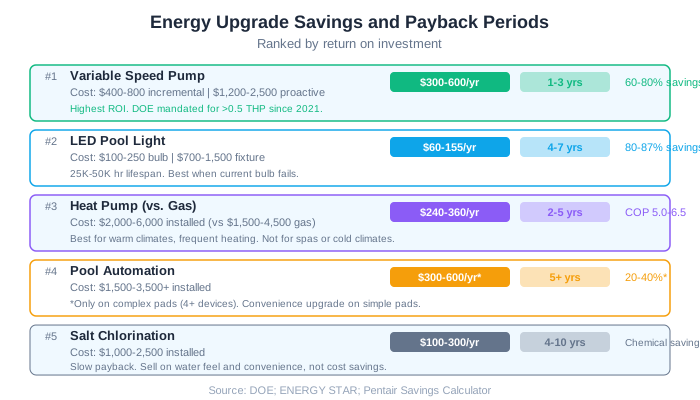
The Upgrade Priority Ranking
Based on documented savings data and real-world payback periods, here is the order in which you should recommend energy upgrades to customers.
- 1Variable speed pump (when current pump fails). Highest ROI, mandated by DOE for most replacements, 1-3 year payback on incremental cost. Recommend to every customer replacing a pump.
- 2LED pool light (when current bulb burns out). Moderate energy savings, but excellent lifespan advantage. Payback improves when you count avoided bulb replacements.
- 3Heat pump (when current heater fails, in warm climates). Strong operating cost advantage for pools heated frequently. Not ideal for spas, cold climates, or infrequent use.
- 4Pool automation (on complex equipment pads only). Real savings on pads with 4+ devices. Convenience upgrade on simple pads. Do not sell on energy savings alone.
- 5Salt chlorination (when customer values the experience). Slow payback on chemical savings. Sell on water feel, reduced chemical handling, and convenience.
Document every upgrade recommendation in your service report. Note the current equipment age, condition, and estimated remaining life. When the equipment fails, the customer already has your recommendation on file and calls you instead of shopping around.
Run a pool route?
The business side of what you just read.
Pricing, chemical costs, and the tools owners use to keep the numbers straight.
- Commercial pool service pricing2026 rate tables and the cost-plus formula
- Chemical cost per poolWhat chemicals actually cost per stop
- Chemical tracking softwareLog readings and dosing from the pool deck
- Pool service softwareRoutes, invoicing, and service reports in one app
- Free profit & rate calculatorsProfit per pool, minimum rate, break-even
Frequently Asked Questions
How much does a variable speed pool pump save per year?
A variable speed pump saves $300-$600 per year compared to a single-speed pump on a typical residential pool. The DOE and ENERGY STAR report up to 65% energy reduction. Actual savings depend on pool size, pump programming, and local electricity rates. Larger pools in warm climates with high utility rates see the biggest savings.
Are pool equipment energy upgrades required by law?
Since July 2021, DOE regulations require all new pool pump motors at or above 0.5 THP to be variable speed. This means most in-ground pool pump replacements must be variable speed by federal law. No other pool equipment upgrades are currently mandated at the federal level, though some states offer rebates for ENERGY STAR certified equipment.
Do LED pool lights really save money?
LED pool lights save $60-$155 per year in electricity compared to 300-500 watt incandescent lights. However, the installed cost of $700-$1,500 means the energy-only payback is 5-10+ years. The real value is the 25,000-50,000 hour lifespan that eliminates bulb replacements for 10-20 years.
Is a heat pump pool heater worth the extra cost over gas?
A heat pump costs $500-$2,000 more than a gas heater to install but saves $240-$360 per year in operating costs for pools heated regularly. It pays for the premium in 2-5 years. Heat pumps are best for warm climates where the pool is heated frequently. They are not ideal for spas, cold climates below 50F, or infrequent heating.
What pool energy upgrades have the fastest payback period?
The variable speed pump has the fastest payback at 1-3 years when replacing a failed single-speed pump (incremental cost basis). LED lights pay back in 4-7 years when factoring in avoided bulb replacements. Heat pumps pay back in 2-5 years in warm climates with regular use. Automation systems rarely pay back in under 5 years on simple residential pools.
Should I recommend a pool automation system for energy savings?
Only on complex equipment pads with four or more controllable devices. On a simple pad with one pump and a light, a variable speed pump with built-in scheduling handles the job. Automation is a convenience upgrade that also saves energy on complex setups, but it should not be sold primarily as an energy-saving device for basic residential pools.