Why Does Pay Structure Matter More Than Pay Amount?
Two pool technicians in the same market earning the same annual income will have completely different attitudes toward their job depending on how they are paid. The hourly tech knows exactly what each day will pay but has no financial incentive to work efficiently. The piecework tech can earn more by moving faster but worries about light route days and weather cancellations. Neither model is perfect, and the best pool companies are increasingly using hybrid structures that capture the upside of both.
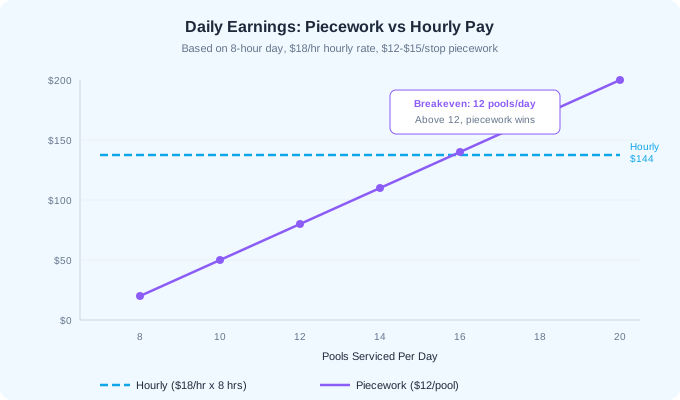
Piecework rates in pool service typically range from $10-$20 per residential pool stop, with technicians completing 15-25 stops per day according to industry data. At $12 per stop and 18 pools per day, a piecework tech earns $216/day or $27/hr equivalent, well above the $18/hr industry average for hourly techs. But that number only works when the route is full and the weather cooperates.
Regardless of pay structure, the FLSA requires that total compensation divided by total hours worked must equal or exceed the federal minimum wage ($7.25/hr, or your state minimum if higher). Overtime at 1.5x the regular rate applies after 40 hours per week for all non-exempt workers.
How Does Hourly Pay Work for Pool Technicians?
Hourly pay is the industry default. Approximately 80% of pool service companies pay technicians hourly according to industry surveys. The range is wide: $14-$17/hr for entry-level cleaners with no experience, $17-$22/hr for experienced route technicians, and $22-$30/hr for senior techs handling equipment repairs in high-cost markets like California and parts of Florida.
Pros of Hourly Pay
- Simple overtime calculation: hours over 40 x 1.5x rate. No complex math.
- Predictable labor costs for the employer. You know what each day costs before it starts.
- Employees feel secure on slow days, weather delays, and short route days.
- Easy to comply with state and federal wage laws.
- Training time, drive time, and administrative time are automatically compensated.
Cons of Hourly Pay
- No built-in incentive for efficiency. A tech who finishes 15 pools in 6 hours earns less than one who takes 8 hours.
- Top performers feel underpaid when they carry the same rate as slower workers.
- Encourages "time stretching" where some techs slow down to maximize hours.
- Harder to scale routes because faster techs are not rewarded for taking on more stops.
How Does Piecework Pay Work for Pool Technicians?
Piecework (also called per-stop or per-pool pay) compensates technicians based on the number of pools serviced rather than hours worked. Typical residential rates range from $10-$15 for basic weekly maintenance stops and $15-$20 for larger pools, pools with complex equipment, or stops that include extra services like filter cleaning or chemical balancing.
Piecework Rate Structures
| Structure | How It Works | Example | Best For |
|---|---|---|---|
| Flat per-stop | Same rate per pool regardless | $12 per pool, all pools | Simple routes, similar pool sizes |
| Tiered per-stop | Different rates by pool complexity | $10 basic, $15 complex, $20 commercial | Mixed residential/commercial routes |
| Differential piecework | Rate increases at volume thresholds | $12/pool for first 15, $15/pool after | Incentivizing high-volume days |
| Piecework + hourly base | Low hourly rate + per-stop bonus | $10/hr + $5 per pool | Guaranteeing minimum while rewarding output |
Pros of Piecework Pay
- Aligns technician incentives with business productivity. Faster work equals higher earnings.
- Top performers can earn $25-$32/hr equivalent, which is a strong retention tool.
- Encourages technicians to build route density and efficiency.
- Labor cost per pool is fixed and predictable for budgeting.
Cons of Piecework Pay
- Quality can suffer when techs rush to maximize stops. Brushing gets skipped, chemical readings get estimated.
- Light route days and weather cancellations reduce earnings, creating resentment.
- Overtime calculation is more complex (total earnings / total hours = regular rate, then add 0.5x for OT hours).
- California has additional piece-rate requirements under AB 1513 that require separate pay for rest and recovery periods.
- Technicians may resist taking on new, unfamiliar pools that slow them down.
What Is the Best Hybrid Pay Model?
The best-performing pool companies in 2026 are using hybrid models that guarantee a minimum daily or hourly rate while adding per-stop bonuses for productivity. This eliminates the downside risk of piecework (bad weather, light days) while keeping the productivity incentive.
Recommended Hybrid Structure
Base rate: $15/hr guaranteed (covers drive time, training days, weather delays). Per-stop bonus: $3-$5 per pool completed above the daily minimum of 12 stops. This structure guarantees $120/day ($15 x 8 hours) on the worst days while allowing top performers to earn $180-$220/day when completing 16-20 stops.
| Pools Completed | Hourly Only ($18/hr) | Piecework Only ($12/stop) | Hybrid ($15/hr + $4 bonus above 12) |
|---|---|---|---|
| 8 (slow day) | $144 | $96 | $120 |
| 12 (average) | $144 | $144 | $120 |
| 15 (good day) | $144 | $180 | $132 |
| 18 (great day) | $144 | $216 | $144 |
| 20 (peak) | $144 | $240 | $152 |
The hybrid model pays less than straight piecework on high-volume days but provides the income floor that technicians value. In practice, technicians on hybrid plans report higher job satisfaction and stay longer because they do not have to worry about income swings during slow periods.
With any hybrid model, you still need to calculate overtime based on the total compensation (base + bonuses) divided by total hours. The per-stop bonus increases the regular rate used for overtime calculation. Your payroll software should handle this automatically.
What Are the FLSA Compliance Requirements?
The Fair Labor Standards Act has specific rules for piecework pay that many pool companies violate unknowingly. Understanding these requirements is essential to avoid wage claims and DOL investigations.
Minimum Wage Compliance
Total piecework earnings divided by total hours worked must equal or exceed the applicable minimum wage for every workweek. If a technician earns $400 from piecework in a 50-hour week, the effective rate is $8/hr, which meets the federal minimum of $7.25 but would violate state minimums in California ($16.50), Florida ($14.00), Arizona ($14.70), and many other pool states.
Overtime Calculation for Piecework
Step 1: Calculate total piecework earnings for the week. Step 2: Divide by total hours worked to get the regular rate. Step 3: Multiply the regular rate by 0.5. Step 4: Multiply that half-rate by the number of overtime hours (hours over 40). Step 5: Add the overtime premium to total piecework earnings.
Example: A technician earns $900 from stops in a 50-hour week. Regular rate = $900 / 50 = $18/hr. Overtime premium = $18 x 0.5 = $9/hr x 10 overtime hours = $90. Total pay = $900 + $90 = $990.
California AB 1513 Requirements
California has the strictest piecework requirements in the country. Under AB 1513, employers must separately compensate piece-rate employees for rest and recovery periods and other nonproductive time at a rate no less than the higher of the applicable minimum wage or the average piece-rate for that pay period. This means a pool tech in California earning $15/stop must be separately paid for 10-minute rest breaks at an hourly rate calculated from their piecework earnings.
If you operate in California and use piecework pay, consult an employment attorney. The AB 1513 calculations are complex and the penalties for violations include back pay plus liquidated damages (double the unpaid amount).
How Do Real Pool Companies Structure Compensation?
Compensation structures vary significantly by region, company size, and business model. Here is what actual pool companies are paying across different markets based on industry data and job postings from Indeed, ZipRecruiter, and Glassdoor.
| Market | Common Model | Typical Rate | Annual Earnings (Full Route) |
|---|---|---|---|
| Phoenix, AZ | Piecework | $10-$14 per stop | $35,000-$48,000 |
| Tampa, FL | Hourly | $16-$20/hr | $33,000-$42,000 |
| Dallas, TX | Hybrid | $14/hr + $3/stop bonus | $38,000-$50,000 |
| Los Angeles, CA | Hourly (AB 1513) | $20-$28/hr | $42,000-$58,000 |
| Las Vegas, NV | Piecework | $12-$16 per stop | $38,000-$52,000 |
| Atlanta, GA | Hourly | $14-$18/hr | $29,000-$37,000 |
The highest-earning technicians across all markets are experienced piecework techs in dense residential areas who can consistently service 18-22 pools per day. At $14/stop and 20 stops per day, that is $280/day or $72,800/year before overtime. These top performers earn more than many office workers in the same market, which is why the best pool companies use piecework to attract and retain talent.
$38,000-$75,000
annual earnings range for pool technicians depending on pay model, market, and productivity
How Should You Handle Performance Bonuses?
Beyond the base compensation model, performance bonuses are the most effective retention and quality tool in pool service. The best bonus structures tie payments to measurable outcomes that benefit both the company and the customer.
Effective Bonus Structures
| Bonus Type | Typical Amount | Metric | Why It Works |
|---|---|---|---|
| Quality bonus | $100-$200/mo | Callback rate under 3% | Prevents rushing on piecework |
| Attendance bonus | $50-$100/mo | Zero unexcused absences | Solves the #1 reliability issue |
| Upsell commission | 10-15% of sale | Equipment repairs, filter replacements | Generates revenue, rewards expertise |
| Customer retention | $50-$100/quarter | Zero customer losses on route | Aligns tech with company growth |
| Referral bonus | $200-$500 | Each new tech hire that stays 90 days | Best recruiting source for pool companies |
A quality bonus paired with piecework pay is the strongest combination. The piecework incentivizes speed while the quality bonus prevents shortcuts. A technician earning $12/stop who loses a $200/month quality bonus for excessive callbacks has a clear financial reason to do thorough work at every stop.
Performance bonuses must be included in the regular rate calculation for overtime purposes. A $200 monthly quality bonus paid in a 4-week month adds $1.25/hr to the regular rate ($200 / 160 hours). This increases the overtime premium. Your payroll software should handle this.
Which Pay Model Should You Choose?
The right pay model depends on your company size, route density, market, and management capacity. Here is a decision framework.
Choose Hourly If:
- You have 1-3 technicians and cannot closely monitor quality on piecework.
- Your routes include significant drive time (spread-out service areas).
- You operate in California and want to avoid AB 1513 compliance complexity.
- Your technicians handle repairs and equipment work alongside cleaning (variable time per stop).
- You prioritize simplicity and FLSA compliance over productivity optimization.
Choose Piecework or Hybrid If:
- You have dense residential routes with 15+ similar pools per route.
- You have quality control systems in place (photo documentation, customer notifications, GPS tracking).
- You want to attract and retain top performers who can out-earn hourly rates.
- You have 5+ technicians and need to scale without micromanaging productivity.
- Your route density supports 15-20 stops per day with minimal drive time.
If you are transitioning from hourly to piecework, set the per-stop rate so that a technician working at average speed earns the same as their current hourly rate. Then let top performers earn more. Never use a pay structure change to reduce total compensation.
Ready to streamline your pool service business?
Pool Founder gives you route optimization, automated invoicing, chemical tracking, and everything else you need to run a more profitable pool business.
Frequently Asked Questions
What is the average piecework rate per pool in 2026?
Residential pool piecework rates range from $10-$20 per stop depending on market, pool size, and services included. The most common range for basic weekly maintenance is $10-$15 per stop. Complex pools, commercial properties, and stops requiring chemical balancing or filter cleaning command $15-$20 per stop.
Can I pay pool technicians per stop without overtime?
No. Piecework employees are still entitled to overtime under the FLSA. You must calculate the regular rate (total piecework earnings / total hours) and pay an additional 0.5x that rate for each hour over 40 in the workweek. There is no piecework exemption from overtime requirements.
Does piecework pay affect service quality?
It can if you do not have accountability systems in place. Without photo documentation, GPS tracking, and customer feedback loops, some technicians will cut corners to increase stops. Pair piecework with a quality bonus and mandatory before/after photos to maintain standards.
What is a good daily minimum guarantee for piecework?
Most pool companies guarantee $120-$160 per day minimum for piecework technicians. This ensures the tech earns a livable wage on weather days, light route days, and during slow seasons. The guarantee should equal approximately 8 hours at your market hourly rate.
How do I transition from hourly to piecework pay?
Set the per-stop rate so average technicians earn the same as their current hourly rate. Introduce the change with a 30-day guaranteed minimum equal to their current weekly pay. This gives techs time to optimize their routes without income loss. Never use a pay model change as a pay cut.
Is piecework pay legal in California for pool technicians?
Yes, but California AB 1513 requires separate compensation for rest periods, recovery periods, and other nonproductive time at the average piece-rate or minimum wage, whichever is higher. The compliance requirements are complex enough that many California pool companies stick with hourly pay.
Sources & References
- CPO Class - Understanding Piecework Pay for Pool Service Technicians
- Rippling - Piece-Rate Pay: Guide for Employers
- Gusto - What is Piece Rate Pay? A Guide for Employers
- California DIR - AB 1513 Piece-Rate Compensation FAQs
- Salary.com - Pool Service Technician Salary 2026
- ADP - Piece-Rate Employees: Minimum Wage, Overtime, and Other Issues