Your Margins Are Getting Squeezed from Both Sides
If you run a pool service company in 2026, you already feel it. Gas just crossed $4.00 a gallon nationally for the first time since 2022, driven by the U.S.-Iran conflict that began in late February. At the same time, tariffs on imported steel, aluminum, and pool equipment have pushed replacement part costs up 7-9%. Chemical prices remain elevated above pre-pandemic levels, and new tariffs on imports from China, Canada, and Mexico are adding pressure. For a pool tech running 15-20 stops a day, these costs stack up fast.
This is not a hypothetical. Pool service operators across Reddit, Facebook groups, and industry forums are asking the same question right now: should I add a fuel surcharge, raise prices, or just eat it and hope things come back down? The Pool Nation Podcast dedicated Episodes 274 and 275 to cost-per-stop math and pricing strategy heading into 2026. The Pool & Hot Tub Alliance (PHTA) is actively working with Congress on tariff policy. This is the moment to get your numbers right.
Corey Adams, Pool Founder co-founder and 15-year pool service veteran, ran routes through the 2022 chlorine crisis and the 2008 gas spike. His take: "You can absorb a $0.50 gas increase for a month. You cannot absorb $1.00 for six months. The guys who move first on pricing protect their businesses. The guys who wait lose money every single day they delay."
What Tariffs Are Currently Affecting Pool Chemicals and Equipment?
As of March 2026, multiple overlapping tariff actions are hitting the pool industry. A 10% baseline tariff applies to most imported goods. Country-specific reciprocal tariffs range from 10% to 41% on 69 named countries. Steel and aluminum face a 50% tariff under Section 232, and that 50% rate now extends to 407 categories of "derivative" products including pumps, compressors, valves, and fittings. Copper and semi-finished copper products carry a 50% tariff effective August 2025.
Which Pool Products Are Hit Hardest by Tariffs?
Pool equipment with steel and aluminum components takes the biggest hit. The Section 232 expansion to derivative products means pool pumps, heaters, filter housings, and plumbing fittings all face the 50% tariff on their metal content. This is why equipment prices from manufacturers like Pentair and Hayward have risen 7-9% in the past year. Pool chemical tariffs are more nuanced. Many bulk chemicals received exemptions, but the 10% baseline tariff on Chinese imports and 25-35% tariffs on Canadian imports still affect supply chains.
| Product Category | Tariff Rate | Source Country Impact | Estimated Price Increase |
|---|---|---|---|
| Pool pumps, motors | 50% on steel/aluminum content | China, Mexico, EU | 7-9% retail |
| Heaters, heat pumps | 50% on metal content | China, EU, India | 8-12% retail |
| Filters, valves, fittings | 50% on metal content | China, Taiwan | 5-10% retail |
| Trichlor tabs (imported) | 10-35% by country | China, Canada | 10-20% wholesale |
| Cyanuric acid (stabilizer) | 10% baseline | China (primary) | 5-15% wholesale |
| Muriatic acid | Mostly domestic, minimal | Canada (some) | 3-5% wholesale |
What Is PHTA Doing About Pool Industry Tariffs?
The Pool & Hot Tub Alliance has adopted an officially agnostic position on tariffs because their membership includes both domestic manufacturers who benefit from tariffs and service companies who pay higher prices because of them. PHTA's Government Relations team and Government Relations Advisory Committee (GRAC) are monitoring each tariff action and encouraging members to report cost impacts directly to their Congressional representatives. If tariffs are hitting your bottom line, PHTA wants to hear from you.
The chemical industry got partial relief. Many large-volume chemicals like polyethylene and polypropylene were exempted from the heaviest tariffs. But pool-specific chemicals like trichlor, which is heavily imported from China, and cyanuric acid did not receive exemptions. Watch for further tariff adjustments as the Section 122 temporary tariffs expire after 150 days.
How Are Gas Prices Trending in 2026?
The national average for regular gasoline hit $4.02 per gallon on March 31, 2026, according to AAA. That is up from $2.97 just one month earlier, a $1.05 jump in roughly four weeks. The spike is directly tied to the U.S.-Iran military conflict that began in late February 2026, which disrupted oil shipping through the Strait of Hormuz and sent crude oil above $100 per barrel.
$4.02/gal
National average gas price, March 31, 2026 (AAA)
Source: AAA Gas Prices
Where Are Gas Prices Headed for the Rest of 2026?
The EIA's March 2026 Short-Term Energy Outlook forecasts an annual average of $3.34 per gallon for 2026, with prices expected to decline to near $3.00 by year-end if the Iran conflict de-escalates. But that forecast was issued before the latest price spike. Macquarie Group analysts warn prices could reach $7.00 per gallon if the conflict extends through summer, though they assign a 40% probability to that scenario. For planning purposes, assume $3.50-$4.50 through at least Q2 2026.
| Timeframe | Gas Price Range | Source |
|---|---|---|
| February 2026 | $2.97/gal (pre-conflict) | AAA |
| March 31, 2026 | $4.02/gal | AAA |
| 2026 annual average (forecast) | $3.34/gal | EIA STEO March 2026 |
| Worst-case scenario | $5.00-$7.00/gal | Macquarie Group analysts |
How Does This Compare to Past Gas Spikes?
This is the first time gas has crossed $4.00 nationally since June 2022, when Russia's invasion of Ukraine pushed prices to a record $5.02. Before that, the 2008 spike hit $4.11. The pattern is the same every time: a geopolitical shock sends prices up fast, service companies absorb the cost for weeks hoping it comes back down, and then scramble to adjust pricing after they have already lost money. The lesson from 2022 and 2008 is the same: move on pricing early.
Regional prices vary wildly. California is averaging $5.87/gallon. Oklahoma is at $3.23. Diesel, which some pool service trucks run on, hit $5.45/gallon, up 45% since the conflict started. If you run diesel trucks, the math is even worse.
What Is the Real Cost Impact per Pool Stop?
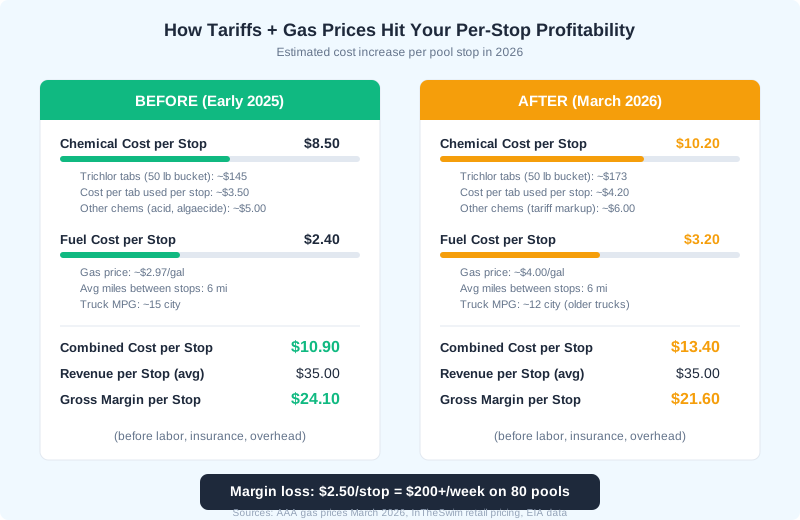
The combined impact of tariffs and gas prices is costing the average pool service company $2.00-$3.00 more per stop compared to early 2025. On a route of 80 pools per week, that is $160-$240 per week in margin erosion, or $640-$960 per month. Over a full year, a company running 80 weekly stops could lose $8,000-$12,000 in profit without changing a single price.
How Do You Calculate Your Fuel Cost per Stop?
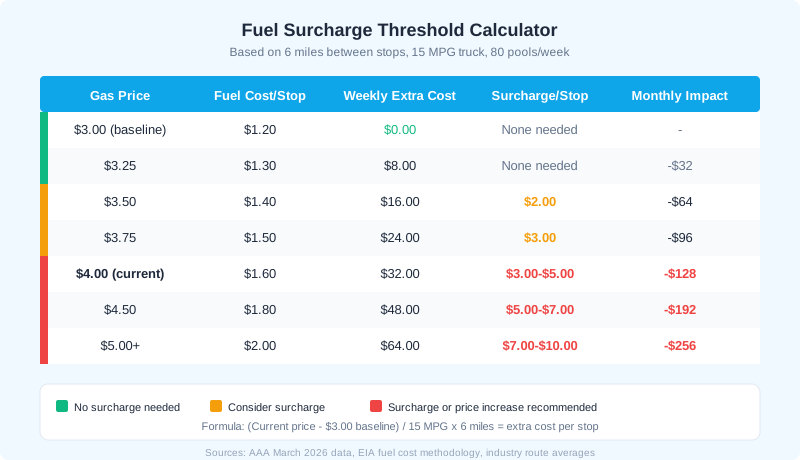
The formula is simple: divide the miles between stops by your truck's MPG, then multiply by the current gas price. For example, if your average distance between pools is 6 miles, your truck gets 15 MPG in city driving, and gas is $4.00: (6 / 15) x $4.00 = $1.60 per stop in fuel alone. At $3.00 gas, that same stop cost $1.20. The difference of $0.40 per stop multiplied by 80 stops per week is $32 per week, or $128 per month.
How Do Chemical Tariffs Affect Your Cost per Stop?
A 50-pound bucket of trichlor tabs currently runs about $173 at retail, down from a peak of $250+ during the 2022 shortage but still well above the $90-$100 pre-pandemic price. The 10% tariff on Chinese chemical imports and 25-35% tariffs on Canadian imports are keeping wholesale prices elevated. If you use roughly 2 tabs per residential pool per week, your chemical cost per stop for trichlor alone is $3.50-$4.20 depending on your supplier pricing. Add muriatic acid, algaecide, and specialty chemicals, and total chemical cost per stop lands at $8.50-$10.50.
The Pool Nation Podcast (Episodes 274-275) walks through a 5-minute cost-per-pool calculator that accounts for chemical costs, drive time, labor, and overhead. If you have not done this math recently, your numbers are probably wrong. Chemical and fuel costs have shifted significantly since Q4 2025.
How Are Other Service Industries Handling Fuel Surcharges?
Fuel surcharges are standard practice in trucking, logistics, and delivery. They are becoming more common in field service industries like HVAC, pest control, and landscaping, though adoption is uneven. Understanding how other industries handle this gives you a template for your own approach.
What Do HVAC and Plumbing Companies Charge?
Most HVAC contractors actually avoid labeling surcharges separately. According to interviews in ACHR News, contractors like Gary Marowske of Flame Heating (90-vehicle fleet, 10,000-12,000 gallons per month) prefer raising flat rates rather than adding a line item. Travis Smith of Sky Heating called fuel surcharges "a recipe to piss off and annoy customers." Scott Merritt of Fire & Ice considered a $10 increase to diagnostic fees instead. The HVAC industry leans toward absorbing fuel into general pricing rather than breaking it out.
What About Pest Control and Landscaping?
Pest control and landscaping companies are more open to explicit fuel surcharges. FieldRoutes, a major pest control software provider, recommends implementing surcharges automatically through billing software. One pest control company charges a 1.95% surcharge when gas hits $3.25 per gallon. A Kansas landscaping contractor implemented a 7.5% fuel charge. In March 2026, landscapers in Wisconsin reported fuel costs running 15-20% higher than the prior year, with service quotes increasing $50-$100 per job.
| Industry | Common Approach | Typical Amount |
|---|---|---|
| Trucking/Logistics | Variable surcharge (standard practice) | 15-30% of freight rate |
| HVAC | Absorb into flat rate increases | 5% general rate increase |
| Pest Control | Automatic surcharge via software | 1.95-5% of invoice |
| Landscaping | Fuel surcharge or quote increase | $50-$100/job or 7.5% |
| Pool Service | Varies (no industry standard) | $3-$10/stop or 3-5% of monthly rate |
Has Any Pool Company Successfully Added a Fuel Surcharge?
Yes. AQUA Magazine reported that Pool Troopers, a large multi-state pool service company, passed on a temporary fuel surcharge to customers via email during the 2022 gas spike. The key word is "temporary." Pool Troopers framed it as a direct response to a specific event (the Russia-Ukraine conflict), communicated it clearly, and removed it when prices stabilized. That model is worth studying for the current situation.
Fuel Surcharge vs. Price Increase: Which Is Better?
A fuel surcharge is a separate line item that goes up and down with gas prices. A price increase is a permanent adjustment to your monthly rate. Both protect your margins, but they send very different messages to customers and have different long-term implications for your business.
What Are the Pros and Cons of a Fuel Surcharge?
| Factor | Fuel Surcharge | Permanent Price Increase |
|---|---|---|
| Customer perception | Transparent, tied to external event | Feels like "you just raised my price" |
| Reversibility | Easy to remove when gas drops | Hard to lower prices once raised |
| Admin complexity | Must track gas prices, adjust monthly | Set it and forget it |
| Long-term revenue | Revenue drops when gas drops | Revenue stays even if costs fall |
| Customer churn risk | Lower (feels temporary/fair) | Higher (feels permanent) |
| Covers all cost increases | Only addresses fuel | Can account for chemicals, labor, insurance too |
When Should You Use a Fuel Surcharge vs. a Price Increase?
Use a fuel surcharge when gas prices spike suddenly due to a specific event (like the current Iran conflict), you expect prices to return to normal within 3-6 months, and you want to maintain goodwill with customers. Use a permanent price increase when your costs have risen across the board (chemicals, labor, insurance, and fuel), you have not raised prices in 12+ months, and you need the revenue regardless of where gas prices go.
Corey's recommendation: "If you haven't raised prices in the last year, don't add a fuel surcharge. Just do a full price increase that accounts for everything. A surcharge on top of an already-too-low rate is a band-aid on a broken arm. But if you just raised prices in January and gas spiked in March, a temporary surcharge is the right move."
How Do You Implement a Fuel Surcharge?
Implementing a fuel surcharge requires three things: a clear calculation formula, a communication plan for customers, and a system to apply it consistently on invoices. There are no federal regulations requiring approval or filings. You can implement a surcharge at any time by simply notifying your customers.
What Formula Should You Use for a Pool Service Fuel Surcharge?
The simplest approach for pool service is a tiered flat-dollar surcharge based on the national average gas price. Set a baseline (the gas price when you last set your rates), then add a fixed surcharge per stop when gas exceeds that baseline by a defined threshold. This is easier to explain to customers than a per-mile calculation and simpler to administer.
How Do You Communicate a Fuel Surcharge to Customers?
Send an email or letter at least 14 days before the surcharge takes effect. Be direct, be short, and tie it to something customers can see for themselves (the price at the pump). Here is a template you can adapt:
Sample fuel surcharge notice:<br/><br/>"Due to the recent surge in fuel prices (national average now exceeds $4.00/gallon, up from $2.97 last month), we are implementing a temporary fuel surcharge of $[X] per service visit effective [date]. This surcharge will be reviewed monthly and adjusted or removed as fuel prices stabilize. We absorb normal fuel cost fluctuations as part of doing business, but the current spike of over 30% in one month exceeds what we can sustain without passing a portion through. We appreciate your understanding. If you have questions, please reply to this email or call us at [phone]."
How Should the Surcharge Appear on Invoices?
List it as a separate line item, not buried in the service charge. Label it "Temporary Fuel Surcharge" so customers know it is distinct from your regular rate and that it will go away. This transparency builds trust. The moment gas prices drop back below your threshold, remove it and send a quick note letting customers know. That follow-through is what turns a potentially negative interaction into proof that you are a fair operator.
What Pricing Strategy Protects Your Margins Best?
The best pricing strategy depends on where you are starting from. If your rates are already competitive and you raised prices within the last year, a temporary fuel surcharge handles the gas spike without overcomplicating things. If you are behind on pricing, use this moment to do a full rate adjustment that accounts for fuel, chemicals, insurance, labor, and inflation all at once.
Should You Separate Chemical Costs from Your Monthly Rate?
The pool service industry is moving in this direction. According to Pool Magazine's 2026 State of Pool Service report, "chems included" is no longer the default strategy. More operators are billing chemicals separately or adding a chemical surcharge to protect against price volatility. The September 2024 BioLab fire in Georgia, combined with the 2020 Louisiana BioLab fire that wiped out 70% of U.S. trichlor production, taught the industry that chemical costs can shift dramatically and unpredictably.
What Is the Recommended Pricing Action Plan for 2026?
- 1Calculate your true cost per stop today. Include fuel at $4.00/gallon, chemicals at current supplier pricing, labor (including drive time), and overhead allocation. The Pool Nation Podcast Episodes 274-275 have a free calculator framework.
- 2Compare that to your revenue per stop. If your monthly rate is $140 and you service a pool weekly, your revenue per stop is $35. If your cost per stop is $25+, your margin is dangerously thin.
- 3If you raised prices in the last 6 months: implement a temporary fuel surcharge of $3-$5 per stop (equivalent to $12-$20/month per customer). Tie it to gas prices exceeding $3.50/gallon.
- 4If you have not raised prices in 12+ months: skip the surcharge and do a full 5-8% rate increase ($7-$12/month on a $150 service). Frame it as an annual adjustment, not a reaction to gas prices.
- 5Consider separating chemical costs. Bill a base service rate plus a chemical fee. This protects you from future chemical price swings and matches the direction the industry is heading.
- 6Communicate early and directly. Send notice 14 days before any change takes effect. One email, plain language, no apologies.
Corey's 80-pool math: "At $4.00 gas and current chemical prices, I am losing roughly $2.50 per stop compared to a year ago. That is $200 a week, $800 a month, almost $10,000 a year. A $5 monthly surcharge on 80 customers recovers $400/month. A $10/month price increase recovers $800/month and catches me up on inflation too. The price increase is the better move for most operators."
Ready to streamline your pool service business?
Pool Founder gives you route optimization, automated invoicing, chemical tracking, and everything else you need to run a more profitable pool business.
Frequently Asked Questions
Are pool chemicals affected by the 2026 tariffs?
Yes, but selectively. Many bulk chemicals received exemptions, but trichlor (commonly imported from China) faces a 10% baseline tariff, and imports from Canada carry a 25-35% tariff. Cyanuric acid imported from China is also subject to the 10% tariff. Domestically produced chemicals like muriatic acid see minimal direct tariff impact, though higher transportation costs (rail shipping rates up 15%) affect pricing across the board.
How much has gas gone up in 2026?
The national average jumped from $2.97/gallon in late February 2026 to $4.02/gallon by March 31, an increase of over $1.00 in roughly one month. This was driven by the U.S.-Iran military conflict disrupting oil supplies through the Strait of Hormuz. Regional prices vary significantly, from $3.23 in Oklahoma to $5.87 in California.
Should I add a fuel surcharge or just raise my prices?
If you raised prices within the last 6 months, a temporary fuel surcharge of $3-$5 per visit makes sense. If you have not raised prices in 12+ months, skip the surcharge and do a full rate increase of 5-8% that accounts for fuel, chemicals, insurance, and inflation. A surcharge on an already-too-low rate does not fix the underlying problem.
How do I calculate the fuel cost per pool stop?
Divide the average miles between stops by your truck's miles per gallon, then multiply by the current gas price. Example: 6 miles between stops, 15 MPG truck, $4.00 gas = (6/15) x $4.00 = $1.60 per stop. At $3.00 gas, that same stop costs $1.20, a difference of $0.40 per stop or $32/week on 80 pools.
Will pool equipment prices go up because of tariffs?
They already have. The August 2025 expansion of Section 232 tariffs to 407 categories of steel and aluminum derivative products means pool pumps, heaters, filters, and fittings face a 50% tariff on their metal content. Pentair and Hayward have already passed through 7-9% retail price increases. Expect another round of increases if the tariff rates hold through 2026.
How are other pool service companies handling the cost increases?
Approaches vary. Pool Troopers implemented a temporary fuel surcharge via email during the 2022 gas spike and removed it when prices stabilized. Many operators are separating chemical costs from their base service rate to protect against volatility. According to Pool Magazine, 47% of operators expect slight cost increases from tariffs over the next year, while 18% expect significant increases.
Sources & References
- AAA Gas Prices, March 31, 2026
- Time: How High Could Gas Prices Go? Iran War Impact, March 2026
- EIA Short-Term Energy Outlook, March 2026
- PHTA Tariff Policy
- Department of Commerce: Section 232 Steel and Aluminum Tariff Expansion, August 2025
- C&EN: Chemicals Mostly Spared Under New Trump Tariff Plan, February 2026
- EZ Pool & Spa Supply: Will New Tariffs Cause Chlorine Prices to Rise?
- ACHR News: Spiking Fuel Prices Hit Contractors
- Pool Magazine: The State of Pool Service in 2026
- NPR: Higher Oil Prices Are Already Affecting American Businesses, March 2026
- Pool Nation Podcast, Episodes 274-275: Cost Per Stop and Pricing Strategy
- Coast: Fuel Surcharge Calculation Formula and Implementation Guide
- ASI Central: Rising Fuel Prices Poised to Drive Up Costs for Suppliers, March 2026