Every Pool on Your Route Has a Dirty Tile Line
Walk along the waterline of any pool that has not been professionally cleaned in the last 12 months. You will see a white, gray, or brownish band of calcium carbonate deposits on the tile and coping. Homeowners notice it. They hate how it looks. Most do not know that professional tile cleaning services exist, and those who do assume it costs thousands of dollars. This is a revenue opportunity hiding in plain sight on every single pool you already service.
Professional pool tile cleaning via glass bead or salt blasting generates $475 to $1,200 per job depending on pool size and deposit severity, with material and labor costs of $75 to $200. That puts gross margins at 75% or higher. The average pool needs tile cleaning every 12 to 24 months, creating a recurring revenue stream that layers on top of your existing maintenance contracts.
This guide covers the tile cleaning process, equipment options, pricing strategies, and how to identify and close tile cleaning opportunities during your regular route stops.
What Causes Calcium Buildup on Pool Tile?
Calcium deposits on pool tile form when calcium-rich water evaporates at the waterline, leaving calcium carbonate (white, chalky) or calcium silicate (gray, glassy) behind. Every pool loses water to evaporation. As water evaporates from the tile surface, the dissolved minerals concentrate and precipitate as scale. High calcium hardness, high pH, and high total alkalinity all accelerate the process.
Calcium Carbonate vs. Calcium Silicate
| Type | Appearance | Hardness | Removal Difficulty | Time to Form |
|---|---|---|---|---|
| Calcium carbonate | White, chalky, flaky | Soft | Easy, acid dissolves it | Months |
| Calcium silicate | Gray, glassy, smooth | Very hard | Difficult, requires blasting | Years |
Calcium carbonate is the more common deposit and responds to muriatic acid application. You can test the deposit type by applying a drop of muriatic acid. If it fizzes and dissolves, it is calcium carbonate. If nothing happens, it is calcium silicate, which has bonded with the tile surface at a molecular level and requires abrasive blasting to remove. Knowing the deposit type before quoting saves you from underbidding a difficult job.
What Are the Professional Tile Cleaning Methods?
Three primary methods exist for professional pool tile cleaning, each with different equipment costs, learning curves, and results. Your choice depends on your budget, the volume of tile work you plan to do, and whether you want to offer this as an in-house service or subcontract it.
| Method | Equipment Cost | Best For | Limitations |
|---|---|---|---|
| Glass bead blasting | $2,500-5,000 | Most tile types, calcium carbonate and silicate | Requires compressor, learning curve |
| Salt blasting (soda) | $1,500-3,500 | Delicate tile, glass tile, light deposits | Less effective on heavy calcium silicate |
| Chemical + pumice scrub | $50-150 | Light calcium carbonate only | Labor intensive, does not remove silicate |
Glass bead blasting is the industry standard for professional tile cleaning companies. A compressor pushes fine glass beads at controlled pressure against the tile surface, removing calcium deposits without damaging the tile glaze. The equipment investment is $2,500 to $5,000 for a quality setup including compressor, blast pot, hoses, nozzle, and media. At an average job price of $750, the equipment pays for itself in four to seven jobs.
What Equipment Do You Need to Start?
- Air compressor: minimum 5.5 CFM at 90 PSI (portable gas-powered recommended for poolside use)
- Blast pot: 50 to 100 pound capacity with pressure regulator and moisture trap
- Glass bead media: #10 to #13 size (finer beads for delicate tile, coarser for heavy deposits)
- Blast nozzle: ceramic tip, 3/16 to 1/4 inch bore
- Safety gear: full face respirator, hearing protection, gloves, blast suit
- Drop cloth or tarp to collect spent media for cleanup
- Wet/dry vacuum for final cleanup of poolside area
Start with chemical and pumice cleaning on your existing route stops to identify demand and build a customer list. Invest in blasting equipment after you have 10 to 15 committed tile cleaning jobs queued up. This approach validates demand before committing capital.
How Should You Price Pool Tile Cleaning?
Pool tile cleaning is priced per linear foot of waterline tile, with minimums ranging from $400 to $1,000 depending on your market. According to Precision Pool Tile and Homewyse, the going rate in 2025 to 2026 is $4.50 to $10 per linear foot, with most residential jobs falling between $475 and $1,200.
$4.50-10/ft
Professional pool tile cleaning rate per linear foot
Source: Precision Pool Tile, Homewyse, Pool Tile Cleaning Vegas
| Pool Size | Linear Feet | Price Range | Typical Time |
|---|---|---|---|
| Small (12x24) | 72 ft | $475-650 | 2-3 hours |
| Medium (16x32) | 96 ft | $575-850 | 3-4 hours |
| Large (20x40) | 120 ft | $700-1,050 | 4-5 hours |
| Freeform/Custom | 100-180 ft | $750-1,500 | 4-7 hours |
| Pool + spa combo | +30-50 ft | +$200-400 | +1-2 hours |
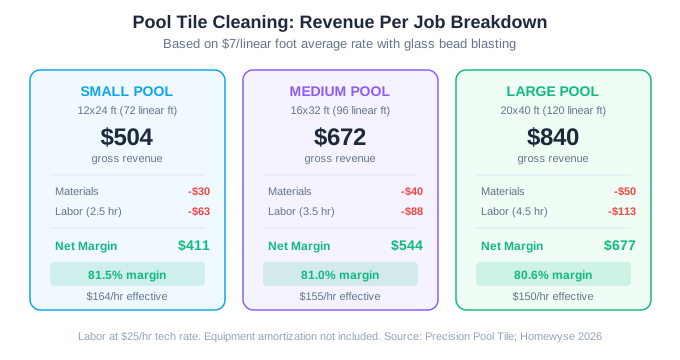
Your material cost per job is $15 to $40 in glass bead media (reusable media reduces this further) plus $5 to $10 in fuel for the compressor. At a midrange price of $7 per linear foot on a 96-foot pool, you gross $672 with under $50 in materials. Even accounting for 3.5 hours of labor at $25 per hour ($87.50), your gross margin exceeds 80%.
How Do You Handle the Minimum Charge?
Set a minimum of $475 regardless of pool size. Mobilizing equipment, setting up, and cleaning up takes a fixed amount of time whether the pool is 50 linear feet or 120. Customers with small pools occasionally push back on the minimum, but the margin compression on jobs below $475 is not worth the windshield time and setup overhead. Frame the minimum as "the cost covers equipment mobilization and includes up to 70 linear feet of cleaning."
How Do You Identify Tile Cleaning Opportunities on Your Route?
Every weekly service visit is a chance to identify and sell tile cleaning. You are already at the pool, already have a relationship with the customer, and can show them the problem in person. This is the single biggest advantage you have over standalone tile cleaning companies that rely on cold leads.
The Three-Step Identification Process
- 1Visual scan during every service visit. Look at the waterline tile from the equipment pad end of the pool. Calcium deposits are most visible at an angle. Note the severity on a 1 to 3 scale in your service app.
- 2Photo documentation. Take a close-up photo of the worst section and attach it to the customer record. When you are ready to offer the service, you have visual proof to share.
- 3Timing the conversation. Bring up tile cleaning when the customer is present during a visit, or send a message through your customer portal with the photo and a quote. Spring is the best time to sell because customers want the pool looking clean for summer.
Corey Adams, Pool Founder co-founder and 15-year pool service veteran, recommends a simple approach: "I tell the customer that calcium deposits are like tartar on teeth. If you clean them every year, it takes an hour and looks great. If you wait five years, you need a jackhammer. The longer they wait, the harder the deposits get, and the more it costs to remove them. That usually gets the appointment booked."
Track tile condition ratings for every pool on your route. After six months, you will have a list of 20 to 40 pools that need cleaning, giving you a built-in pipeline of high-margin work you can schedule during slower months to smooth seasonal revenue.
How Often Should Pool Tile Be Cleaned?
Recommended tile cleaning frequency depends on water chemistry, local fill water mineral content, and how well you maintain the LSI on each pool. In areas with hard fill water (calcium hardness above 300 ppm from the tap), tile cleaning may be needed annually. In areas with softer water, every 18 to 24 months is typical.
| Condition | Cleaning Frequency | Revenue Potential |
|---|---|---|
| Hard fill water (300+ ppm CH) | Every 12 months | $475-1,200/year per pool |
| Moderate fill water (200-300 ppm CH) | Every 18 months | $475-1,200 every 18 months |
| Soft fill water (under 200 ppm CH) | Every 24 months | $475-1,200 every 2 years |
| Pool with water features | Every 12 months | Splash zones scale faster |
| Salt pool | Every 12-18 months | Cell byproducts accelerate scaling |
Salt pools tend to need more frequent tile cleaning because the electrolysis process creates calcium deposits at a slightly faster rate, particularly near return jets where the chlorinated water exits the cell. If you service salt pools, build tile cleaning into your annual maintenance recommendation for those accounts.
Run a pool route?
The business side of what you just read.
Pricing, chemical costs, and the tools owners use to keep the numbers straight.
- Commercial pool service pricing2026 rate tables and the cost-plus formula
- Chemical cost per poolWhat chemicals actually cost per stop
- Chemical tracking softwareLog readings and dosing from the pool deck
- Pool service softwareRoutes, invoicing, and service reports in one app
- Free profit & rate calculatorsProfit per pool, minimum rate, break-even
Frequently Asked Questions
How much does pool tile cleaning cost?
Professional pool tile cleaning costs $4.50 to $10 per linear foot, with most residential jobs totaling $475 to $1,200 depending on pool size and deposit severity. A standard 16x32 pool with 96 linear feet of waterline tile typically costs $575 to $850. Most companies set a minimum charge of $400 to $500 regardless of pool size to cover equipment mobilization.
What is the best method for cleaning pool tile?
Glass bead blasting is the industry standard for professional tile cleaning. Fine glass beads are propelled at controlled pressure to remove calcium deposits without damaging the tile glaze. Salt (soda) blasting is gentler and better for delicate or glass tile. Chemical and pumice scrubbing works for light calcium carbonate deposits but cannot remove calcium silicate buildup.
How often should pool tile be cleaned?
Every 12 to 24 months depending on local water hardness and how well chemistry is maintained. Pools filled with hard water (calcium hardness above 300 ppm from the tap) typically need annual cleaning. Pools with softer fill water can go 18 to 24 months. Salt pools and pools with water features tend to need cleaning more frequently.
Can I clean pool tile myself with muriatic acid?
Muriatic acid removes calcium carbonate (white, chalky deposits) but does not remove calcium silicate (gray, hard deposits). Apply acid only to drained tile surfaces, never pour acid directly on underwater tile. For anything beyond light surface deposits, professional blasting is more effective and less risky to the tile surface. Acid misapplication can etch tile glaze and damage grout.
What equipment do I need to start a tile cleaning service?
A basic glass bead blasting setup costs $2,500 to $5,000 and includes a portable air compressor (minimum 5.5 CFM at 90 PSI), blast pot with pressure regulator, glass bead media, ceramic nozzle, and safety gear (respirator, hearing protection, gloves). At an average job price of $750, the equipment pays for itself in four to seven jobs.
Is pool tile cleaning profitable as an add-on service?
Extremely profitable. Material costs run $15 to $50 per job (glass bead media and fuel). At a midrange rate of $7 per linear foot, a 96-foot pool generates $672 in revenue. Even with 3.5 hours of labor, gross margins exceed 75%. The service also strengthens customer retention because clients with annual tile cleaning booked are less likely to switch service providers.