Do Not Quit Your Job Until the Math Works
You are cleaning pools on weekends and after work. You have 15-20 customers, the phone keeps ringing, and you are turning people away because you do not have enough hours in the day. The obvious next step is going full-time. But quitting a steady paycheck for a side hustle that has never been your primary income is one of the highest-stakes decisions you will make.
The pool service business is one of the best side hustles that transitions to full-time work. The recurring revenue model, low overhead, and year-round demand in Sun Belt markets make the math favorable. But "favorable" and "ready" are different things. Going full-time too early burns through savings. Going too late leaves money on the table.
1.5x
your current salary in consistent monthly gross revenue before you should consider going full-time
Source: Red Nation Media Group
Corey Adams, Pool Founder co-founder and 15-year pool service veteran, has seen both sides. "The guys who succeed going full-time are not the ones with the most customers. They are the ones who waited until the numbers were right and had a financial cushion. The ones who jump too early end up desperate and making bad decisions."
What Revenue Threshold Do You Need Before Going Full-Time?
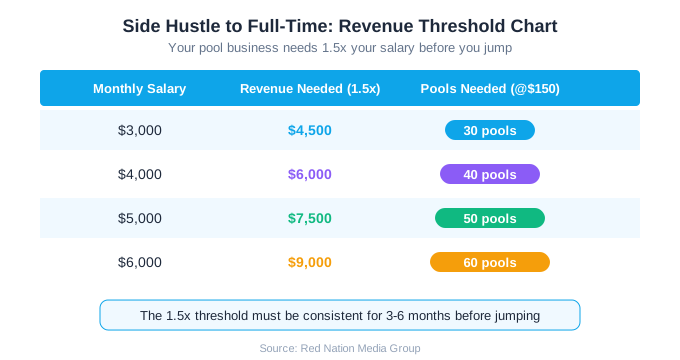
Your pool service side hustle needs to consistently generate 1.5x to 2x your current monthly salary in gross revenue before going full-time makes financial sense. That extra 50-100% covers self-employment tax (15.3%), business insurance, health insurance, retirement contributions, and the operating costs that your employer currently subsidizes.
Here is the math. If your day job pays $4,500/month after taxes, your pool business needs to gross $6,750-$9,000/month reliably. At $150/pool/month, that means 45-60 active accounts. The biggest mistake is assuming $5,000 in business revenue replaces a $5,000 salary. It does not.
| Current Salary (Monthly) | Revenue Needed (1.5x) | Pools Needed (at $150/mo) |
|---|---|---|
| $3,000 | $4,500 | 30 |
| $4,000 | $6,000 | 40 |
| $5,000 | $7,500 | 50 |
| $6,000 | $9,000 | 60 |
The 1.5x number needs to be consistent for at least 3-6 months. Do not jump based on one great month. Seasonal spikes, one-time cleanups, and green pool recoveries can inflate a single month well above your baseline.
How Much Cash Should You Have Saved Before Going Full-Time?
You need 3 to 6 months of personal living expenses in cash before going full-time. This is not optional. It is the difference between making smart business decisions and desperate ones. When you are worried about making rent, you take bad customers, underprice your service, and skip investments that the business needs.
Calculate your monthly living expenses: rent or mortgage, utilities, food, car payment, insurance premiums (including health insurance you will now need to buy yourself), and any debt payments. Multiply by 3 for the minimum cushion, 6 for comfortable.
| Monthly Expenses | 3-Month Cushion | 6-Month Cushion |
|---|---|---|
| $3,000 | $9,000 | $18,000 |
| $4,000 | $12,000 | $24,000 |
| $5,000 | $15,000 | $30,000 |
| $6,000 | $18,000 | $36,000 |
This savings cushion is separate from your business operating expenses. You also need working capital for chemicals, fuel, equipment replacement, and marketing. Having a thin personal cushion and zero business reserves is a recipe for going back to a job within six months.
What Should Your Transition Plan Look Like?
The transition from side hustle to full-time should be a planned process, not a dramatic Monday morning decision. Give yourself 3-6 months of deliberate preparation while still employed.
- 1Months 1-2: Validate the numbers. Track your monthly revenue, expenses, and profit for at least 3 consecutive months. Confirm you are hitting the 1.5x threshold consistently.
- 2Month 3: Set up business infrastructure. Form your LLC if you have not already. Get proper insurance (general liability, commercial auto). Set up a business bank account and accounting system.
- 3Month 4: Build the customer pipeline. Start marketing for new customers who will fill weekday time slots once you go full-time. You need a waitlist ready for day one.
- 4Month 5: Price your health insurance. This is the expense most side-hustlers forget. Marketplace health insurance for a family can run $800-$1,500/month. Factor this into your numbers.
- 5Month 6: Give notice and launch. Have your savings cushion in place, your infrastructure set up, and your first two weeks of full-time routes planned.
Before giving notice, check if your current employer offers COBRA health insurance continuation. COBRA lets you keep your employer health plan for up to 18 months, though you pay the full premium. It buys time to find a marketplace plan.
How Fast Can You Scale Once You Go Full-Time?
Going full-time typically doubles your available service hours from 15-20 per week (side hustle) to 40-50 per week. That capacity lets you immediately take on customers you have been turning away and aggressively pursue new ones. Most operators double their pool count within the first 3-4 months of going full-time.
If you had 20 pools as a side hustle doing Saturday routes, going full-time lets you build to 50-60 pools within one season. At $150/month, that is $7,500-$9,000 in monthly recurring revenue. After expenses, a solo operator running 50 pools full-time can expect $60,000-$75,000 in annual take-home.
| Timeline | Side Hustle Pools | Full-Time Pools | Monthly Revenue |
|---|---|---|---|
| Pre-transition | 20 | - | $3,000 |
| Month 1 full-time | - | 25 | $3,750 |
| Month 3 full-time | - | 35 | $5,250 |
| Month 6 full-time | - | 50 | $7,500 |
| Month 12 full-time | - | 60-70 | $9,000-$10,500 |
The speed of scaling depends on your market and your customer acquisition effort. Spring and early summer are the best times to go full-time because demand peaks and you can fill routes quickly. Going full-time in November in a seasonal market means sitting on a thin route through winter.
What Are the Hidden Costs of Going Full-Time?
Several expenses that your employer currently covers become your responsibility when you go full-time. These hidden costs are the reason the 1.5x revenue threshold exists. Ignoring them is the fastest way to end up back at a job.
- Self-employment tax: 15.3% of net earnings covers Social Security and Medicare. As an employee, your employer pays half. As self-employed, you pay both halves.
- Health insurance: Individual plans run $400-$700/month. Family plans run $800-$1,500/month on the ACA marketplace. This may be your single largest new expense.
- Retirement savings: No more employer 401(k) match. You need to fund a SEP IRA or Solo 401(k) yourself if you want to save for retirement.
- Equipment replacement: Poles, test kits, vacuum heads, and pumps break. Budget $100-$200/month for equipment maintenance and replacement.
- Quarterly tax payments: The IRS requires estimated quarterly tax payments. Failing to make them results in penalties. Set aside 25-30% of profit for taxes.
15.3%
self-employment tax rate on net earnings, covering both the employer and employee portions of Social Security and Medicare
Source: IRS Self-Employment Tax Guidelines
How Do You Know If You Are Not Ready?
Not everyone should go full-time, and not every side hustle is ready to become a primary income. Be honest with yourself about these red flags.
- Revenue is inconsistent. If your monthly income swings from $2,000 to $5,000 with no predictable pattern, you do not have the stability to rely on it full-time.
- Your customer base is all word-of-mouth. Word-of-mouth is great but uncontrollable. If you cannot generate new leads through a repeatable system (door hangers, online presence, partnerships), you are one slow month from trouble.
- You have no savings cushion. Going full-time with zero savings means your first slow month becomes a personal financial crisis. Build the cushion first.
- You have not run the full cost math. If you have not priced health insurance, calculated self-employment tax, and accounted for equipment replacement, your "profit" number is artificially high.
- You are running from your job, not running to pool service. Hating your day job is not a business plan. Going full-time works when the pool business pulls you forward, not when the job pushes you out.
There is no shame in running pool service as a profitable side hustle for years. Some operators build to 20-30 weekend accounts generating $3,000-$4,500/month in supplemental income and never go full-time. That is a perfectly valid outcome. The key is making the decision based on math, not emotion.
Free starter kit
Start a pool service business with the numbers already run.
A short email series from an owner who started with $1,200 and a used truck. No software pitch, just the four things that decide whether year one works.
- Startup cost breakdownEvery line item from $2K bootstrap to fully equipped
- Pricing calculatorThe minimum you can charge per visit and still profit
- First-10-customers playbookDoor hangers, referrals, and the phone script that closes
- Licensing & insurance checklistWhat your state requires and which insurers pay claims
Already running routes? Try Pool Founder free
Frequently Asked Questions
How many pool customers do I need before going full-time?
You need enough customers to generate 1.5x your current monthly salary in gross revenue. At $150/pool/month, that is typically 30-60 pools depending on your current income. More importantly, that revenue level needs to be consistent for 3-6 months before you make the jump.
Can you make a living cleaning pools?
Yes. A solo pool tech running 50-60 pools full-time at $150/month generates $90,000-$108,000 in gross annual revenue. After expenses, take-home pay is typically $60,000-$80,000. Multi-tech operations with 100+ pools can generate $150,000+ in owner income.
What is the best time of year to go full-time in pool service?
Spring (March-April) is ideal in most markets. Pool demand ramps up, customers are looking for new service providers, and you have the entire peak season ahead to build your route. Going full-time in fall or winter means surviving the slow season before getting a full peak season of revenue.
Do I need an LLC to run a pool service business full-time?
An LLC is strongly recommended for liability protection. It separates your personal assets from your business debts and liabilities. Formation costs $50-$500 depending on your state. General liability insurance ($800/year average) is also essential from day one of full-time operation.
How much should I charge per pool as a full-time pool service?
Monthly rates vary by market. Florida averages $143, Arizona averages $130, Texas averages $198, and California runs $200-$275. As a full-time operator, do not race to the bottom on price. Your rate needs to cover chemical costs (10-15%), vehicle expenses, insurance, self-employment tax, and leave 15-25% net profit.
What happens if I go full-time and it does not work out?
This is exactly why the savings cushion matters. If the business does not generate enough revenue within 6 months, you still have savings to cover personal expenses while you find employment. Pool service experience translates well to other trades and service industries. Going back to a job is not failure. Going back broke is.
Sources & References
- Red Nation Media Group: The Financial Threshold for Quitting Your Job
- KMF Business Advisors: Pool Service Business Profitability 2026
- IRS: Self-Employment Tax (Social Security and Medicare Taxes)
- Cabana 2025 Pool Service Pricing Study
- Pool Business Forum: Pool Service Revenue Benchmarks and Industry Averages