Why Is the Phone Still Your Best Sales Tool?
Home service businesses miss an average of 27% of inbound calls, and each missed call costs approximately $1,200 in lost revenue according to Invoca research. For pool service companies, the math is worse because a single residential customer represents $1,680 to $2,100 in annual recurring revenue at $140 to $175 per month. Miss five calls in a week, and you are looking at $8,400 to $10,500 in lifetime annual revenue that went to a competitor who answered the phone.
Research from Ambs Call Center found that 85% of callers who reach voicemail will not try again. They will call the next company on the list. And 80% of people who do reach voicemail hang up without leaving a message. Your phone is ringing with people ready to buy. The question is whether you are converting those calls into customers or losing them to the company that picks up first.
Corey Adams, Pool Founder co-founder and 15-year pool service veteran: "Early in my career I let every call go to voicemail while I was on a route. I thought I would call them back at lunch. By then, they had already booked with someone else. The day I started answering every call or having someone answer for me, my close rate doubled."
What Is the Best Way to Answer a Pool Service Call?
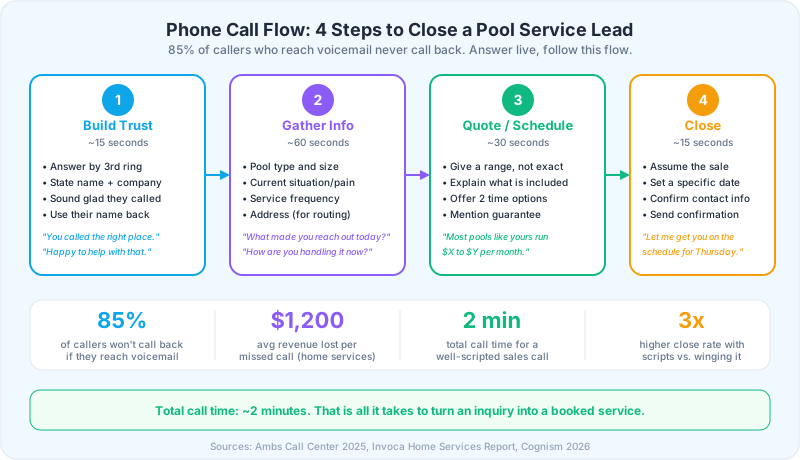
The first 10 seconds of a phone call determine whether the caller stays engaged or starts looking for an excuse to hang up. You need to accomplish three things in your greeting: identify yourself and your company, sound professional and welcoming, and take control of the conversation. A scripted greeting does all three consistently, every time, regardless of whether you are answering from your truck or your office.
The Greeting Script
Answer by the third ring. Callers start forming negative impressions after four rings. Use this format: "Good [morning/afternoon], this is [Your Name] with [Company Name]. Thanks for calling. How can I help you today?" This script works because it gives your name (builds trust), gives your company name (confirms they called the right place), thanks them (shows appreciation), and opens with a question (puts you in control).
Never answer with just "Hello?" or your company name alone. Both sound unprofessional. And never answer with "Please hold." If you cannot give the caller your attention, let it go to a trained answering service rather than putting them on hold within 2 seconds of calling.
What to Do When You Cannot Answer
When you are elbow-deep in a pump basket, you cannot answer a phone call. Have a plan for this. Options include a dedicated office person or spouse who answers with the same script, a virtual receptionist service ($100-$300/month) that follows your script, or an auto-text feature that sends an immediate text message: "Thanks for calling [Company]. I am on a service call right now. I will call you back within 30 minutes. Is there anything urgent?" That text keeps the lead warm until you can call back.
What Questions Should You Ask to Qualify the Caller?
After the greeting, your job is to gather enough information to either quote on the spot or schedule an assessment visit. The discovery phase should take about 60 seconds. You are not interrogating the caller. You are having a conversation that happens to collect the information you need to help them.
The Discovery Questions (In Order)
- 1"What made you reach out today?" This reveals their pain point and urgency. A green pool is urgent. Shopping for a better price is not.
- 2"Tell me about your pool. Is it in-ground or above-ground, and do you know the approximate size?" This helps you estimate chemical costs and service time.
- 3"How are you handling maintenance right now? DIY, another company, or not at all?" This tells you if you are replacing a competitor or starting fresh.
- 4"What is the address? I want to see if you are in our service area." This lets you check route density and drive time.
- 5"How often are you looking for service? Weekly, bi-weekly, or are you open to my recommendation?" This frames you as the expert.
The most important question is the first one: "What made you reach out today?" Their answer tells you everything. If their pool is green, they need help now. If their current company stopped showing up, they value reliability. If they just moved in, they need education. Match your pitch to their specific pain.
Red Flags to Listen For
- "What is your cheapest price?" signals a price shopper who will leave for $5/month savings. Qualify carefully before investing time.
- "My last company was terrible." Ask what specifically went wrong. If they had three companies in two years, the problem may not be the companies.
- "I just need it done once." One-time cleanups are fine, but quote them at a premium rate and use the visit to pitch recurring service.
- "Can you come today?" Urgency is good, but do not rearrange your entire route. Offer the next available slot and explain why scheduled service prevents emergencies.
How Should You Quote Pricing Over the Phone?
The biggest mistake pool service owners make on the phone is refusing to give any pricing information. Callers are shopping. If you say "I need to come out and look at it before I can give you a price," you lose most of them. They will call the next company that gives them a number. Give a range, not an exact price, and frame it around what is included.
The Range Pricing Script
"Based on what you have described, most pools like yours run between $[low] and $[high] per month for weekly service. That includes all chemicals, water testing, skimming, brushing, vacuuming, and a service report after every visit so you always know what we did. The exact price depends on a few things I would want to see in person, but that gives you the ballpark. Does that range work for your budget?"
| Pool Type | Low Range | High Range | What Affects Price |
|---|---|---|---|
| Standard residential (10K-20K gal) | $130/mo | $165/mo | Condition, equipment, access, distance |
| Large residential (20K-40K gal) | $165/mo | $225/mo | Volume, chemical usage, surface area |
| Pool + spa combo | $175/mo | $250/mo | Separate chemical balancing required |
| Green pool recovery (one-time) | $300 | $600 | Severity, filter condition, debris load |
Handling the "That Is Too Expensive" Objection
"I understand price is important. Let me ask you this: what are you comparing that to?" Then listen. If they are comparing to DIY, explain the time, chemical knowledge, and equipment cost they are absorbing. If they are comparing to another company, ask what that company includes. Often the lower quote excludes chemicals, does not include water testing, or skips the service report. When you compare apples to apples, your price is usually competitive.
Never compete on price alone. Compete on what is included. "We include chemicals, testing, a written report after every visit, and we track your water chemistry history so we can prevent problems before they happen. Most companies just skim and dump chlorine." That positions you as the professional, not the cheapest option.
What Objections Will You Hear and How Do You Handle Them?
Every pool service phone call has a moment where the caller hesitates. They are not saying no. They are looking for reassurance. Knowing the five most common objections and having a response ready for each one turns hesitation into bookings.
| Objection | What They Really Mean | Response |
|---|---|---|
| I need to think about it | I need more information or reassurance | "Absolutely. What questions can I answer right now to help you decide?" |
| I want to get a few quotes | I want to make sure I am not overpaying | "Smart move. When you are comparing, ask what chemicals are included and whether they provide service reports." |
| My spouse needs to approve it | This might be real or might be a polite exit | "Of course. Would it help if I sent a text summary you can share with them? I can include exactly what is covered." |
| I will call you back | I am probably not going to call back | "Happy to hold the slot for 24 hours. Can I follow up tomorrow morning if I have not heard from you?" |
| I can do it myself for cheaper | I do not understand the full cost of DIY | "Many of our customers started that way. The chemicals, testing equipment, and time add up to $80-$100/month plus 2-3 hours of your weekend." |
The Follow-Up Close
If they do not book on the first call, you need a follow-up system. Send a text within 5 minutes of hanging up summarizing what you discussed and the price range. Call back within 24 hours. If no answer, text again at 48 hours. After that, send one final text at 7 days. Studies show that 80% of sales require at least 5 follow-up touches, but most salespeople give up after one.
80%
of sales require at least 5 follow-up touches, but 44% of salespeople give up after just one attempt
Source: Cognism Cold Calling Statistics 2026
How Do You Close the Call and Book the Service?
Closing is not aggressive selling. Closing is assuming the caller wants what they called about and making it easy for them to say yes. The assumptive close works because the caller already demonstrated intent by picking up the phone and calling you. Your job is to remove friction, not create pressure.
The Assumptive Close Script
"Great. It sounds like weekly service at [$X] per month is going to be the best fit. I have availability on [Day] and [Day] this week. Which works better for you?" Notice you are not asking "Would you like to sign up?" You are asking which day they prefer. The decision to buy is assumed. The only question is timing.
After They Say Yes
- 1Confirm their full name, service address, phone number, and email
- 2Explain what happens next: "I will send you a welcome text with my name, our service day, and what to expect on the first visit"
- 3Set expectations for the first visit: "The first service takes a bit longer because I do a full assessment of your pool and equipment"
- 4Ask for gate code, lock combo, or special access instructions
- 5Thank them by name: "Thanks, [Name]. You are going to love how easy this is. I will see you on [Day]"
Send the confirmation text within 5 minutes of hanging up. Include your name, company name, service day, and a photo of yourself or your truck. This prevents buyer remorse and makes the relationship feel real before you even show up.
What Phone Systems Work Best for Pool Service Companies?
Your phone system should support your sales process, not fight against it. Solo operators need something different than a 5-truck company. Here are the options ranked by company size and budget.
| Solution | Best For | Cost | Key Feature |
|---|---|---|---|
| Personal cell + auto-text | Solo operators, 0-30 pools | Free (carrier plan) | Immediate text when you cannot answer |
| Google Voice | Solo operators wanting a business number | $10/month | Separate business number, call recording |
| Virtual receptionist service | 30-80 pools, no office staff | $100-$300/month | Live person answers with your script |
| VoIP system (OpenPhone, Grasshopper) | 50-150 pools, small team | $15-$30/user/month | Call routing, shared inbox, auto-attendant |
| AI phone answering | 80+ pools, high call volume | $50-$200/month | 24/7 coverage, books appointments, qualifies leads |
The most important feature at any size is the ability to respond immediately when you cannot answer live. Whether that is an auto-text, a virtual receptionist, or an AI phone system, the caller needs to feel acknowledged within 30 seconds of calling. Dead silence and voicemail are the two fastest ways to lose a lead.
Track your phone metrics monthly: total inbound calls, answer rate, calls converted to appointments, and appointments converted to customers. If your answer rate is below 80%, you need a better system. If your conversion rate is below 30%, you need better scripts.
Ready to streamline your pool service business?
Pool Founder gives you route optimization, automated invoicing, chemical tracking, and everything else you need to run a more profitable pool business.
Frequently Asked Questions
How many calls does the average pool service company miss per week?
Research shows that small businesses answer only about 38% of incoming calls. For a pool service company receiving 15-20 calls per week during peak season, that means 9-12 missed calls. At $1,200 average revenue per missed home service call, that is $10,800 to $14,400 in potential lost revenue per week.
Should you give pricing over the phone for pool service?
Yes, give a price range. Refusing to discuss pricing causes callers to hang up and call competitors who will give them a number. Use range pricing: "Most pools like yours run $140 to $175 per month." This sets expectations without locking you into an exact price before seeing the pool.
How quickly should you return a missed pool service call?
Within 15 minutes or less. After 30 minutes, the caller has likely already reached a competitor. If you cannot call back immediately, send an auto-text within 30 seconds acknowledging their call and giving a callback timeframe. Speed to lead is the single biggest factor in phone conversion.
What is a good phone close rate for pool service companies?
A well-trained pool service phone operator should close 30-50% of qualified inbound calls on the first conversation. With proper follow-up over 7 days, that number can reach 50-65%. If your first-call close rate is below 20%, your script or training needs work.
Should a pool service company use a call answering service?
If you are a solo operator or small team that cannot consistently answer the phone during business hours, a virtual receptionist service at $100-$300/month will pay for itself with 1-2 converted calls per month. The key is providing them with your exact script and qualification questions so callers get a consistent experience.