Unpaid Invoices Are a System Problem, Not a Customer Problem
Seventy-three percent of small businesses report that customer delinquency increased over the past year, and late payments cost companies an average of $40,000 annually according to QuickBooks 2025 data. For pool service companies, the math is brutal: if you are running 100 accounts at $175 per month and 30% are paying late, that is $5,250 in limbo every single month.
$40,000
average annual cost of late payments to small businesses
Source: Intuit QuickBooks 2025 Late Payments Report
The good news: most unpaid pool service invoices are not deadbeats trying to skip out. They are disorganized homeowners who forgot, lost the invoice, or genuinely did not realize they owed you. The right collection process recovers 85 to 90% of outstanding balances without damaging the customer relationship. The wrong process either writes off too much or alienates customers who would have paid with a simple reminder.
Corey Adams is blunt about this: "For years I let invoices slide because I did not want to seem pushy. Then I realized I was running a charity, not a business. A professional collection process is not rude. It is expected. Your customers deal with auto-pay on their mortgage, their electricity, their phone bill. They can handle a payment reminder from their pool company."
Payment Terms That Prevent Collection Problems
The best collection strategy is never needing one. Set clear payment terms from day one and enforce them consistently. Most collection problems trace back to vague or unwritten payment expectations.
Payment Terms to Include in Every Service Agreement
- Payment due on the 1st of each month for the current month of service (billing in advance, not arrears)
- Accepted payment methods: credit card, debit card, ACH bank transfer, or check
- Late fee: $15 or 1.5% of balance per month after 15 days past due (check your state maximum)
- Service suspension: accounts 30 days past due are subject to service hold until balance is current
- Card on file required for all new accounts (even if they choose to pay by check)
- Collections: accounts 90 days past due may be referred to a third-party collection agency
Bill in advance, not in arrears. When you bill on the 1st for that month of service, you know before you start servicing the pool whether the customer has paid. Billing after service is complete gives the customer your labor before you have their money.
Late fee laws vary by state. Most states allow 1% to 1.5% per month on outstanding balances for service businesses. Check your state statutes before setting your late fee percentage. The fee itself is less important than the signal: you take payment seriously.
The 5-Stage Escalation Process
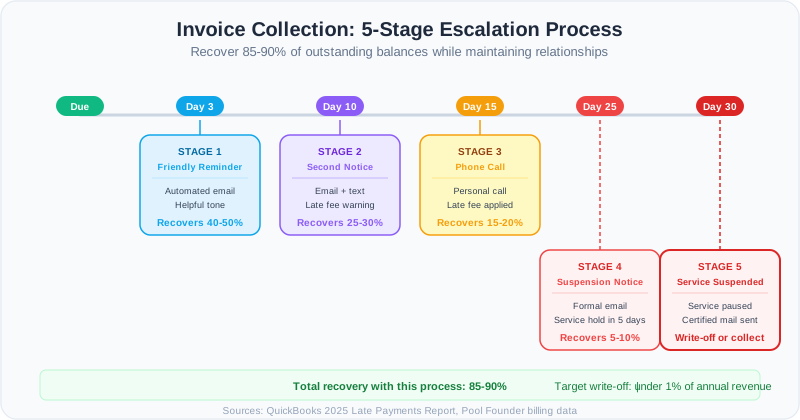
When an invoice goes unpaid despite clear terms, follow this escalation process. Each stage increases urgency while maintaining professionalism. Document every contact attempt in your billing software.
Stage 1: Friendly Reminder (Day 3 Past Due)
Send an automated email reminder. Keep the tone helpful, not demanding. Subject line: "Quick reminder: your pool service invoice is due." Body: "Hi [Name], just a friendly reminder that your [Month] pool service invoice of $[Amount] was due on [Date]. You can pay online here: [Link]. If you have already sent payment, please disregard this message."
Stage 2: Second Notice with Late Fee Warning (Day 10)
Send a second email and a text message. Reference the first reminder. Subject line: "Second notice: invoice past due." Include a note that a late fee will be applied after day 15. This is the stage where most payments come in. The text message is critical because emails get buried.
Stage 3: Phone Call (Day 15)
Make a personal phone call. This is not optional. Many customers who ignore emails will respond immediately to a human voice. Keep the conversation brief: "Hi [Name], this is [Your Name] from [Company]. I am calling because your pool service invoice from [Month] is still showing as unpaid. Is there anything I can help with to get that taken care of?" Apply the late fee after this call regardless of the outcome.
Stage 4: Service Suspension Notice (Day 25)
Send a formal email with the subject line: "Service hold notice: account past due." State clearly that service will be paused on day 30 until the balance is current. This is the stage where you learn whether the customer intends to pay at all. Most will either pay immediately or reveal a financial hardship that you can address with a payment plan.
Stage 5: Final Notice and Service Suspension (Day 30)
If the balance remains unpaid, suspend service and send a final notice. Include the total amount owed (original invoice plus late fees), a deadline for payment (14 days), and a statement that the account may be referred to collections if not resolved. Deliver this notice by email and certified mail.
| Stage | Day | Action | Expected Recovery |
|---|---|---|---|
| 1 | 3 | Automated email reminder | 40-50% of outstanding |
| 2 | 10 | Email + text with late fee warning | 25-30% of remaining |
| 3 | 15 | Personal phone call + late fee applied | 15-20% of remaining |
| 4 | 25 | Service suspension notice | 5-10% of remaining |
| 5 | 30 | Suspend service, final notice | Identifies true write-offs |
When to Offer a Payment Plan
Payment plans make sense for two situations: a long-time customer experiencing temporary financial difficulty, or a customer with a large outstanding balance from multiple months. They do not make sense for first-time customers who refuse to pay.
Structure payment plans simply: the customer pays 50% of the outstanding balance immediately, then the remainder over two to three equal monthly installments added to their regular service charge. Require auto-pay for the payment plan. Get the agreement in writing via email confirmation at minimum.
Never continue providing service while a payment plan is in progress unless the customer is also paying their current monthly charge. A payment plan covers the past balance. Current service still needs to be paid current.
Sending Accounts to Collections
For accounts that reach 90 days past due with no response to your escalation process, collections is appropriate. The balance is not worth your time to chase further, and the customer has demonstrated they will not pay voluntarily.
Collection agencies for small business accounts typically charge 25 to 50% of the amount collected, with lower rates for higher balances. You can also file in small claims court for balances under your state maximum (typically $5,000 to $10,000). Small claims is often more effective for single large balances, while collection agencies work better for multiple smaller amounts.
64%
of small businesses have invoices 90 or more days overdue
Source: QuickBooks Late Payments Report 2025
Before sending to collections, send one final letter (certified mail) giving the customer 10 days to pay in full or contact you to arrange payment. This is both a legal best practice and a last chance for recovery. About 10 to 15% of customers pay at this stage when they realize collections is real.
Automating the Entire Collection Process
Every step of this escalation process can and should be automated except the Stage 3 phone call. Your billing software should handle reminders, late fee calculations, and notifications without you lifting a finger.
| Stage | Automation | Manual Action Required |
|---|---|---|
| Day 3 reminder | Automated email from billing software | None |
| Day 10 second notice | Automated email + text | None |
| Day 15 phone call | System flags account for call | 5-minute phone call |
| Day 15 late fee | Auto-applied to account | None |
| Day 25 suspension notice | Automated email | Review before sending |
| Day 30 service hold | Auto-pause in scheduling | Confirm with tech |
With automation, managing accounts receivable for 100+ customers takes less than 2 hours per month instead of 8 to 12. The system handles the repetitive work, and you only intervene for phone calls and escalation decisions.
Ready to streamline your pool service business?
Pool Founder gives you route optimization, automated invoicing, chemical tracking, and everything else you need to run a more profitable pool business.
Frequently Asked Questions
How late should I let a pool service invoice go before suspending service?
Thirty days past due is the standard threshold for service suspension. This gives the customer time to respond to three escalation contacts (day 3 email, day 10 second notice, day 15 phone call) before you take action. Suspending earlier than 30 days risks losing customers who simply forgot. Waiting longer than 30 days increases your bad debt exposure.
Should I charge late fees on pool service invoices?
Yes. A late fee of $15 or 1.5% per month (whichever is greater) is standard for service businesses. The fee itself generates minimal revenue, but it signals that you take payment seriously. Include your late fee policy in your service agreement so customers know the terms before they start.
How do I handle a customer who says they cannot afford to pay?
Offer a payment plan: 50% now, the remainder over two to three monthly installments. Require auto-pay for the plan. If they cannot afford even that, suspend service and offer to restart when they are ready. Do not continue providing free service. You cannot help a customer who cannot pay you if you go out of business from absorbing their costs.
What percentage of unpaid invoices should I expect to write off?
With a proper escalation process, you should write off less than 1% of annual revenue. Without a process, pool companies commonly write off 2 to 4% of revenue. For a company doing $300,000 in annual revenue, that is the difference between $3,000 and $12,000 in lost income.
Is it worth sending a $175 pool service invoice to collections?
Generally no. Collection agencies charge 25 to 50% of the recovered amount, so you would net $87 to $131 on a $175 invoice. Small claims court costs $30 to $75 in filing fees plus your time. For single small invoices, write them off and focus your energy on prevention. Collections makes financial sense for balances of $500 or more, or when you have multiple unpaid invoices from the same customer.