What Is Your Pool Business Actually Worth?
Whether you are thinking about selling your pool service business, buying one, or just curious about what you have built, you need to understand how buyers assign value. The number is not a guess. Buyers use specific methods with real math, and knowing those methods puts you in a stronger position on either side of the table.
1.6x - 5.6x SDE
the range pool cleaning businesses typically sell for, based on Seller's Discretionary Earnings
Source: Sundance Financial / DealStream 2026
That is a wide range. A business earning $100,000 in SDE could sell for $160,000 or $560,000 depending on dozens of factors. This guide breaks down the three valuation methods buyers use, what pushes you toward the high or low end, and how to increase your number before you go to market.
What Is SDE and Why Does It Matter for Pool Service Valuation?
Seller's Discretionary Earnings (SDE) is the most common metric buyers use to value owner-operated pool service businesses. SDE starts with your net profit and adds back the owner's salary, one-time expenses, non-cash charges like depreciation, and personal expenses you run through the business.
The formula is straightforward: Net Profit + Owner Salary + Owner Benefits + Interest + Depreciation + One-Time Expenses = SDE. This number represents the total economic benefit available to a single owner-operator.
| Line Item | Amount | Notes |
|---|---|---|
| Net Profit (Schedule C) | $45,000 | After all expenses |
| Owner Salary / Draws | $65,000 | What you paid yourself |
| Owner Health Insurance | $8,400 | Personal policy through business |
| Owner Vehicle (personal use %) | $4,800 | Estimated personal portion |
| One-Time Legal Fee | $3,000 | Lawsuit settlement, non-recurring |
| Depreciation | $6,200 | Non-cash expense |
| SDE Total | $132,400 | This is what buyers value |
Most pool service owners underestimate their SDE because they forget to add back personal expenses. That truck payment, cell phone bill, and health insurance running through the business all count. A proper SDE calculation often comes in 30% to 50% higher than net profit alone.
What Are the Three Pool Service Valuation Methods?
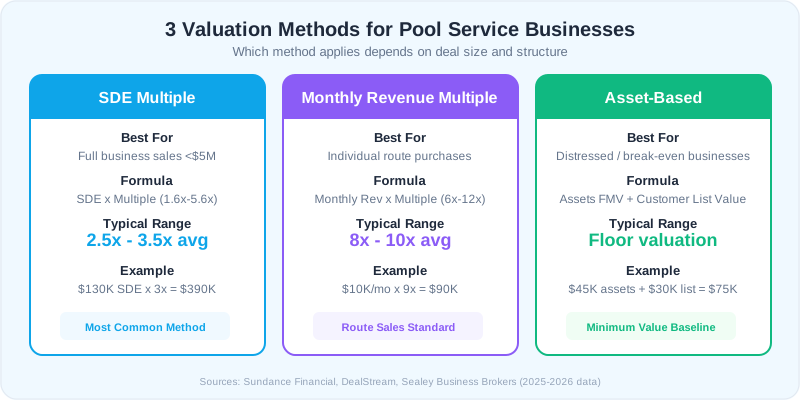
Buyers choose their valuation method based on the size and structure of the deal. Here are the three approaches you will encounter.
Method 1: SDE Multiple
This is the standard for owner-operated pool service businesses valued under $5 million. The buyer calculates your SDE, then multiplies it by a factor (the "multiple") based on the quality of your business. Pool service businesses typically trade at 1.6x to 5.6x SDE, with the average falling around 2.5x to 3.5x.
| Business Profile | Typical SDE Multiple | Example Value (at $130K SDE) |
|---|---|---|
| Solo operator, no contracts, basic records | 1.5x - 2.0x | $195,000 - $260,000 |
| Small team, some contracts, decent records | 2.0x - 3.0x | $260,000 - $390,000 |
| Multi-crew, strong contracts, clean books | 3.0x - 4.0x | $390,000 - $520,000 |
| Scaled operation, manager-run, high retention | 4.0x - 5.6x | $520,000 - $728,000 |
Method 2: Monthly Revenue Multiple
This method is common when buying or selling individual pool routes rather than entire businesses. The buyer takes your total monthly recurring revenue and multiplies it by 6x to 12x. A route billing $10,000 per month might sell for $60,000 to $120,000 depending on quality factors.
| Route Quality | Monthly Revenue Multiple | Example ($10K/mo route) |
|---|---|---|
| Starter (under 40 accounts, loose records) | 6x - 8x | $60,000 - $80,000 |
| Standard (40-100 accounts, stable history) | 8x - 10x | $80,000 - $100,000 |
| Premium (dense, high retention, autopay, contracts) | 10x - 12x+ | $100,000 - $120,000+ |
Method 3: Asset-Based Valuation
This method adds up the fair market value of tangible assets (trucks, equipment, chemical inventory) plus the value of the customer list. It is less common for profitable pool businesses because it usually produces the lowest number. Buyers use it as a floor: the business is worth at least this much even if profits drop.
Most pool service transactions use Method 1 (SDE multiple) for full business sales and Method 2 (monthly revenue multiple) for individual route purchases. Asset-based valuation is typically only the primary method for distressed or break-even businesses.
What Factors Increase a Pool Service Business Valuation?
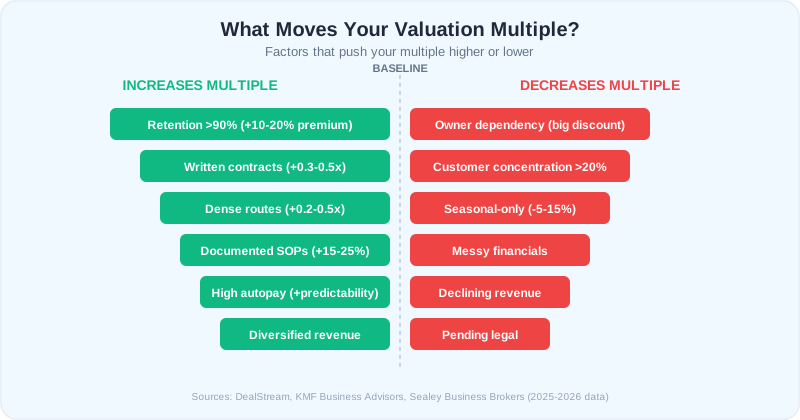
The difference between a 2x and a 5x multiple is not luck. It is the result of specific, measurable business characteristics. Here are the factors that move the needle most.
- Customer retention above 90%. High retention proves your customers are sticky. Brokers report a 10% to 20% premium on businesses with retention rates above 80% year over year.
- Written service contracts. Contracts reduce churn risk for the buyer. Month-to-month accounts are worth less than contracted accounts.
- Route density. Tight geographic clusters mean less drive time, more stops per day, and higher profit per tech. Sun Belt routes with dense subdivisions command 0.2x to 0.5x higher multiples.
- Autopay penetration. The higher your autopay percentage, the more predictable your cash flow. Buyers love predictability.
- Documented processes. An operations manual, training materials, and clear SOPs signal a transferable business. This alone can add 15% to 25% to your multiple.
- Diversified revenue. Maintenance plus repairs plus equipment sales reduces risk. Pure maintenance-only routes are simpler but less valuable.
- Clean financial records. Two to three years of clean books with a CPA review or compiled financial statements. Messy books scare buyers and reduce multiples.
What Decreases a Pool Service Business Valuation?
Just as certain factors push your multiple up, others drag it down. Buyers look for red flags that signal risk.
- Owner dependency. If customers know you by name and the business collapses without you, buyers see risk. The more the business depends on you personally, the lower the multiple.
- High customer concentration. If one commercial account makes up 20%+ of revenue, losing that account devastates the business. Buyers discount for concentration risk.
- Seasonal revenue without off-season services. Businesses concentrated in a short operating window get a 5% to 15% valuation discount compared to year-round operations.
- Deferred maintenance on equipment. Trucks and equipment that need replacement within a year reduce the effective sale price.
- Pending legal issues. Outstanding complaints, lawsuits, or regulatory violations are deal killers or steep discounts.
- Declining revenue trend. Two consecutive years of revenue decline signals a business in trouble, regardless of current profitability.
How Do You Calculate SDE for a Pool Service Business?
Calculating SDE correctly requires going line by line through your financials. Start with your tax return (Schedule C for sole proprietors, or your company financials for LLCs and S-corps) and make the following adjustments.
- 1Start with net income. This is your bottom line after all expenses.
- 2Add back owner compensation. Salary, draws, bonuses, and any payments to yourself or family members who do not work at market-rate roles.
- 3Add back personal benefits. Health insurance, retirement contributions, life insurance, vehicle expenses (personal use portion), and cell phone bills running through the business.
- 4Add back interest and depreciation. These are financing and accounting choices, not operating expenses. The buyer will have different financing.
- 5Add back one-time expenses. Legal settlements, moving costs, large equipment purchases that will not recur, or pandemic-related costs.
- 6Remove one-time revenue. If you had an unusually large one-time project, back it out to show normalized revenue.
Do not inflate your SDE. Experienced buyers and brokers will scrutinize every add-back. Claiming personal vacations as "business travel" or inflating owner salary add-backs destroys trust and kills deals.
Should You Get a Professional Business Valuation?
A professional valuation from a certified business appraiser costs $3,000 to $7,000 for a small pool service business. Whether you need one depends on the situation.
| Situation | Professional Valuation? | Why |
|---|---|---|
| Selling a route under $100K | Usually no | Monthly revenue multiple is straightforward |
| Selling a business $100K-$500K | Recommended | Adds credibility, helps set realistic price |
| Selling a business $500K+ | Yes | Buyers expect it, banks require it for SBA loans |
| Buying a business (any size) | Recommended | Protects you from overpaying |
| Estate planning or divorce | Required | Legal proceedings need certified valuations |
Corey Adams puts it simply: "I have seen owners leave $50,000 to $100,000 on the table because they used a napkin calculation instead of understanding the real methods. The valuation is not the place to cut corners."
Ready to streamline your pool service business?
Pool Founder gives you route optimization, automated invoicing, chemical tracking, and everything else you need to run a more profitable pool business.
Frequently Asked Questions
How much is a pool service business worth?
Pool service businesses typically sell for 1.6x to 5.6x their Seller's Discretionary Earnings (SDE). A business with $130,000 in SDE could be worth $208,000 to $728,000 depending on factors like customer retention, route density, contracts, and how dependent the business is on the owner. Individual pool routes sell for 6x to 12x monthly recurring revenue.
What is SDE for a pool service business?
Seller's Discretionary Earnings (SDE) is your net profit plus owner salary, owner benefits, interest, depreciation, and one-time expenses added back. It represents the total economic benefit available to a single owner-operator. SDE is typically 30% to 50% higher than net profit alone because it includes all the personal expenses you run through the business.
How do I increase the value of my pool service business before selling?
Focus on the factors that increase multiples: get customer retention above 90%, move customers to written contracts and autopay, tighten route density, document your processes in an operations manual, diversify revenue with repair and equipment services, and maintain clean financial records for at least two to three years before selling.
What is the difference between SDE and EBITDA for pool service valuation?
SDE includes the owner's salary as an add-back, making it the standard for owner-operated businesses. EBITDA does not add back owner salary, so it is used for larger businesses where the owner has been replaced by a hired manager. Most pool service businesses under $5 million in value use SDE. Larger operations with professional management teams use EBITDA.
How long does it take to sell a pool service business?
A well-prepared pool service business typically sells in 3 to 9 months from listing to close. Businesses with clean books, strong retention, and realistic pricing sell faster. Overpriced listings or businesses with messy financials can take 12 months or longer, and some never sell at all.
Sources & References
- Sundance Financial - SDE Multiples by Industry 2026
- DealStream - Pool Service Business Rules of Thumb Guide
- Sealey Business Brokers - Ultimate Guide to Pool Route Valuation
- KMF Business Advisors - Pool Service Business Profitability 2026
- Tupelo - How to Value a Pool Cleaning Business
- Fast Business Valuations - Pool Service Route Valuation Formula