You Do Not Need a 30-Page Business Plan to Start a Pool Route
Most pool service business plan templates floating around online were written for bank loan officers, not for the person who is about to load chemicals into a truck and go clean pools. They ask you to write a 30-page document with executive summaries, market analysis sections, and five-year financial projections. By the time you finish it, pool season is over.
The SBA recommends a lean business plan format that can be completed in under an hour and fits on a single page. That is exactly what you need when you are starting or professionalizing a pool service operation. One page that covers who you serve, what you charge, how you get customers, and what the numbers need to look like to keep the lights on.
10.4M
residential swimming pools in the United States, with 60-65% of owners hiring professional service
Source: PHTA / PoolDial 2026 Industry Data
Corey Adams, Pool Founder co-founder and 15-year pool service veteran, puts it this way: "The guys who succeed in this business do not have the best business plans. They have clear numbers, a tight service area, and the discipline to stick to their pricing. You can fit all of that on one page."
What Goes on a One-Page Pool Service Business Plan?
A one-page pool service business plan covers seven sections: your business identity, target customer, service area, services and pricing, startup costs, 12-month revenue targets, and customer acquisition plan. Each section should be two to four sentences. If you cannot explain it briefly, you have not thought it through enough.
This format works whether you are starting from scratch with zero pools or running 60 accounts and trying to get organized before hiring your first tech. The goal is a living document you actually reference, not a filing cabinet decoration.
| Section | What It Answers | Example |
|---|---|---|
| Business Identity | Who are you and what do you do? | ABC Pool Care LLC, residential weekly pool maintenance |
| Target Customer | Who is your ideal account? | Homeowners with in-ground pools, $400K+ homes, 3-bed suburbs |
| Service Area | Where do you operate? | 15-mile radius from zip code 85254, Scottsdale AZ |
| Services & Pricing | What do you charge? | Weekly maintenance $150/mo, chemicals included |
| Startup Costs | What does it take to launch? | $8,500 total: truck, equipment, insurance, chemicals |
| 12-Month Revenue | What are your monthly targets? | Month 6: 30 pools at $150 = $4,500/mo recurring |
| Customer Acquisition | How do you get customers? | Door hangers in target neighborhoods, Nextdoor, referral program |
How Do You Define Your Target Customer for a Pool Route?
Your target customer is the homeowner profile that generates the most revenue per stop with the least friction. For most pool service businesses, this is a residential homeowner with an in-ground pool in a neighborhood dense enough to cluster 4-6 stops within a few miles of each other.
Be specific. "Homeowners with pools" is not a target customer. "Homeowners with in-ground plaster pools in subdivisions built between 2005-2020 in the 85254 zip code" is a target customer. The more specific you get, the easier your marketing becomes and the tighter your routes stay.
Route density is one of the biggest profit drivers in pool service. A tech who drives 5 minutes between stops instead of 15 minutes can service 3-5 more pools per day. Your target customer definition should prioritize geographic clustering over everything else.
You should also define what you do not want. If you do not want commercial accounts, write that down. If you do not want pools more than 20 minutes from your home base, write that down. Saying no to the wrong customers is how you build a route worth owning.
How Should You Set Pricing in Your Business Plan?
Your pricing needs to cover your costs, pay you a living wage, and leave room for profit. That sounds obvious, but most new pool service owners set prices based on what the guy down the street charges instead of what their own numbers require. Start with your costs and work forward.
| Market | Avg Monthly Rate | Range | Notes |
|---|---|---|---|
| Florida | $143 | $100-$200 | High volume, competitive market |
| Arizona | $130 | $100-$175 | Year-round service, lower cost of living |
| Texas | $198 | $150-$250 | Varies widely by metro (Austin $218, El Paso $168) |
| California | $200-$275 | $150-$350 | Higher labor costs, 20-30% premium over Sun Belt |
These are averages from 2025-2026 market data. Your rate should reflect your specific service area, the services you include (chemicals or not), and your target customer. Do not race to the bottom on price. The pool companies that grow are the ones charging enough to deliver great service and still make money.
$1,000-$1,600
annual revenue per residential pool customer depending on service level and chemical inclusion
Source: KMF Business Advisors 2026
What Startup Costs Should You Plan For?
A solo pool service business can launch for $5,000-$15,000 if you already have a reliable vehicle. If you need a truck, budget $15,000-$30,000 total. These numbers cover the essentials: equipment, insurance, initial chemical inventory, business licensing, and basic marketing materials.
| Expense | Low End | High End |
|---|---|---|
| Vehicle (used truck/van) | $5,000 | $15,000 |
| Equipment (test kit, pole, vac, brushes) | $800 | $2,000 |
| Initial chemical inventory | $500 | $1,200 |
| General liability insurance (annual) | $800 | $1,200 |
| Business registration and licensing | $100 | $500 |
| Marketing (door hangers, shirts, cards) | $300 | $800 |
| Software and payment processing setup | $50 | $150 |
General liability insurance for pool service businesses averages $67 per month or about $800 per year, according to Insureon. If you hire employees, add workers compensation at roughly $2-$4 per $100 of payroll. Commercial auto insurance is separate from your personal policy and is required if you are using the vehicle for business.
Do not skip insurance to save money at launch. One slip-and-fall at a customer property or one cracked pool tile can cost more than your entire first year of revenue. General liability is non-negotiable from day one.
How Do You Build 12-Month Revenue Projections for a Pool Business?
Start with a realistic customer acquisition rate and multiply by your monthly service rate. Most solo operators add 3-5 new customers per month in their first year through a combination of door hangers, referrals, and online presence. That puts you at 15-30 pools by month six and 30-50 pools by month twelve.
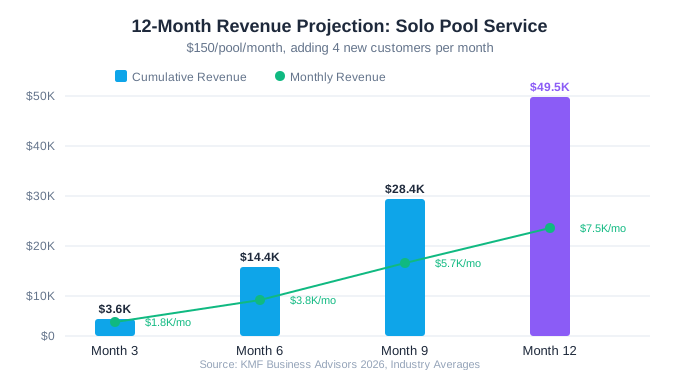
| Month | Total Pools | Monthly Revenue | Cumulative Revenue |
|---|---|---|---|
| Month 3 | 12 | $1,800 | $3,600 |
| Month 6 | 25 | $3,750 | $14,400 |
| Month 9 | 38 | $5,700 | $28,350 |
| Month 12 | 50 | $7,500 | $49,500 |
This example assumes $150 per pool per month and a steady acquisition of 4 new customers per month with minimal churn. Your actual numbers will vary based on your market, pricing, and how aggressively you pursue new business. The point is to have targets you measure against monthly.
Industry data shows most pool service businesses reach operational break-even within 9-12 months when they maintain 40+ weekly service stops and keep customer retention above 80%. At 50 pools and $150/month, your gross revenue is $90,000 annually, which puts a solo operator in the $60,000-$75,000 take-home range after expenses.
What Customer Acquisition Tactics Work Best for New Pool Businesses?
Door hangers in neighborhoods with pools are the highest-ROI tactic for a new pool service business. At $0.35 per door and a 2% conversion rate, your customer acquisition cost is about $18 per customer. Compare that to $45 per lead from Google Ads or $150-$300 per lead from paid advertising, and it is not even close for a startup on a tight budget.
- Door hangers: Target subdivisions with visible pool equipment. 1,000 hangers costs $100-$300 to print. Walk the neighborhood yourself on weekday mornings when homeowners are at work.
- Nextdoor: Create a free business page. Respond to pool-related posts. Ask early customers to recommend you. Nextdoor reaches homeowners who trust neighbor recommendations over ads.
- Referral program: Offer one month free service for every successful referral. Your customer acquisition cost drops below $50 per customer, far less than any paid channel.
- Google Business Profile: Free to set up. Appears in local search results. Ask every customer for a review after their third service visit.
- Pool builder partnerships: New pool installations need ongoing service. Introduce yourself to local builders and offer a referral fee or reciprocal arrangement.
The common mistake is spending money on Facebook ads or Google Ads before you have 20 customers and a handful of reviews. Paid advertising works, but it works better when you have social proof backing it up. Start with free and low-cost tactics first.
How Do You Use This Business Plan After You Write It?
A business plan that sits in a drawer is worthless. Print your one-page plan and put it where you will see it every week. The two numbers that matter most in your first year are total active customers and monthly recurring revenue. If those are growing, you are on track. If they stall, go back to your acquisition plan and increase activity.
Review your plan monthly. Compare actual revenue to projected revenue. If you are behind, figure out why. Is it an acquisition problem (not enough new customers) or a retention problem (customers leaving)? Each one has a different fix.
Update your plan every quarter. Your pricing may change. Your service area may expand. Your customer mix may shift toward more commercial accounts. The plan should reflect where you actually are, not where you were six months ago.
If you ever need a more detailed plan for a bank loan or SBA financing, your one-page plan becomes the outline. You already have the core numbers. Expanding it into a traditional format is just adding context, market research, and financial statements around the framework you have already built.
Free starter kit
Start a pool service business with the numbers already run.
A short email series from an owner who started with $1,200 and a used truck. No software pitch, just the four things that decide whether year one works.
- Startup cost breakdownEvery line item from $2K bootstrap to fully equipped
- Pricing calculatorThe minimum you can charge per visit and still profit
- First-10-customers playbookDoor hangers, referrals, and the phone script that closes
- Licensing & insurance checklistWhat your state requires and which insurers pay claims
Already running routes? Try Pool Founder free
Frequently Asked Questions
Do I need a business plan to start a pool service business?
You do not need a 30-page formal plan, but you absolutely need to know your numbers. A one-page plan covering your target customer, pricing, startup costs, and monthly revenue targets gives you a framework to make decisions and measure progress. Without it, you are guessing.
How much money do I need to start a pool service business?
A solo pool service business can launch for $5,000-$15,000 if you have a reliable vehicle. If you need to buy a truck, budget $15,000-$30,000 total. The biggest line items are the vehicle, general liability insurance ($800/year average), initial chemical inventory ($500-$1,200), and equipment ($800-$2,000).
How many customers should I target in my first year?
Most solo operators realistically add 3-5 new customers per month and finish year one with 30-50 active accounts. At $150 per pool per month, that is $4,500-$7,500 in monthly recurring revenue. Focus on building route density in a tight geographic area rather than spreading across a wide service zone.
What is a good monthly rate to charge for pool service?
Monthly rates vary by market. Florida averages $143, Arizona averages $130, Texas averages $198, and California ranges from $200-$275. Your rate should cover chemical costs (10-15% of revenue), labor, vehicle expenses, insurance, and leave a 15-25% profit margin.
Should I include a marketing plan in my pool service business plan?
Yes, but keep it simple. For a new pool business, your marketing plan is three things: door hangers in neighborhoods with pools ($18 customer acquisition cost at 2% conversion), a free Nextdoor business page, and a referral program offering one month free service per referral. Add paid advertising once you have 20+ customers and reviews.
How long does it take for a pool service business to be profitable?
Most pool service businesses reach break-even within 9-12 months when they maintain 40+ weekly service stops and keep retention above 80%. At 50 pools and $150 per month, gross annual revenue is about $90,000, which supports a solo operator take-home of $60,000-$75,000 after expenses.
Sources & References
- U.S. Small Business Administration: Write Your Business Plan (Lean Format)
- KMF Business Advisors: Pool Service Business Profitability 2026
- Insureon: Pool and Spa Cleaning Services Insurance Costs
- Nexus Marketing: Door Hanger Customer Acquisition Cost ($18 CAC)
- Cabana 2025 Pool Service Pricing Study
- PoolDial: How Many Pools Are in the United States (2026 Data)