The Short Answer: 10-14 Pools Per Day on a Tight Route
How many pools can one person service per day? On a well-organized residential route, a solo technician can realistically hit 10 to 14 full-service pools per day. That means weekly chemical treatment, skimming, brushing, emptying baskets, checking equipment, and logging water chemistry. Not just a quick chlorine dump and drive off.
That range is not a ceiling. Piecework techs doing chemical-only stops can hit 20-25 pools per day. But for full-service maintenance, which is what most residential customers expect and what builds a route worth selling, 10-14 is the realistic daily target before quality starts to slip.
12
average full-service pools per day for a trained tech on an optimized route
Source: Pool Business Forum / Industry Benchmarks
Corey Adams, Pool Founder co-founder and 15-year pool service veteran, has run routes on both ends of this spectrum. "Your daily pool count is really a function of three things: how long each stop takes, how far you drive between them, and how organized your truck is. Fix those three and 12 pools a day is comfortable."
How Long Does a Full-Service Pool Stop Take?
A standard full-service residential pool stop takes 20 to 40 minutes depending on pool size, condition, and equipment configuration. The average across the industry is about 30 minutes per stop. That includes testing water chemistry, adding chemicals, skimming the surface, brushing walls and tile, vacuuming or checking the auto cleaner, emptying skimmer and pump baskets, and inspecting equipment.
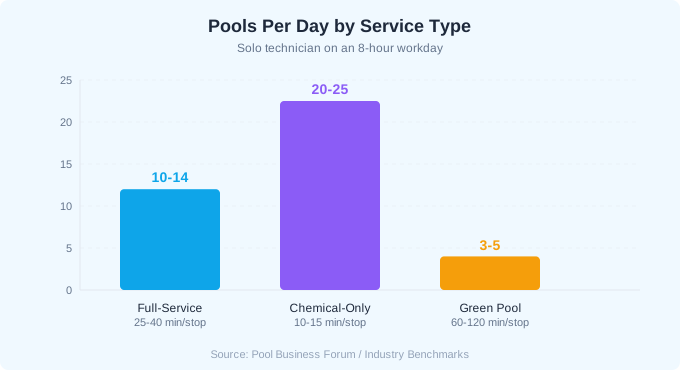
| Service Type | Time Per Stop | Daily Capacity |
|---|---|---|
| Full-service maintenance | 25-40 min | 10-14 pools |
| Chemical-only service | 10-15 min | 20-25 pools |
| Green pool cleanup | 60-120 min | 3-5 pools |
| Filter clean (add-on) | 30-60 min extra | Reduces daily by 2-3 |
The variation matters. A clean 10,000-gallon plaster pool with a working auto cleaner takes 20 minutes. A 25,000-gallon pool with a screened enclosure full of debris, a cartridge filter that needs hosing, and a salt cell throwing errors takes 45 minutes. Your daily number depends heavily on the mix of pools on your route.
How Does Drive Time Between Stops Affect Your Daily Count?
Drive time is the silent killer of pool route productivity. On a tight residential route with good density, you are driving 5 to 10 minutes between stops. On a spread-out route, that jumps to 15 to 20 minutes. The difference adds up fast over a full day.
Here is the math. If you average 30 minutes per pool stop and work an 8-hour day with a 30-minute lunch, you have 450 minutes of productive time. With 5-minute drives between stops, you can fit 12-13 pools. With 15-minute drives, that drops to 9-10 pools. Three extra minutes of drive time per stop costs you 2-3 pools per day.
20-30%
reduction in drive time when switching from manual route planning to optimized routing
Source: Zeo Route Planner 2026
Companies that optimize their routes report a 15-25% increase in daily pool capacity. That means a tech doing 10 pools per day on a poorly planned route could hit 12-13 on the same route after resequencing stops for minimal drive time.
The best way to build density is to target specific neighborhoods when acquiring new customers. Every new customer within a 5-minute radius of an existing stop makes the entire route more efficient. Corey Adams calls this "filling the gaps" and considers it one of the most underrated growth strategies in pool service.
What Factors Shrink Your Daily Pool Count?
Several real-world factors push your daily number below the 10-14 target. Understanding them helps you plan realistic schedules and set proper customer expectations.
- Green pools and heavy treatments: A green pool recovery can take 60-120 minutes and blow up your entire afternoon. Schedule these as the last stop of the day or on a dedicated cleanup day.
- Filter cleans: Cartridge filter cleans add 30-60 minutes to a stop. DE filter teardowns can take even longer. Schedule filter cleans on lighter route days.
- Customer conversations: Homeowners who want to talk eat 10-15 minutes per stop. Friendly is good, but if every stop turns into a 15-minute chat, you are losing 2-3 pools per day.
- Equipment issues: Diagnosing a pump that will not prime, a heater throwing error codes, or a salt cell that needs cleaning adds unplanned time to your route.
- Gate and access problems: Locked gates, wrong codes, dogs in the backyard, and construction blocking access all add time. Keep a gate code list updated and communicate with customers about access.
- Spread-out routes: Taking a customer 20 minutes outside your core area costs you a full pool stop worth of drive time, round trip.
The biggest daily count killer is inconsistency. Some days you hit 14 pools easily. Other days equipment issues and green pools limit you to 8. Planning for an average of 11-12 per day gives you buffer for the inevitable disruptions.
How Many Pools Can One Tech Handle Per Week?
A full-time solo technician working five days per week on optimized routes can maintain 50 to 70 pools on a weekly service schedule. That is 10-14 pools per day, five days per week. Some techs push to 80 pools by adding a half day on Saturday, but burnout becomes a real factor at that volume.
| Weekly Capacity | Daily Average | Monthly Revenue (at $150/pool) |
|---|---|---|
| 50 pools | 10/day | $7,500 |
| 60 pools | 12/day | $9,000 |
| 70 pools | 14/day | $10,500 |
The sweet spot for most solo operators is 55-65 pools per week. At that volume, you have enough buffer to handle filter cleans, equipment calls, and the occasional green pool without falling behind on your regular route. Going above 65 means any disruption causes a cascade of missed or rushed stops.
When you are consistently at 60+ pools and turning away new customers, that is your signal to hire your first tech. You want to hire before you are desperate, not after you have been skipping pools for two weeks.
What Does a Realistic Daily Schedule Look Like?
A 12-pool day starts before most people are awake and finishes in the early afternoon. Here is what a typical route day looks like for a solo operator running residential weekly maintenance.
- 16:00-6:30 AM: Load truck, check chemical inventory, review route for the day. Confirm any gate code changes or customer notes from the night before.
- 26:30-7:00 AM: Drive to first stop. Start with the pool closest to your home base.
- 37:00 AM-12:30 PM: Service pools 1-8. Average 30 minutes per stop with 5-10 minute drives between. This is your core productive block.
- 412:30-1:00 PM: Lunch break. Restock chemicals from your truck supply if needed.
- 51:00-3:00 PM: Service pools 9-12. Afternoon stops tend to take slightly longer because pools have had all morning to accumulate debris.
- 63:00-3:30 PM: Drive back. Log any equipment issues or customer requests that need follow-up.
This schedule puts you home by 3:30-4:00 PM most days, which is one of the lifestyle advantages of pool service. The trade-off is early mornings and physical work in the heat. But compared to most trades, the hours are predictable and the workday is relatively short when your route is dialed in.
How Do You Increase Your Daily Pool Count Without Cutting Corners?
The goal is not to rush through pools. It is to eliminate wasted time so you can deliver the same quality service to more customers. Here are the highest-impact changes.
- Optimize route order: Resequence your stops so you are always driving to the nearest next pool. Route optimization software can reduce drive time by 20-30%, adding 2-3 pools to your daily capacity.
- Pre-measure chemicals: Know what each pool needs before you arrive. If you are testing, treating, and logging at every stop, you are spending 5 extra minutes per pool that pre-dosing can eliminate for stable accounts.
- Organize your truck: Every tool should have a designated spot. You should be able to grab your test kit, pole, and chemical caddy in under 30 seconds. A disorganized truck costs you 2-3 minutes per stop.
- Schedule heavy jobs separately: Do not mix filter cleans and green pool recoveries into your regular route day. Dedicate one afternoon per week to heavy jobs so your main route days stay efficient.
- Build route density: Every time you add a customer, prioritize addresses near existing stops. A tight route with 12 pools in 3 subdivisions beats a spread-out route with 12 pools across 20 miles.
Small improvements compound. Saving 3 minutes per stop and 2 minutes per drive across 12 pools frees up an entire hour. That is one more pool per day, 5 more per week, and 260 more per year. At $35-$45 per stop, that is an extra $9,000-$12,000 in annual revenue from time savings alone.
Free starter kit
Start a pool service business with the numbers already run.
A short email series from an owner who started with $1,200 and a used truck. No software pitch, just the four things that decide whether year one works.
- Startup cost breakdownEvery line item from $2K bootstrap to fully equipped
- Pricing calculatorThe minimum you can charge per visit and still profit
- First-10-customers playbookDoor hangers, referrals, and the phone script that closes
- Licensing & insurance checklistWhat your state requires and which insurers pay claims
Already running routes? Try Pool Founder free
Frequently Asked Questions
Can a pool tech service 20 pools in a day?
Yes, but only on chemical-only routes where each stop takes 10-15 minutes. Piecework techs running chlorine-and-go stops commonly hit 20-25 per day. For full-service maintenance including skimming, brushing, vacuuming, and equipment checks, 14 is a realistic maximum before quality suffers.
How many pools can one person maintain per week?
A full-time solo tech on optimized routes can maintain 50-70 pools per week on a weekly service schedule. The sweet spot is 55-65 pools, which leaves buffer for filter cleans, equipment calls, and disruptions without falling behind on the regular route.
What is the average time to clean a pool professionally?
A standard full-service residential pool stop takes 25-40 minutes, with 30 minutes being the industry average. This includes water testing, chemical treatment, skimming, brushing, checking baskets, and inspecting equipment. Chemical-only visits take 10-15 minutes.
How does route density affect how many pools you can service?
Route density has a massive impact. A tech driving 5 minutes between stops can service 12-13 pools in an 8-hour day. At 15 minutes between stops, that drops to 9-10 pools. Companies that optimize route density report a 15-25% increase in daily pool capacity.
When should a solo pool tech hire their first employee?
When you are consistently at 60+ pools per week and turning away new customers, it is time to hire. You want to bring someone on before you are maxed out so you have time to train them properly. Hiring when you are already drowning leads to rushed training and quality issues.