What New Pool Companies Actually Need From Software
Starting a pool service company means figuring out a hundred things at once: routes, pricing, equipment, insurance, licensing, and finding your first customers. The last thing you need is complex software that takes weeks to learn and costs hundreds of dollars before you have enough revenue to justify it. But you also cannot afford to run your new business on sticky notes and text messages because the habits you build in the first six months define how your operation scales.
The right software for a new pool company has three qualities: it is simple enough to set up in an afternoon, affordable enough to justify on 20 to 30 pools, and capable enough that you do not need to switch platforms when you hit 100 or 200 pools. Most startups make one of two mistakes. They either use nothing and build bad habits, or they buy enterprise software that overwhelms them. This guide helps you find the middle ground.
Corey Adams started his pool service business with a clipboard and a spreadsheet. He switched to software when he hit 40 pools and wished he had started on day one. The time he spent re-entering customer data, rebuilding routes, and fixing billing errors from the spreadsheet era cost him more than six months of software subscription fees.
What Software Features Do New Pool Companies Need?
New pool companies need four features on day one: route management, service logging, customer records, and invoicing. Everything else is a future problem. If the software handles these four workflows on your phone while you are driving between stops, it is doing its job. Features like advanced reporting, AI dispatching, and marketing automation matter when you have 200 pools and five technicians. They do not matter when you have 25 pools and one truck.
| Feature | Startup Priority | Why It Matters |
|---|---|---|
| Route management (mobile) | Critical | Tells you where to go and in what order |
| Service logging (chemicals, notes, photos) | Critical | Replaces the clipboard from day one |
| Customer records | Critical | Stores everything in one place instead of your phone contacts |
| Invoicing / billing | Critical | Gets you paid without chasing checks |
| Chemical tracking | High | Professional service documentation from the start |
| QuickBooks sync | Moderate | Important at tax time but not day one |
| Customer portal | Moderate | Reduces phone calls as customer count grows |
| Route optimization | Moderate | Becomes important at 50+ pools |
| Advanced reporting | Low | Not useful until you have enough data to analyze |
| Dispatch / fleet management | Not needed | Solo operators do not dispatch themselves |
What features should startups avoid paying for?
Dispatch boards, multi-branch management, enterprise reporting dashboards, and workforce management modules solve problems that new pool companies do not have. ServiceTitan does not publish pricing, but reported figures run $245+ per technician per month for features designed for 20-truck operations. A solo operator paying that rate is spending $2,940+ per year on capabilities they will not use for years, if ever.
The best indicator of startup fit: Can you import your first 20 customers and build a route in under one hour with no help? If the software requires a "kickoff call" or a multi-week implementation, it was not built for a company at your stage.
Which Pool Service Software Platforms Serve Startups Best?
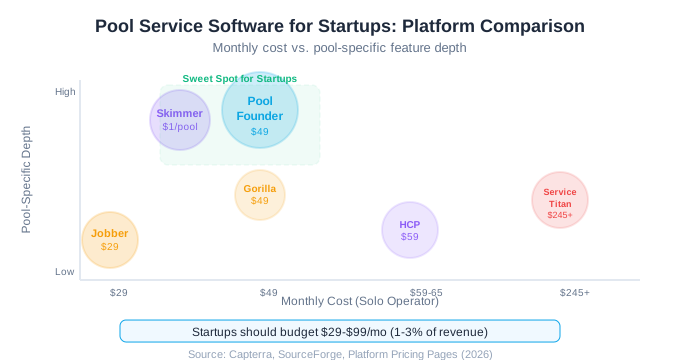
Not every platform is designed for new companies. Some are too expensive. Some are too complex. Some lack the pool-specific features that differentiate you from the guy with a net and no software. The best startup platforms combine low entry cost, fast setup, and enough capability to grow with you for the first two to three years.
| Platform | Monthly Cost (Solo) | Pool-Specific | Setup Time | Best For |
|---|---|---|---|---|
| Pool Founder | $49/mo (flat) | Yes | Under 30 min | Pool startups wanting AI routing + flat pricing |
| Skimmer | $1/location, $49/mo min (Getting Started) | Yes | 1 - 2 hours | Budget-conscious operators under 50 pools |
| Jobber | $49/mo (Core; $29/mo prepaid annual) | No | 1 - 2 hours | Multi-trade startups (pool + lawn, etc.) |
| GorillaDesk | $49/mo | Partial | 1 - 3 hours | Multi-service startups (pool + pest + lawn) |
| PoolBrain | $115/mo ($50 base + $65/tech) | Yes | 1 - 2 hours | Chemistry-focused solo operators |
| Housecall Pro | $79/mo ($59/mo annual) | No | 1 - 3 hours | Customer acquisition-focused startups |
Pool Founder: Best overall for pool service startups
Pool Founder is purpose-built for pool service with chemical tracking, AI-powered route optimization, invoicing, and a customer portal, all at a flat $49/month for a solo operator. There are no per-pool fees, so your software cost stays the same whether you have 20 pools or 120. Setup takes under 30 minutes with CSV import and automatic route building. The 30-day free trial with no credit card required means you can test the full platform for a month before paying anything.
Skimmer: Best per-pool pricing for very small operations
Skimmer's Getting Started plan at $1 per service location per month (with a $49/month minimum) matches Pool Founder's entry price for operations up to 49 pools. The tradeoff is that per-location pricing scales with every new customer. At 100 pools on the Scaling Up plan, Skimmer costs $200/month while Pool Founder stays at $49. Skimmer also has the largest pool-specific user community for peer support.
Jobber: Best for multi-trade startups
If you are starting a business that does pool service alongside landscaping, pressure washing, or handyman work, Jobber's Core plan at $49/month ($29/month if you prepay annually) is one of the cheapest entry points with solid scheduling and invoicing. The tradeoff is zero pool-specific features. No chemical tracking, no water chemistry reports, no pool-specific workflows. For pure pool service startups, Jobber leaves a significant gap.
How Much Should a New Pool Company Spend on Software?
A new pool service company should budget $29 to $99 per month for business management software, which represents 1% to 3% of revenue for a startup with 30 to 60 pools. Spending less than $29/month usually means using free tools that create bad habits. Spending more than $150/month as a startup means paying for features you will not use for a year or more.
| Revenue Stage | Monthly Revenue | Software Budget | % of Revenue |
|---|---|---|---|
| Pre-launch (0 pools) | $0 | $0 (use free trials) | N/A |
| Starting (10-30 pools) | $1,500 - $5,000 | $29 - $49/mo | 1 - 3% |
| Growing (30-75 pools) | $5,000 - $13,000 | $49 - $99/mo | 0.7 - 2% |
| Established (75-150 pools) | $13,000 - $26,000 | $99 - $179/mo | 0.4 - 1.4% |
| Scaling (150+ pools) | $26,000+ | $99 - $249/mo | Under 1% |
Notice that software cost as a percentage of revenue drops as you grow, especially with flat-rate pricing. A startup at 30 pools paying $49/month spends 1% to 3% of revenue on software. The same company at 150 pools still paying $49 to $99/month spends under 0.8%. Flat-rate pricing becomes more economical with every customer you add, which is the opposite of per-pool pricing models where cost scales linearly with growth.
What is the ROI of software for a new pool company?
Pool service software saves a solo operator 5 to 10 hours per week in administrative work: route planning, invoice creation, customer communication, and data entry. At an effective billing rate of $50 per hour, that is $250 to $500 per week in recovered productive time. Even at the conservative end, $49/month in software generates $1,000+ per month in recovered time. The ROI is immediate and measurable from the first week.
What Should Startups Avoid When Choosing Software?
New pool companies make three common software mistakes: buying enterprise software too early, using no software at all, or choosing a platform that forces a disruptive migration within a year. Each mistake costs money and momentum during the most critical growth phase of the business.
Mistake 1: Enterprise software on a startup budget
ServiceTitan charges $245+ per technician per month with a 12-month contract and $1,000-$5,000+ in implementation fees. A solo operator who signs up for ServiceTitan on day one commits to $4,000 to $8,000 in first-year software costs before they have enough revenue to justify a tenth of that. The enterprise features (dispatch boards, fleet management, multi-branch reporting) solve problems that do not exist for a startup.
Mistake 2: Running on spreadsheets and paper
The "I'll get software when I'm bigger" approach seems frugal but costs more in the long run. Every month without software is a month of customer records in your phone contacts, route plans on napkins, and invoices created manually. When you finally adopt software, you spend days re-entering data and building routes that should have been automated from the start. Start with software on day one, even if it is a free trial.
Mistake 3: Choosing a platform you will outgrow in 12 months
Switching software is not difficult (see our migration guide), but it is disruptive. A startup that chooses a basic tool because it is free, then switches to pool-specific software six months later, then switches again at 100 pools loses a week of productivity with each migration. Choose a platform that handles 20 pools today and 200 pools in two years. The best startup software grows with you.
Ask yourself: "Will I still be on this platform at 150 pools?" If the answer is no because of pricing tiers, missing features, or scalability limits, choose a different platform now and save yourself the migration later.
When Should a Growing Pool Company Upgrade or Switch Software?
The right time to evaluate your software is when you hit one of three trigger points: your monthly software cost exceeds 2% of revenue, your technicians are spending more time on workarounds than actual feature use, or you are hiring your second technician and need team management capabilities. Most pool companies hit at least one of these triggers between 50 and 100 pools.
Growth milestones that trigger software evaluation
| Milestone | Trigger | What to Look For |
|---|---|---|
| 50 pools | Manual route planning takes 30+ minutes per week | Route optimization that reduces drive time automatically |
| 75 pools | Billing takes an entire evening each month | Automated recurring billing with autopay |
| 100 pools | Per-pool software costs reach $100-$200/month | Flat-rate pricing that does not penalize growth |
| First hire | Need to assign routes and track technician work | Team management, route assignment, service verification |
| 150+ pools | Customer communication becomes a bottleneck | Customer portal, automated reports, branded service documentation |
The ideal scenario is choosing software at the start that handles all of these milestones without requiring a switch. Pool Founder's $49/month Solo plan covers a startup's needs from 1 to 60+ pools. The $99/month Team plan covers growth to three technicians. The $179/month Growth plan covers up to six technicians, and the $249/month Pro plan covers up to 10. No pricing surprises, no per-pool fees, no forced migrations.
Pool Founder offers a 30-day free trial with full access to every feature and no credit card required. For a startup, that means a full month of professional software at no cost while you build your customer base. Start from day one and never look back.
Step-by-Step: Setting Up Software for a New Pool Company
Setting up pool service software should take less than one hour for a new company. If you are starting from scratch with zero customers, the process is even faster because there is no data to import. Here is the exact sequence for getting operational on day one.
- 1Sign up for a free trial on the platform you chose. Do not enter a credit card. Use the trial period to validate the tool before committing money.
- 2Enter your first 5-10 customers. Manually add the customers you have signed or are about to service. Include name, address, phone, email, service frequency, and monthly price.
- 3Build your first week of routes. Assign customers to days of the week. If the platform has route optimization, let it order the stops. If not, order them by proximity using common sense.
- 4Set up service templates. Create a service checklist that matches what you do at every stop: skim, brush, vacuum, check chemicals, empty baskets, inspect equipment.
- 5Configure billing. Set each customer's monthly rate and billing date. Turn on autopay if available. Connect to QuickBooks if you are using it.
- 6Download the mobile app. Log in on your phone and verify that your route, customer info, and service templates appear correctly.
- 7Service your first route on the app. Use the software for a full day of stops. Log chemicals, take photos, and mark stops complete. This is your real test.
- 8Send your first invoice. After the first billing cycle, send invoices through the software. Verify payments are recorded and synced.
The entire setup process takes 30 to 60 minutes for a new company with 10 to 20 customers. After your first full week using the software, you will know whether it works for your daily workflow. If it does, start adding customers directly into the system from day one. If it does not, try a different platform while you are still in the trial period.
Ready to streamline your pool service business?
Pool Founder gives you route optimization, automated invoicing, chemical tracking, and everything else you need to run a more profitable pool business.
Try Pool Founder free for 30 daysFrequently Asked Questions
What is the best pool service software for a brand new company?
Pool Founder is the best overall choice for new pool companies because it combines pool-specific features (chemical tracking, dosing recommendations, service reports) with flat-rate pricing ($49/month) and under-30-minute setup. Skimmer is a strong alternative for very small operations at $1/location with a $49/month minimum. Jobber ($49/month, or $29/month prepaid annually) is the cheapest option but lacks pool-specific features.
Should I use free software when starting a pool company?
There is no permanently free pool-specific software worth using. Free tools like spreadsheets create bad habits and data silos that cost more to fix later. Instead, use a free trial (Pool Founder offers 30 days with no credit card, Jobber and Housecall Pro offer 14 days) to start with professional software at no cost while you build revenue. The $49-$99/month cost of paid software typically saves 5-10 hours per week in admin time.
How much does pool service software cost for a startup?
Pool service software for startups ranges from roughly $29 to $115 per month. Pool Founder is $49/month flat for a solo operator. Skimmer starts at $1/location with a $49/month minimum (so about $49-$50/month for 20-50 pools). Jobber starts at $49/month ($29/month prepaid annually). Budget 1-3% of monthly revenue for software, which pays for itself by saving 5-10 hours per week in administrative work.
When should a new pool company start using software?
Day one. Every customer record, route plan, and invoice you create outside of software is data you will need to re-enter later. Starting with software from your first customer builds good operational habits and creates a complete history of your business from the beginning. Use a free trial to start at zero cost.
Can I switch software later if I outgrow my first platform?
Yes. Most pool service platforms support CSV export of customer data, making migration possible in one to two weeks. However, switching is disruptive and costs productivity. The better approach is choosing a platform that scales from your first 20 pools to your first 200. Pool Founder's flat-rate pricing and full feature set at every tier means no forced migrations as you grow.
Do I need pool-specific software or will general field service software work?
Pool-specific software is the better choice for companies focused on pool maintenance because it includes chemical tracking, water chemistry documentation, and service reports that general platforms like Jobber and Housecall Pro lack entirely. If pool service is only a small part of your business alongside other trades, general field service software may provide better breadth. For pool-focused startups, start pool-specific.