Year One Financials Are Not a Guess. They Are a Plan.
Financial projections for a pool service business are not about predicting the future with perfect accuracy. They are about knowing your numbers well enough to make smart decisions month by month. When should you buy a second truck? Can you afford to hire? Should you take that customer 20 miles outside your service area? The answers all live in your projections.
Most pool service owners skip this step because it feels like homework. Then they end up in month eight wondering why they are working 50 hours a week and barely breaking even. The math is not complicated. Revenue minus expenses equals profit. The trick is knowing what those numbers actually are in the pool service business.
15-25%
typical net profit margin for well-run pool service businesses
Source: IBISWorld / KMF Business Advisors 2026
Corey Adams, Pool Founder co-founder and 15-year pool service veteran, has helped dozens of operators build their first-year projections. "The owners who know their cost per pool stop, their break-even point, and their monthly overhead number sleep better at night. They make decisions from data, not from gut feelings."
How Do You Project Monthly Recurring Revenue for a Pool Business?
Monthly recurring revenue (MRR) is the foundation of your financial projections. It equals the number of active pools multiplied by your average monthly rate. For a first-year pool business, the key variable is how fast you add customers and how many you keep.
Most solo operators starting from zero add 3 to 5 new customers per month through door hangers, referrals, and online presence. Churn in year one is typically 10-15% because you are still figuring out which customers are a good fit. Build that attrition into your model.
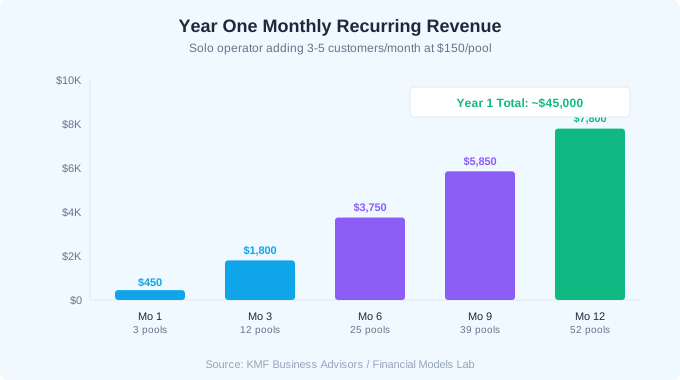
| Month | New Adds | Cancels | Active Pools | MRR |
|---|---|---|---|---|
| Month 1 | 3 | 0 | 3 | $450 |
| Month 3 | 4 | 1 | 12 | $1,800 |
| Month 6 | 4 | 1 | 25 | $3,750 |
| Month 9 | 5 | 1 | 39 | $5,850 |
| Month 12 | 5 | 2 | 52 | $7,800 |
This model assumes $150 per pool per month, which is close to the national average for full-service weekly maintenance. Your actual rate depends on your market. Florida averages $143, Texas averages $198, and California runs $200-$275. Plug in your local rate for more accurate projections.
The standard annual revenue per residential pool customer ranges from $1,000 to $1,600 depending on pool size, service frequency, and whether chemicals are included. Higher-end accounts with salt systems and spa combos can push past $2,000 per year.
What Are the Major Expense Categories for a Pool Service Business?
Pool service expenses fall into five categories: chemicals and supplies, vehicle costs, insurance, marketing, and overhead. In year one, your biggest expense after your own labor is usually the vehicle, followed by chemicals and insurance.
| Expense Category | Monthly Cost (Solo, 40 Pools) | % of Revenue |
|---|---|---|
| Chemicals and supplies | $600-$900 | 10-15% |
| Vehicle (fuel, maintenance, payment) | $600-$1,000 | 10-17% |
| Insurance (GL, auto, WC if applicable) | $200-$350 | 3-6% |
| Marketing and advertising | $100-$300 | 2-5% |
| Software, phone, admin overhead | $100-$250 | 2-4% |
Total operating expenses for a solo operator running 40 pools typically land between $1,600 and $2,800 per month, or roughly 27-47% of gross revenue. The goal is to keep total expenses below 40% of revenue once you are past the ramp-up phase, leaving 15-25% net profit after paying yourself.
How Much Do Chemical Costs Eat Into Pool Service Revenue?
Chemical costs are your single largest variable expense and the one most pool service owners underestimate. For residential pools using traditional chlorine, expect to spend $15-$25 per pool per month on chemicals. That includes liquid chlorine, muriatic acid, stabilizer, and specialty chemicals for occasional treatments.
Homeowners pay $50-$80 per month in chemical costs for chlorine pools and $20-$40 for saltwater pools. As a service provider buying in bulk, your cost should be lower. But chemical prices have been volatile since 2020, with liquid chlorine prices increasing over 60% in many markets.
10-15%
of gross revenue typically goes to chemical costs for a well-run pool service operation
Source: Pool Business Forum
- Chlorine pools: $15-$25/month per pool in chemical costs. Higher in summer when demand increases and algae pressure is strongest.
- Salt pools: $5-$15/month per pool. Lower chemical costs but salt cell inspection adds service time.
- Bulk purchasing: Buy chlorine and acid from a wholesale distributor, not a retail pool store. The price difference is 30-40% on high-volume chemicals.
- Seasonal variation: Chemical costs spike 25-40% in peak summer months. Your projections should account for this, not assume flat costs year-round.
If chemicals are exceeding 15% of your revenue, either your pricing is too low or you have pools that are consistently problematic. Track chemical usage per pool monthly to identify which accounts are eating your margin.
What Are Realistic Vehicle and Fuel Costs for a Pool Route?
Vehicle expenses are the second-largest cost center for most pool service businesses. This includes your truck payment (or depreciation if owned), fuel, maintenance, and commercial auto insurance. The IRS standard mileage rate for 2025 is $0.70 per mile, which covers all vehicle operating costs.
A pool tech running a tight route drives 50-80 miles per day. On a spread-out route, that jumps to 100-150 miles. At $3.10-$3.50 per gallon and a truck getting 15-18 MPG, daily fuel costs range from $10 to $35. Monthly fuel runs $200-$700 depending on route density.
| Vehicle Expense | Monthly Cost | Annual Cost |
|---|---|---|
| Truck payment (used) | $250-$450 | $3,000-$5,400 |
| Fuel (50-100 miles/day) | $250-$600 | $3,000-$7,200 |
| Maintenance and repairs | $100-$200 | $1,200-$2,400 |
| Commercial auto insurance | $150-$300 | $1,800-$3,600 |
Total vehicle costs typically run $750-$1,550 per month. Route density is the most effective way to reduce this. Every minute of unnecessary drive time costs fuel and opportunity. Building a tight route from the start keeps your vehicle costs at the low end of these ranges.
How Do You Account for Seasonality in Pool Service Projections?
Seasonality affects both revenue and expenses, but the impact depends heavily on your market. Year-round markets like Florida, Arizona, and Southern California see minimal seasonal drop-off. Markets with cold winters like the Mid-Atlantic, Midwest, and Northeast can lose 30-50% of revenue from November through March.
Even in year-round markets, you should plan for seasonal variation. Summer months bring higher chemical costs (25-40% above baseline) but also more service calls and upsell opportunities. Winter months in warm markets see lower chemical usage but more cancellations as snowbirds leave.
| Season | Revenue Impact | Expense Impact | Net Effect |
|---|---|---|---|
| Spring (Mar-May) | +10-15% (ramp up) | Normal | Positive |
| Summer (Jun-Aug) | Peak (baseline) | +25-40% chemicals | Best margins if priced right |
| Fall (Sep-Nov) | -5-15% (wind down) | -10-20% chemicals | Still profitable |
| Winter (Dec-Feb) | -10-50% (market dependent) | -20-40% chemicals | Break even or slight loss |
In seasonal markets, build a 2-3 month cash reserve during peak season to cover winter overhead. Your monthly projection should not assume flat revenue across all 12 months unless you are in South Florida or the Phoenix metro.
What Should Your Break-Even Point Look Like?
Your break-even point is the number of active pools where monthly revenue covers all expenses, including paying yourself a reasonable salary. For most solo operators, break-even falls between 25 and 40 pools depending on your market rate and expense structure.
Here is the math. If your monthly overhead (insurance, vehicle, phone, software) is $2,000 and your variable costs (chemicals, supplies) are $20 per pool, then at $150 per pool per month, each pool contributes $130 toward overhead. $2,000 divided by $130 equals 16 pools to cover overhead. Add a $4,000/month salary for yourself, and you need about 46 pools to break even with pay.
9-12 months
typical time to reach operational break-even for a new pool service business
Source: Financial Models Lab / KMF Business Advisors
Industry data shows most pool service businesses reach operational break-even within 9 to 12 months when they maintain 40+ weekly service stops and keep customer retention above 80%. At 50 pools and $150/month, gross annual revenue is about $90,000. After expenses, a solo operator can expect $60,000-$75,000 in take-home pay.
By year two, owners who continue growing can expect EBITDA approaching $200,000+ with a 2-3 person operation. The jump from solo to multi-tech is where the economics of pool service really start to compound.
How Do You Track Actuals Against Your Projections?
Projections are only useful if you compare them to actual results every month. The three numbers to track are monthly recurring revenue, total expenses, and customer count. If any of these deviate more than 15% from your projection, dig in and figure out why.
- Revenue below projection: Are you adding fewer customers than planned? Is your average rate lower than expected? Are customers canceling faster than you budgeted for?
- Expenses above projection: Check chemical costs first. Then vehicle costs. Then look for one-time expenses (equipment replacement, unexpected repairs) that you did not budget for.
- Customer count on track but revenue low: You may have a pricing problem. If you are discounting to win customers, your average rate will drag your revenue below projection even with the right customer count.
Update your projections quarterly with actual data. Your month-six projection will be much more accurate than your month-one projection because you will have real data on acquisition rates, churn, chemical costs, and seasonal patterns specific to your market.
Keep a simple spreadsheet with three columns per month: projected revenue, actual revenue, and variance. When actual exceeds projected, you know your growth is ahead of plan. When it falls behind, you catch it early enough to adjust.
Free starter kit
Start a pool service business with the numbers already run.
A short email series from an owner who started with $1,200 and a used truck. No software pitch, just the four things that decide whether year one works.
- Startup cost breakdownEvery line item from $2K bootstrap to fully equipped
- Pricing calculatorThe minimum you can charge per visit and still profit
- First-10-customers playbookDoor hangers, referrals, and the phone script that closes
- Licensing & insurance checklistWhat your state requires and which insurers pay claims
Already running routes? Try Pool Founder free
Frequently Asked Questions
How much revenue can a solo pool service business make in year one?
A solo operator adding 3-5 customers per month typically finishes year one with 40-55 active pools. At $150 per pool per month, that is $72,000-$99,000 in gross annual revenue. After expenses, take-home pay for a solo operator is usually $50,000-$75,000 in the first year.
What percentage of pool service revenue goes to chemicals?
Chemical costs typically represent 10-15% of gross revenue for a well-run operation. At $150/month per pool, that is $15-$25 per pool per month in chemical expenses. Costs spike 25-40% in summer. If chemicals exceed 15% of revenue, either your pricing is too low or specific pools need repricing.
How many pools do you need to break even?
Most solo operators break even at 25-40 pools depending on market rates and expenses. If your monthly overhead is $2,000 and you pay yourself $4,000, you need about 46 pools at $150/month (with $20/pool in variable costs). The typical timeline to reach break-even is 9-12 months.
What insurance do you need for a pool service business?
At minimum, you need general liability insurance (averaging $800/year or $67/month) and commercial auto insurance ($1,800-$3,600/year). If you hire employees, add workers compensation at $2-$4 per $100 of payroll. A Business Owner Policy (BOP) bundles general liability and commercial property at a lower combined rate.
How do seasonal markets affect pool service financial projections?
Markets with cold winters can see 30-50% revenue drops from November through March. Even year-round markets like Florida and Arizona see seasonal variation in chemical costs and customer counts. Build a 2-3 month cash reserve during peak season and adjust your monthly projections to account for seasonal dips.
What profit margin should a pool service business target?
Well-run pool service businesses achieve 15-25% net profit margins. In year one, margins may be lower as you ramp up customer count and absorb startup costs. By year two with 80+ pools, you should be consistently above 15%. If margins are below 10%, review your pricing and expense structure.
Sources & References
- KMF Business Advisors: Pool Service Business Profitability 2026
- Financial Models Lab: Pool Maintenance Owner Income ($212k to $16M EBITDA)
- Insureon: Pool and Spa Cleaning Services Insurance Costs
- IRS: 2025 Standard Business Mileage Rate (70 cents per mile)
- Cabana 2025 Pool Service Pricing Study
- Pool Business Forum: Pool Service Pricing Strategies