Is AI in Pool Service Software Actually Useful or Just Marketing Hype?
AI-powered features in pool service software have progressed from vaporware marketing buzzwords to measurable operational tools that save pool companies 5-12 hours per week on route optimization, customer onboarding, and administrative tasks that previously required manual data entry and human judgment calls. The gap between platforms with genuine AI capabilities and those that merely label basic automation as "AI" has widened dramatically in 2025-2026, creating a real competitive advantage for early adopters while exposing the limitations of platforms that bolted AI terminology onto unchanged feature sets.
This guide separates genuine AI capabilities from rebranded automation by evaluating what each platform's AI actually does, how it learns from your data, and what measurable time or revenue impact operators report after implementation. (For a feature-by-feature ranking of every platform beyond AI, see the full pool service software comparison.) The pool service industry is early enough in AI adoption that the companies deploying it now are building operational advantages that compound over time as their AI systems learn from more data.
What AI Capabilities Exist in Pool Service Software Today?
Pool service AI capabilities fall into five functional categories in 2026: conversational AI assistants that answer business questions and execute tasks, route optimization algorithms that learn from actual driving patterns, automated customer and job import from unstructured data, predictive scheduling that anticipates service needs, and smart chemical dosing recommendations based on historical readings and environmental conditions. Not every platform offers all five, and the depth within each category varies from basic rule-based automation to genuine machine learning.
How Is AI Different From Basic Automation in Pool Software?
Basic automation follows fixed rules (if invoice is 30 days overdue, send reminder email), while AI learns from your operational data to make decisions that improve over time (this route sequence produced 18% less drive time than last month because the system identified a traffic pattern on Tuesdays that makes the reverse order faster). The distinction matters because automation saves time on repetitive tasks, but AI saves time on judgment-intensive tasks that previously required an experienced operator's knowledge.
| Capability | Basic Automation | AI-Powered | Business Impact |
|---|---|---|---|
| Route sequencing | Sort stops by proximity (static) | Optimize sequence based on traffic, service time, and historical patterns | 15-25% more drive time reduction vs. basic sorting |
| Customer import | CSV upload with column mapping | Parse unstructured spreadsheets, detect fields, auto-map data | Hours saved per import; fewer errors |
| Scheduling | Recurring calendar events | Predict optimal service timing based on pool usage, weather, and chemistry trends | Reduce over-servicing and under-servicing |
| Chemical dosing | Static dosing chart lookup | Recommend doses based on pool history, season, bather load, and weather forecast | 10-20% reduction in chemical waste |
| Business insights | Canned reports with filters | Natural language Q&A about your business data with contextual recommendations | Decisions made in minutes instead of hours of spreadsheet analysis |
Which AI Features Deliver the Fastest ROI for Pool Companies?
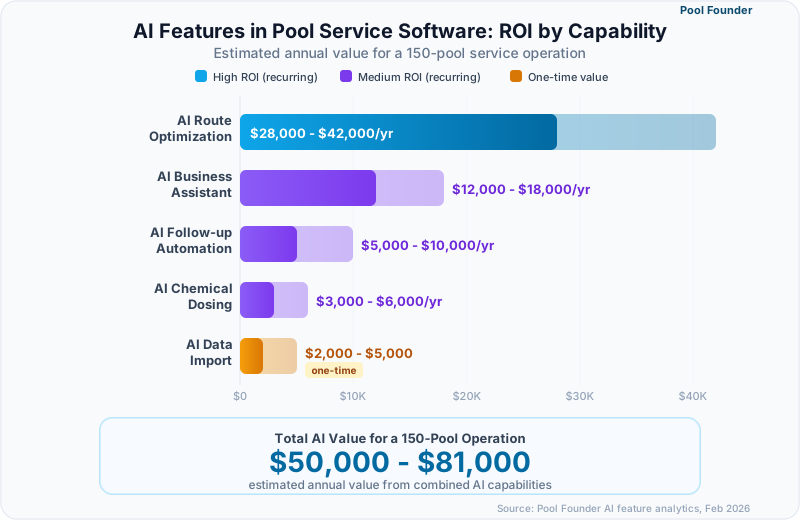
AI route optimization delivers the fastest measurable ROI because drive time reduction translates directly to fuel savings and additional billable stops within the first week of deployment. AI customer import delivers the second-fastest ROI for companies migrating platforms or onboarding new accounts in bulk, reducing a 4-8 hour manual data entry project to a 15-minute AI-assisted process. Conversational AI assistants deliver compounding ROI over time as operators use them for business analysis, customer communication drafting, and operational decision-making that previously required hours of manual review.
Evaluate AI features by asking: "What specific task does this replace, and how many hours per week did that task consume?" If the answer is vague or the time savings are less than 30 minutes per week, the AI feature is not yet mature enough to influence your purchasing decision.
How Do AI Features Compare Across Pool Service Platforms?
Pool Founder leads the AI category with three distinct AI systems (George conversational assistant, AI route optimization, and AI data import), while PoolBrain focuses exclusively on AI chemical dosing, ServiceTitan applies AI to dispatch optimization for large fleets, and Jobber's Copilot provides basic AI-assisted business insights. The competitive landscape reveals a clear split between platforms building AI into their core workflow versus platforms adding surface-level AI features to marketing materials without fundamentally changing how the software operates.
| AI Feature | Pool Founder | PoolBrain | ServiceTitan | Jobber | Skimmer |
|---|---|---|---|---|---|
| AI business assistant | George — full conversational AI for business Q&A, task execution, and recommendations | Not available | Not available | Copilot — basic insights and suggestions | AI Insights — natural-language reporting Q&A (included since July 2026); no general in-app assistant |
| AI route optimization | Automatic clustering, rebalancing, and continuous learning from actual routes | Not available | AI dispatch optimization for multi-tech fleets | Basic algorithmic optimization | Route optimizer on higher plans (not AI) |
| AI data import | Parse unstructured spreadsheets, auto-detect fields, create customers and jobs from messy data | Not available | Implementation-assisted import | Not available | Not available |
| AI chemical dosing | Dosing recommendations based on pool history | Advanced AI dosing with weather, bather load, and seasonal models | Not available | Not available | Orenda-powered calculations on Scaling Up plan (formula-based, not AI) |
| AI scheduling | Smart job scheduling based on route density and customer patterns | Basic scheduling | Capacity-based scheduling with AI optimization | Basic scheduling suggestions | Not available |
| Learning capability | Improves with your usage data over time | Chemical models improve with reading history | Dispatch patterns improve with scale | Limited learning | None advertised |
What Is George and How Does Pool Founder's AI Assistant Work?
George is Pool Founder's conversational AI assistant that understands your business data and can answer natural language questions like "which route is my least profitable?" or "show me customers who haven't been serviced in 3 weeks," then execute follow-up actions based on the conversation. Unlike chatbots that search help documentation, George connects directly to your operational data, analyzing routes, customers, revenue, chemical history, and scheduling to provide answers that would otherwise require exporting data to a spreadsheet and spending 30-60 minutes on manual analysis.
- Business intelligence: Ask George questions about revenue trends, route profitability, customer churn risk, and technician performance using plain English
- Task execution: George can draft customer communications, suggest schedule changes, and identify operational inefficiencies from your data
- Contextual recommendations: Based on your business patterns, George proactively suggests improvements like rebalancing an overloaded route day or following up with at-risk customers
- Data analysis: George can compare this month to last month, this year to last year, or any time period across any metric your system tracks
How Does PoolBrain's AI Chemical Dosing Compare?
PoolBrain's AI chemical dosing system is the most technically advanced chemical recommendation engine in pool service software, using machine learning models trained on historical readings, weather data, bather load estimates, and seasonal patterns to predict chemical demand before problems develop. The system calculates dosing recommendations that account for variables like upcoming rain forecasts or expected temperature spikes that traditional dosing charts ignore entirely. For companies where chemical precision is the primary competitive advantage, PoolBrain's dosing AI is genuinely differentiated.
What Does Jobber's Copilot Actually Do?
Jobber's Copilot provides AI-generated business insights and basic operational suggestions within the Jobber dashboard, such as identifying revenue trends, flagging overdue follow-ups, and suggesting pricing adjustments. The tool is useful for surface-level business awareness but does not connect to pool-specific data (chemical readings, route efficiency, equipment history) because Jobber does not capture that data natively. For pool companies specifically, Copilot's value is limited to general business metrics rather than pool-operational intelligence.
The phrase "AI-powered" appears on almost every software marketing page in 2026. Before trusting the label, ask the vendor three questions: What data does the AI learn from? How does it improve over time? What specific task does it replace that I am doing manually today?
How Does AI Route Optimization Differ From Traditional Optimization?
Traditional route optimization calculates the shortest path between a set of stops using distance or drive time as inputs, producing a single static sequence that does not adapt until you manually re-run the optimizer. AI route optimization continuously learns from actual service data, including how long each pool actually takes (not the default 20-minute estimate), which neighborhoods have traffic at which times, and how your route composition changes as customers are added and removed, producing sequences that improve automatically over weeks and months of use.
31%
Additional drive time reduction achieved by AI route optimization versus static algorithmic optimization after 90 days of learning
Source: Pool Founder route optimization data, 2025
What Data Does AI Route Optimization Learn From?
AI routing systems ingest four categories of operational data that static optimizers ignore: actual service duration per stop (replacing flat estimates with real averages), time-of-day traffic patterns that affect drive times between specific neighborhoods, seasonal route composition changes as biweekly and monthly customers cycle on and off, and technician-specific patterns like which techs are faster at certain pool types or prefer certain geographic areas.
| Data Input | Traditional Optimization | AI Optimization | Impact on Route Quality |
|---|---|---|---|
| Drive time between stops | Static Google Maps estimate | Time-of-day adjusted based on historical actuals | 5-10% more accurate sequencing |
| Service duration per pool | Flat 20-minute estimate for all pools | Learned average per pool (15 min for basic, 35 min for large) | Better day-end time predictions |
| Customer additions/removals | Requires manual re-optimization | Automatic rebalancing when customer base changes | Eliminates route drift over time |
| Biweekly/monthly gaps | Creates geographic holes on off-weeks | Fills gaps with complementary schedules automatically | 10-15% efficiency gain for mixed frequencies |
| Traffic patterns | Not considered | Learns rush-hour bottlenecks between specific areas | Avoids predictable delays |
How Long Does AI Route Optimization Take to Show Results?
AI route optimization produces immediate improvements on day one through geographic clustering (comparable to traditional optimization), then incrementally improves over 30-90 days as the system accumulates actual service data from your routes. The first-day improvement typically saves 15-20% of drive time versus manual routing. By day 90, the AI has enough data to identify patterns invisible to static algorithms, adding another 8-15% improvement that compounds the initial savings. Pool Founder users report the most noticeable quality jump around week 4-6 when the system has processed a full cycle of weekly, biweekly, and monthly customers.
AI route optimization becomes more valuable as your business becomes more complex. A solo operator with 60 weekly pools on fixed days sees modest AI benefits. A company with 300 accounts across weekly, biweekly, and monthly frequencies with 5 technicians sees transformative improvements because the optimization problem is exponentially harder to solve manually.
How Does AI-Powered Data Import Save Time During Software Migration?
AI data import reduces pool service software migration from a multi-day manual data entry project to a 15-30 minute guided process by automatically parsing unstructured spreadsheets, detecting customer names, addresses, phone numbers, service schedules, and equipment details without requiring perfect column headers or consistent formatting. Traditional CSV import requires every column to be labeled correctly, every field formatted identically, and every data type matched to the right destination field, a process that fails 30-40% of the time on first attempt and consumes 4-8 hours of troubleshooting for a typical 200-customer import.
What Makes Pool Founder's AI Import Different From Standard CSV Upload?
Pool Founder's AI import accepts messy, real-world spreadsheets that pool operators actually maintain, including columns labeled inconsistently ("Name," "Customer," "Pool Owner"), addresses split across multiple fields or combined into one, phone numbers in different formats, and service notes mixed with scheduling data. The AI identifies what each column contains regardless of the header label, maps it to the correct field, and flags ambiguous entries for human review rather than failing the entire import.
| Import Capability | Standard CSV Import | Pool Founder AI Import |
|---|---|---|
| Column header requirements | Must match expected field names exactly | AI detects content type regardless of header |
| Address formatting | Must be in consistent format across all rows | Handles split fields, combined addresses, missing zip codes |
| Phone number formats | Fails on mixed formats (some with dashes, some without) | Normalizes all formats automatically |
| Duplicate detection | Imports duplicates; manual cleanup required | Identifies and flags potential duplicates before import |
| Missing data handling | Skips rows with missing required fields | Imports partial records and flags missing fields for review |
| Time for 200 customers | 4-8 hours including troubleshooting | 15-30 minutes including review |
| Error rate | 5-15% of records need manual correction | Under 2% with human review step |
How Does AI Import Handle Equipment and Service Schedule Data?
Beyond basic customer records, Pool Founder's AI import can extract pool equipment details (pump models, filter types, heater specs), service frequencies (weekly, biweekly, monthly), route day assignments, and chemical baseline readings from spreadsheets that contain this data in any format. The AI recognizes contextual clues, such as "M-W-F" meaning Monday-Wednesday-Friday service, "Pentair IntelliFlo" as a pump model, or "$175/month" as a service rate, and maps them to the appropriate fields without manual configuration.
94%
Average field detection accuracy on first pass for Pool Founder AI import across unstructured spreadsheets
Source: Pool Founder import data, 2025
If you are considering switching pool service software but dreading the data migration, AI import is the feature that eliminates the biggest barrier. Request a demo of the import process with YOUR actual spreadsheet to see how the AI handles your specific data before committing to any platform.
How Should Pool Companies Evaluate AI Features Before Buying?
Pool companies should evaluate AI features by testing them during a free trial with real business data rather than relying on marketing demos, because AI performance depends entirely on the quality and quantity of data it receives, and a demo using a perfect sample dataset will always look better than real-world operation with messy, incomplete data from an actual pool business. The three questions that separate genuine AI value from marketing are: Does it learn from my data? Does it improve over time? Can I measure the time it saves?
What Should You Test During a Free Trial of AI Features?
A thorough AI evaluation during a free trial requires testing each AI feature against a real operational task, measuring the time difference between the AI-assisted process and your current manual process, and verifying that the AI output is accurate enough to trust without extensive manual review.
- 1AI route optimization: Import one full week of stops, let the AI optimize, compare total estimated drive time against your current manual sequence using Google Maps
- 2AI data import: Upload your actual customer spreadsheet in its current messy format and evaluate how many records import correctly without manual intervention
- 3AI assistant (if available): Ask 5 business questions you would normally answer by reviewing spreadsheets or reports, and check the accuracy and speed of the AI responses
- 4AI chemical dosing (if available): Compare the AI's dosing recommendations against your experienced technician's calculations for 10 different pool scenarios
- 5AI scheduling: Add 5 new hypothetical customers and evaluate whether the AI places them on optimal route days based on geography and existing schedule density
Which AI Features Are Worth Paying More For?
AI route optimization and AI data import justify premium pricing because they replace hours of manual work with minutes of automated processing and the results are immediately measurable in saved time and improved efficiency. AI business assistants like George justify their cost for operators who currently spend 3-5 hours per week on business analysis, report generation, or customer communication drafting. AI chemical dosing justifies premium pricing only for companies managing complex pool environments (saltwater, variable bather loads, commercial pools) where precise chemistry prevents expensive callbacks.
| AI Feature | Weekly Time Saved | Monthly Value (at $50/hr operator time) | Worth Paying Premium? |
|---|---|---|---|
| AI route optimization | 3-5 hours/month (ongoing) | $150-$250 + fuel savings + added stops | Yes — immediate and compounding ROI |
| AI data import | 4-8 hours per migration | $200-$400 one-time savings | Yes — if switching platforms or onboarding in bulk |
| AI business assistant | 2-4 hours/week | $400-$800 | Yes — for owners spending significant time on analysis |
| AI chemical dosing | 30-60 min/week | $100-$200 + chemical cost reduction | Depends — highest value for complex pool environments |
| AI scheduling | 1-2 hours/week | $200-$400 | Yes — for companies adding 5+ customers per month |
The pool companies gaining the most from AI in 2026 are not the largest ones. They are the ones with 100-400 accounts where the owner still handles routing, scheduling, and business analysis personally. AI features at this scale eliminate the operational ceiling that prevents solo operators and small teams from growing without hiring office staff.
Ready to streamline your pool service business?
Pool Founder gives you route optimization, automated invoicing, chemical tracking, and everything else you need to run a more profitable pool business.
Frequently Asked Questions
What is AI pool service software?
AI pool service software uses artificial intelligence and machine learning to automate tasks that traditionally required human judgment, including route optimization that learns from actual driving patterns, data import that parses unstructured spreadsheets, conversational assistants that answer business questions from your operational data, and chemical dosing recommendations that account for weather, season, and pool history. Pool Founder, PoolBrain, ServiceTitan, and Jobber all include some level of AI functionality, though the depth and usefulness varies significantly.
Is AI route optimization better than standard route optimization?
Yes, measurably. AI route optimization delivers 15-25% drive time reduction from day one (comparable to standard optimization), then improves an additional 8-15% over 30-90 days as it learns your actual service patterns, traffic conditions, and per-pool service times. Standard optimization calculates the shortest path once and does not adapt. For a 60-pool route, the AI learning phase typically adds savings of 15-25 minutes per day beyond what static optimization achieves.
What is George in Pool Founder?
George is Pool Founder's conversational AI assistant that connects directly to your business data and can answer natural language questions like "which route had the highest revenue last month?" or "show me customers who are overdue for filter cleaning." George can analyze trends, compare time periods, identify at-risk customers, and suggest operational improvements based on your actual data. Unlike generic AI chatbots, George understands pool service operations and has access to your routes, customers, chemical history, and financial data.
How does AI data import work for pool service software?
AI data import accepts messy, real-world spreadsheets and automatically detects what each column contains regardless of header labels. It normalizes inconsistent formatting (mixed phone number formats, split address fields, varied date formats), identifies potential duplicates, and maps data to the correct fields in your new system. Pool Founder's AI import processes a 200-customer spreadsheet in 15-30 minutes with 94% first-pass accuracy, compared to 4-8 hours for traditional CSV import with 85-95% accuracy.
Does PoolBrain use AI for chemical dosing?
Yes, PoolBrain offers the most advanced AI chemical dosing system in pool service software. Their models incorporate historical chemical readings, weather forecasts, seasonal patterns, and estimated bather load to predict chemical demand before problems develop. The system recommends proactive dosing adjustments rather than reactive corrections, which reduces chemical waste by 10-20% and prevents the water quality swings that cause callbacks. The AI improves its recommendations over time as it accumulates more reading data for each pool.
Is AI pool service software more expensive than regular software?
Not necessarily. Pool Founder includes AI route optimization, George AI assistant, and AI data import in its standard plans starting at $49/month. PoolBrain runs $50/month base plus $65 per technician and includes AI chemical dosing. ServiceTitan's AI dispatch features are part of its enterprise pricing, which is not published (reported figures run $245-$500 per technician per month). Jobber's Copilot is included in higher-tier plans. The cost of AI features varies less by AI capability and more by the platform's overall pricing model and target market segment.
Can AI really replace manual route planning?
AI can replace 90-95% of manual route planning work for pool service companies. It handles stop sequencing, day assignment for new customers, rebalancing when customers cancel, and gap-filling for biweekly schedules automatically. The remaining 5-10% involves edge cases like customer-requested time windows, technician preferences, and special access requirements that still benefit from human override. Pool operators who switch from manual planning to AI routing consistently report that they never return to manual methods because the time savings are too significant.
How do I know if an AI feature is real or just marketing?
Ask three questions: Does it learn from my specific data or use the same rules for everyone? Does it improve its recommendations over time? Can the vendor show me a before-and-after measurement from an actual customer? Genuine AI features can answer all three questions specifically. Marketing-labeled "AI" that is actually basic automation will deflect with vague answers about "smart algorithms" or "intelligent automation" without explaining what data the system learns from or how it adapts to your business.
Sources & References
- Pool & Spa News Technology Trends Report 2025
- Skimmer 2026 State of Pool Service Report